PINE PLAINS — Parents, daycare operators and employers from across northern Dutchess County had an opportunity to outline their biggest concerns regarding childcare access on Wednesday, Aug. 19, at a focus group led by the Child Care Council of Dutchess and Putnam County.
Childcare centers have been closing across the region, but a new $20 million pilot program aims to address the crisis. In April, Dutchess was one of three counties across the state chosen for the pilot program. Starting in 2027, funding will aim to create space for 1,000 more children in childcare programs in Dutchess County, part of a statewide initiative to prepare for universal child care.
But local officials note that money can’t fix the system on its own. Childcare centers are still in short supply. With area representatives from town, county, state, and federal government in attendance — including State Senator Michelle Hinchey, Assemblymember Didi Barrett, County Legislator Chris Drago, and Millerton Mayor Jenn Najdek — stakeholders gathered at the Pine Plains Free Library to discuss a path forward.
Drago opened the discussion by emphasizing the gravity of the situation. “Without childcare, folks can’t work,” he said in his opening remarks. “Student enrollment is down, and that has a trickle-down effect.”
After Drago’s introductory remarks, the focus group was split into two sections. Upstairs, business owners and politicians discussed the hurdles that make it difficult to operate a daycare in the area. Downstairs, parents talked about the day-to-day challenges they’ve encountered in finding childcare.
“Childcare is about economic development,” Barrett told parents. “I think the real issue here is, how do we get more childcare in the rural parts of Dutchess County?”
Dutchess County has seen a number of childcare centers close in recent years. Last November, the North East Community Center shuttered its free daycare program due to declining enrollment and rising costs. The center’s chair, Irene Banning, was on hand Wednesday to give her perspective. “It’s a tough business for a center-based approach,” Banning said. “It’s a brutally tough business from a money perspective.”
The lack of daycare has an impact on employers.
Jordan Schmidt of Chaseholm Farm and Rion LoBrutto of Harney & Sons cited the need to accommodate alternative schedules for their employees because of a lack of childcare.
“Building a continuous team becomes very challenging,” said Schmidt. LoBrutto added that Harney & Sons are “pretty flexible with our employees, but people have to leave early, or their kids get sick. We have a lot of families that work for us. A husband will work the day shift and his wife will work the night shift. That’s not exactly great for their family life.”
Millerton mayor Jenn Najdek added that the area once had robust childcare infrastructure, specifically referencing the Astor Head Start program. The Millerton location of the Astor Head Start Program closed in 2021 due to declining enrollment. NECC took over their space on South Center Street.
Banning also noted the number of unlicensed at-home providers that have sprung up to fill the gap. Several other meeting participants cited leaning on friends or family to provide ad hoc child care. “One of the things I’ve been trying to figure out is, why is that? And what can be done to change that?”
Banning questioned the lengthy training requirements and building certifications required by the state, as well as the fluctuating funding sources a childcare center relies on. “First it’s grants, then it’s reimbursements. And every time it changes, you have to change your business model.”
Several attendees said they had taken steps to open their own childcare centers, but were ultimately discouraged by the time, cost and rules. Chaseholm Farm’s Jordan Schmidt is one of them. She was ultimately discouraged, however, when rising insurance costs and demanding regulations outweighed the potential benefits. “I think we need to be really clear on what we’re asking home providers,” Schmidt said. “What does the lift look like financially and time-wise?”
Jennifer Mañón, who runs the Panorama Early Childhood center in Red Hook, said her organization was initially able to survive thanks in part to COVID stimulus money. But Panorama struggles with the stringent ratio guidelines set by New York’s Office of Children and Family Services. Under current regulations, centers must provide one caregiver for every four children ages 6 weeks to 18 months and one for every five children ages 18 months to 3 years. The requirements ease as children get older: one caregiver for every seven 3-year-olds, eight 4-year-olds, and nine 5-year-olds.
Schmidt and Mañón called out the OCFS saying it’s time for change.
Hinchey said the Legislature has given OCFS the authority to change the ratios. In December 2025, she supported Senate Bill S.278, which eased some of the state’s more stringent child care staffing requirements. Gov. Kathy Hochul signed the measure into law, but it did not set a deadline for OCFS to revise its rules.
“That’s something I think we can push for,” Hinchey said. “That’s something that could change tomorrow and be helpful in adding seats.”
Despite the numerous grievances, the focus group ended on a positive note. The money is there, and the politicians encouraged any prospective caregivers to apply for grants through the county’s Child Care Assistance Program. “This is a solid commitment for three years,” said Didi Barrett’s Chief of Staff Gunnar Wordon. “It would be beneficial to figure out who can at least apply for this and take it from there.”
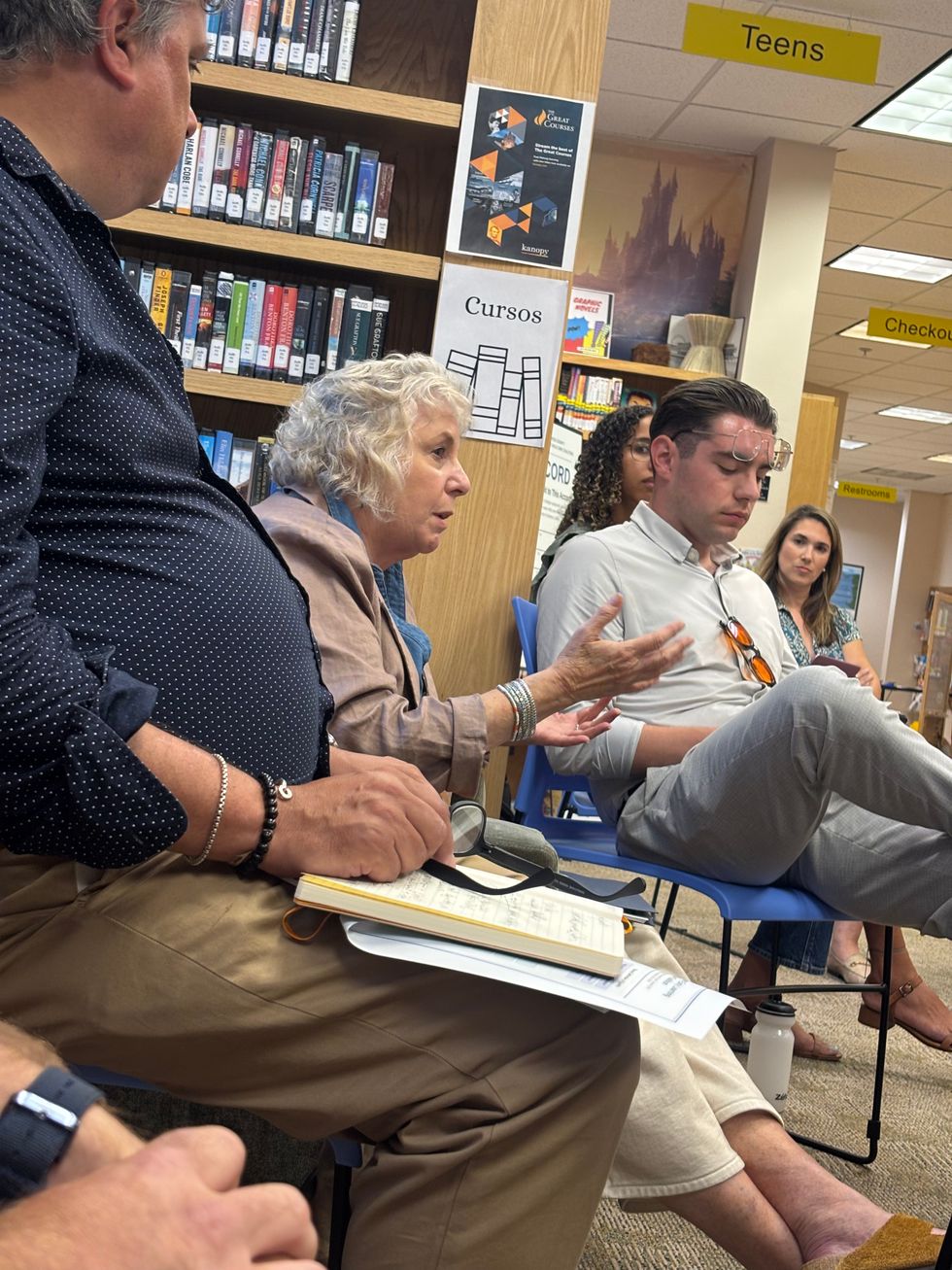 New York Assemblymember Didi Barrett attended Wednesday’s focus group to hear from local parents.Photo by Graham Corrigan







 Pay Bill for Robin Starr’s service in the Continental Army.Courtesy the Alex Breanne Corporation
 John Mills speaking at Quinnipiac University.Courtesy the Alex Breanne Corporation

 Stephanie Saetta,with her rescue dog George and Blue (left), a shepherd mix awaiting his forever home.Madi Long