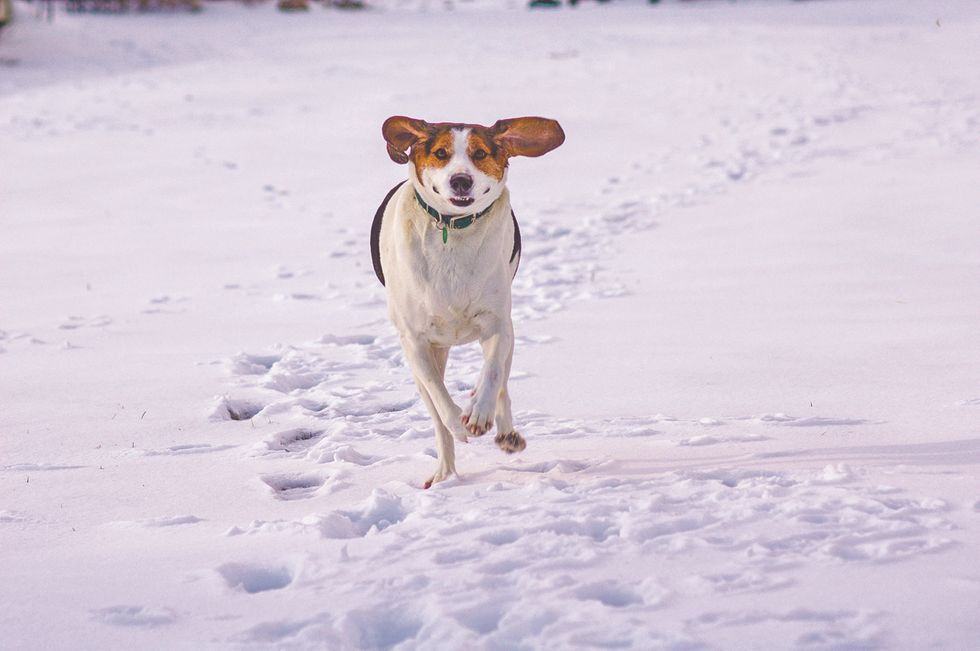
Veterinarian gives guidance for pet care in cold weather

Photo from Metro Creative Connection

PINE PLAINS — Whether welcoming a new puppy on Christmas morning or helping an old “best friend” adjust to the colder weather, common sense can go along way in making good decisions, according to Dr. Barbara Clayton of Clayton Veterinary Practice in Pine Plains.
She notes that because animals come with their own good instincts, paying attention to the way they behave can provide cues on what a pet might need as can age, size, health and even the coat the animal sports. Usually the animal — given the option — will probably make good decisions for itself.
In cold weather, for example, she noted that a dog with a fine coat, ever a massive breed such a Great Dane, might prefer a quick trip outside with a rapid return inside, “curled up on a pillow in a ball” or perhaps acting as a chihuahua-sized loving lap dog.
Speaking fondly, she emphasized, “It depends on the dog. Some dogs do not want to come in from the cold. I had a dog who loved (it). She’d make a bed in the snow. She’d curl up, and I’d try to call her in and she’d look up and wag her tail and say ‘I’m good.’”
She said, “Some of these big huskies, these big fluffy German shepherd-y dogs — they love being out” and they might appreciate being in a clean and comfortable dog house. Those structures should not be set on the ground, however, but instead be raised so the air can provide insulation with the opening set away from the wind and possibly equipped with a flap-like doggie door.
Non-chewable bedding such as clean straw or shavings rather than a comforter or “something they might eat” or that would attract insects or mice should be used.
If, despite an owner’s best efforts, a dog becomes overly chilled, its own system will begin to attempt to warm itself by shivering. Warm towels, blankets or a warm drink can bring relief. She adds, however that because a dog can then become overheated, if the pet tries to move away from those, let it go.
She cautions against using devices such as electric blankets which could cause burns.
In addition to the cold, she said owners need to protect paws and recommends using only non-toxic de-icing products that are made specifically for pets. “If the dog is being walked off the property where you don’t know what’s been used,” she recommends doggie boots.
There are also cream-like products for paws such those used on sled dogs that are especially good for “these younger, sprier dogs that want to run around and play in the snow or on the ice.”
As for the age-old question of the wisdom of a puppy popping out from beneath the tree on Christmas morning, Clayton feels It can be a good experience but if — and only if — everyone has thought carefully about what the commitment means.
Saying, “Pets are not toy trains. Dogs are not dolls,” she recommends against a surprise gift.
“Everyone needs to be on board” as they consider what the needs of the animal will be as well as their own circumstances such as age, the sizes of people in the house, health, allergies, and the ability to provide the time, space, and effort to give the dog the proper amount of play and exercise.
She says, “look at your lifestyle, and research some different breeds that meet the criteria, and then talk to breeders that breed them.”
Clayton emphasizes, “Every dog should be crate trained. It’s their room — their safe place. Feed your dog in the crate... give them treats” but be sure any chew toys don’t become small enough to swallow. That is why she is “not a fan” of rawhide bones, which can be chewed down in size, preferring instead antlers or the like.
Finances can become an issue so to be sure the pet can get treatment when needed, Clayton recommends pet insurance be purchased.
As a final precaution, Clayton suggests pets be implanted with chips so any which are lost — especially in winter’s cold — can be returned to the warmth of their homes and families.
Anthony Musso discusses his book “Hidden Treasures of the Hudson Valley” at the North East Historical Society’s annual meeting on Saturday, Nov. 15. The book centers on historical sites across the region with rich backgrounds and low ticket-prices for maximum accessbility.
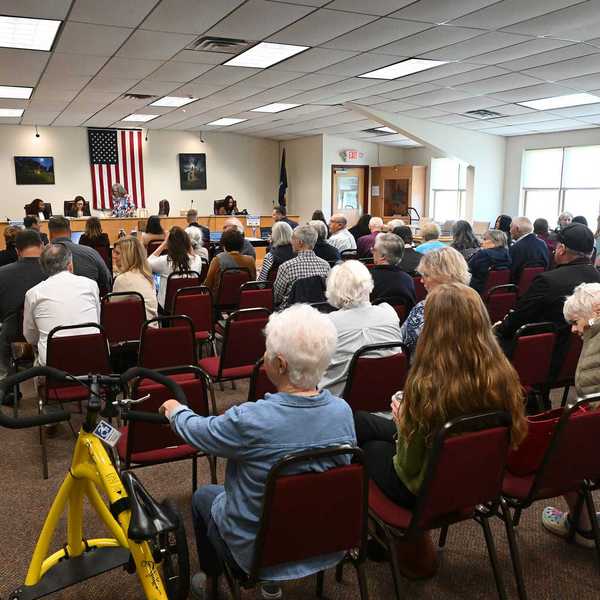
MILLERTON — With his signature Brooklyn accent, sense of humor and wealth of knowledge, author and historian Anthony “Tony” Musso brought American Revolution history to life at the NorthEast-Millerton Library Annex in partnership with the North East Historical Society.
The talk marked Musso’s first speaking engagement at the Annex and coincided with the historical society’s annual meeting.
Musso guided attendees through an oral tour shaped by excerpts from his three-volume series, “Hidden Treasures of the Hudson Valley,” which together highlight 165 local historical sites that are rich in history and light on the wallet. Each book features 55 locations that are open to the public.
“I included places that fly under the tourists’ radar,” said Musso, addressing the crowd of more than 30 attendees. “Many of them are run by historical societies, so the added benefit is a free or nominal charge.”
His presentation began with Pawling’s Quaker Hill, where in 1740 a group of Quakers petitioned the Religious Society of Friends to build their own meeting house so they wouldn’t have to travel elsewhere to go to Sunday worship.
“It was kind of small,” Musso remarked of the original structure. “They ran into a problem within the first five years because they had so many people standing around, they couldn’t all get inside.” As a result, in 1767 the Quakers got permission to build a bigger meeting house just across the street.
“This one was a two-story structure with a wrap-around balcony where they could fit everybody inside.” Musso described an event in 1778 during a regular Sunday worship when three officers from the Continental Army came into the meeting house, sat respectfully in the back, and when the service came to a close they announced that they were going to commandeer the building.
“Nearby, George Washington led a large encampment of troops and they wanted to have this building be used as a medical hospital,” Musso said.
During the army’s occupation, the makeshift hospital was overseen by Dr. James Fallon, and many people referred to it as “Fallon’s Hospital.” Approximately 100 troops were treated there throughout its four months of winter operation.
“If you know anything about Quaker beliefs, pacifism is right at the top,” said Musso. “And although the military was not putting armament, cannons or munition in the building — it was for a humanitarian purpose — the Quakers abandoned the building as long as the army was there and found another building down the hillside.”
The Quakers also refused to provide the army with provisions, Musso said, which exacerbated harsh conditions that winter.
When the army left, the Quakers returned to the building and continued with their meetings and worship. Musso added that in 1932, the meeting house was acquired by the historical society of Quaker Hill and Pawling, and “that’s why the building is in such meticulous shape today.”
Musso went on to explain that while George Washington never stayed at encampment with his troops, he did commandeer a house for four months down the hill in the village of Pawling — the home of John Kane, who was originally a Patriot at the start of the American Revolution but switched sides and became a Loyalist.
From there, Musso expanded the tour to Westchester and Rockland counties, including the location where Benedict Arnold turned over the plans, layout and staffing for Fort Arnold to British spy John André — and the site where Andre was subsequently hanged.
As a seasoned historian, speaker and guide, Musso shared one of his tricks if he ever feels like his audience is losing interest. He brings up Hamilton the musical. “I don’t lie to people,” he jokes, “but I say, ‘I can’t prove this, but I’ve heard that some of the music from Hamilton was written here.’”
Though Musso didn’t delve into the rich history of North East’s Coleman Station during the presentation, Musso said it is one of the sites included in his books.
Musso has lived in LaGrange for 40 years, and his career has spanned decades at the post office, writing for the Poughkeepsie Journal, and authoring numerous nonfiction books. “I love the history of this area, and I’m not going to stop telling it anytime soon.”
North East Historical Society annual meeting
Other business from the North East Historical Society included acknowledgements of board members and volunteers. President Ed Downey expressed gratitude for the society’s partnership with the NorthEast-Millerton Library, noted that four members are up for re-election and shared that membership has increased by 54% over the last decade, now totaling 179 — among the highest of any historical society in Dutchess County.
Downey also highlighted ongoing digitization efforts, saying the goal is to “digitize and publish” the historic Millerton Telegram and 90 years of The Millerton News. Downey added that this is a costly project and relies heavily on donations to sustain the work.
“Once Upon a Time in America” features ten portraits by artist Katro Storm.
The Kearcher-Monsell Gallery at Housatonic Valley Regional High School in Falls Village is once again host to a wonderful student-curated exhibition. “Once Upon a Time in America,” ten portraits by New Haven artist Katro Storm, opened on Nov. 20 and will run through the end of the year.
“This is our first show of the year,” said senior student Alex Wilbur, the current head intern who oversees the student-run gallery. “I inherited the position last year from Elinor Wolgemuth. It’s been really amazing to take charge and see this through.”
Part of what became a capstone project for Wolgemuth, she left behind a comprehensive guide to help future student interns manage the gallery effectively. “Everything from who we should contact, the steps to take for everything, our donors,” Wilbur said. “It’s really extensive and it’s been a huge help.”
Art teacher Lilly Rand Barnett first met Storm a few years ago through his ICEHOUSE Project Space exhibition in Sharon, “Will It Grow in Sharon?” in which he planted cotton and tobacco as part of an exploration of ancestral heritage.
“And the plants did grow,” said Barnett. She asked Storm if her students could use them, and the resulting work became a project for that year’s Troutbeck Symposium, the annual student-led event in Amenia that uncovers little-known or under-told histories of marginalized communities, particularly BIPOC histories.
Last spring, Rand emailed to ask if Storm would consider a solo show at HVRHS. He agreed.
And just a few weeks ago, he arrived — paints, brushes and canvases in tow.
“When Katro came to start hanging everything, he took up a mini art residency in Ms. Rand’s room,” Wilbur said. “All her students were able to see his process and talk to him. It was great working with him.”
Perhaps more unexpected was his openness. “He really trusted us as curators and visionaries,” Wilbur said. “He said, ‘Do with it what you will.’”

Storm’s artistic training began at New Haven’s Educational Center for the Arts. His talent earned him a full scholarship to the Arts Institute of Boston, then Boston’s Museum School, where he painted seven oversized portraits of influential Black figures — in seven days — for his final project. Those works became the backbone of his early exhibitions, including at Howard University’s National Council for the Arts.
Storm has created several community murals like the 2009 READ Mural featuring local heroes, and several literacy and wellness murals at the Stetson Branch Library in New Haven. Today, he teaches and works, he said, “wherever I set up shop. Sometimes I go outside. Sometimes I’m on top of roofs. Wherever it is, I get the job done.”
His deep ties to education made a high school gallery an especially meaningful stop. “No one really knew who these people were except maybe John Lennon,” Storm said of the portraits in the show. “It’s really important for them to know James Baldwin and Shirley Chisholm. And now they do.”
The exhibition includes a wide list of subjects: James Baldwin, Shirley Chisholm, Redd Foxx, Jasper Johns, Marilyn Manson, William F. Buckley, Harold Hunter, John Lennon, as well as two deeply personal works — a portrait of Tracy Sherrod (“She’s a friend of mine… She had an interesting hairdo”) and a tribute to his late friend Nes Rivera. “Most of the time I choose my subjects because there are things I want to see,” Storm said.
Storm’s paintings, which he describes as “full frontal figuratism,” rely on drips, tonal shifts, and what feels like emerging depth. His process moves quickly. “It depends on how fast it needs to get done,” he said. “Sometimes I like to take the long way up the mountain. Instead of doing an outline, I just start coloring, blocking things off with light and dark until it starts to take shape.”
He’s currently in a black-and-white phase. “Right now, I’m inspired by black and white, the way I can really get contrast and depth.”
Work happens on multiple canvases at once. “Sometimes I’ll have five paintings going on at one time because I go through different moods, and then there’s the way the light hits,” he said. “It’s kind of like cooking. You’ve got a couple things going at once, a couple things cooking, and you just try to reach that deadline.”
For Wilbur, who has studied studio arts “ever since I was really young” and recently applied early decision to Vassar, the experience has been transformative. For Storm — an artist who built an early career painting seven portraits in seven days and has turned New York’s subway corridors into a makeshift museum — it has been another chance to merge artmaking with education, and to pass a torch to a new generation of curators.
Le Petit Ranch offers animal-assisted therapy and learning programs for children and seniors in Sheffield.
Le Petit Ranch, a nonprofit offering animal-assisted therapy and learning programs, opened in April at 147 Bears Den Road in Sheffield. Founded by Marjorie Borreda, the center provides programs for children, families and seniors using miniature horses, rescued greyhounds, guinea pigs and chickens.
Borreda, who moved to Sheffield with her husband, Mitch Moulton, and their two children to be closer to his family, has transformed her longtime love of animals into her career. She completed certifications in animal-assisted therapy and coaching in 2023, along with coursework in psychiatry, psychology, literacy and veterinary skills.
Le Petit Ranch operates out of two small structures next to the family’s home: a one-room schoolhouse for animal-assisted learning sessions and a compact stable for the three miniature horses, Mini Mac, Rocket and Miso. Other partner animals include two rescued Spanish greyhounds, Yayi and Ronya; four guinea pigs and a flock of chickens.
Borreda offers programs at the Scoville Library in Salisbury, at Salisbury Central School and surrounding towns to support those who benefit from non-traditional learning environments.
“Animal-assisted education partners with animals to support learning in math, reading, writing, language and physical education,” she said. One activity, equimotricité, has children lead miniature horses through obstacle courses to build autonomy, confidence and motor skills.

She also brings her greyhounds into schools for a “min vet clinic,” a workshop that turns lessons on dog biology and measuring skills into hands-on, movement-based learning. A separate dog-bite prevention workshop teaches children how to read canine body language and respond calmly.
Parents and teachers report strong results. More than 90% of parents observed greater empathy, reduced anxiety, increased self-confidence and improved communication and cooperation in their children, and every parent said animal-assisted education made school more enjoyable — with many calling it “the highlight of their week.”

Le Petit Ranch also serves seniors, including nursing home residents experiencing depression, social withdrawal or reduced physical activity. Weekly small-group sessions with animals can stimulate cognitive function and improve motor skills, balance and mobility.
Families can visit Le Petit Ranch for animal- assisted afterschool sessions, Frech immersion or family walks. She also offers programs for schools, libraries, community centers, churches, senior centers and nursing homes.
For more information, email info@lepetitranch.com, visit lepetitranch.com, follow @le.petit.ranch on Instagram or call 413-200-8081.