Thank you!
Your support is sustaining the future of local news in our communities.

Pine Plains solar project heads to court

Solar Farm
Carson Power’s rendering of the controversial solar farm (in white) that was just approved by the Pine Plains Town Planning Board for construction at 454 Bean River Road. Composite image by The Millerton news

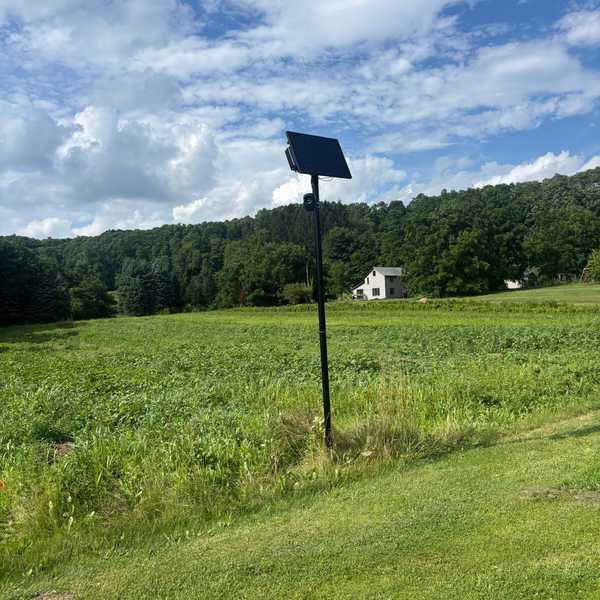
PINE PLAINS — The controversial solar farm project at Pulvers Corners will come before a judge in state Supreme Court in Carmel on Tuesday, March 19, where a group of residents is seeking an injunction prohibiting work on the site.

The group, Preserve Pine Plains, filed an Article 78 action against the town Planning Board and certain property owners and developers of the project, which envisions a 10MW Tier 3 solar complex consisting of 24,000 solar panels on farmland at Pulvers Corners and located at 454 Bean River Road.

Article 78 proceedings put the action of an official or agency under review by a court.

Carson pilot program

Meanwhile, the Town Board on Thursday, Feb. 22, held a special meeting at Town Hall to discuss a pilot program with Carson Power LLC, the New York City firm proposing the Tier 3 solar farm, that would amount to a “payment in lieu of taxes” to the town.

Town Supervisor Brian Walsh said the program would provide a payment to the town “above and beyond land taxes.”

At Thursday’s board meeting, the board members voted against accepting the initial monetary terms of the pilot agreement with Carson, and said they plan to retain an independent consultant to assess the situation.

Meantime, the board voted to halt any tree clearing on the site until there is a signed pilot agreement.

According to a primer published by the American Bar Association, payment in lieu of taxes agreements are gaining popularity with alternative energy projects like wind and solar. Under them, governments can assign tax liabilities based on the assessed value, or amount of electricity generated, or based on a rate per megawatt.

Another path is for local taxing authorities to negotiate a payment agreement. Walsh indicated that the pilot program with Carson could lead to a yearly payment.

March 19 court date

The future of the Pulvers Corners project will be the subject of oral arguments before Supreme Court Justice Gina C. Capone on March 19, following filing of memorandums scheduled through the beginning of March by sets of attorneys involved in the case.

Mindy Zoghlin, of the Zoghlin Group LLC in Rochester, who represents Preserve Pine Plains, filed in support of the group’s petition Friday, Feb. 16.

The group claims the Town Board failed to take a “hard look” at “significant adverse impacts” with respect to community character and town planning documents. It also claims the Planning Board failed to take a “hard look” at the project’s impacts on plants and animals and on aesthetic resources and “ignored identified areas of environmental concerns.”

Those named in the suit, besides the Planning Board, are Pulvers Corner Solar 1 LLC, Pulvers Corners Solar 2 LLC, Nexamp Inc., Carson Power, Carol Giardino, Diane Weck, Lucie M. Giardino and John Does.

The town is represented by Warren S. Replansky, and is expected to file a response Monday, March 4.

Early this month, New York State’s Office of Renewable Energy Siting denied Hecate Energy LLC’s bid to build a 60MW solar farm, known as Shepherd’s Run, at the at the intersection of routes 23 and 7 in the Town of Copake. In the denial, the agency granted the Town of Copake’s move to stop the project because the company had lost control of land initially included in the project. Hecate may reapply to build a smaller 42MW facility.


Latest News

Millerton dressmaker forged path as early businesswoman
Mary Kisselbrack, left, and her husband, George.
Provided

If you’ve driven down Main Street in Millerton, you’ve passed the former home and shop of one of the village’s earliest female entrepreneurs. At a time when most businesses were owned by men, Mary Kisselbrack made a name for herself in the late 1800s as a well-respected milliner and dressmaker.

On April 11, 1891, train conductor George Kisselbrack purchased a 124-by-232-foot vacant lot at 54 Main St. and hired locally renowned builders Beers and Trafford to design what would become their home and Mary’s business.

Keep ReadingShow less
Wastewater project coming to fruition after decades of debate

Millerton’s business community will soon see the completion of a public wastewater system, addressing what local officials and business owners have called a major constraint on commercial development in the community for decades.

The $13.8 million project, which is expected to serve the core of the Village of Millerton and a commercial stretch of the Town of North East along U.S. Route 44, represents one of the largest infrastructure investments in the community in decades, and brings an end to calls for a sewer system that stretch back to World War II. Officials say the system will safeguard local waterways while creating a foundation for long-term economic stability.

Keep ReadingShow less
Millerton Moviehouse marks 120 years with structural upgrades

Wooden beams made from tree trunks comprise the load-bearing structure under Millerton’s Moviehouse.

Graham Corrigan

There are a handful of buildings that have stood the test of time over Millerton’s 175-year history. But if there’s one that stands out as a singular representation of the town, it’s the Millerton Moviehouse and its iconic clock tower.

Built in 1903 as a grange hall, it was soon converted into a movie theater with a second-floor ballroom. It was one of a handful of buildings that came to define the town in the following decades, standing tall across the street from the Episcopal Church and Millerton Inn, next to Terni’s, and up the hill from Millerton’s train station.

Keep ReadingShow less
google preferred source

Want more of our stories on Google? Click here to make us a Preferred Source.

Irondale Schoolhouse: a piece of living history

Ralph Fedele sits at a desk in the historic Irondale Schoolhouse, which he led the effort to relocate to downtown Millerton.

Aly Morrissey
“It was in dire straits. Right on the road, but beautiful. I remember thinking, ‘Wouldn’t that be a great building to move into the village?’” —Ralph Fedele

A one-room schoolhouse sits on Main Street along the Harlem Valley Rail Trail, offering an opportunity for locals and visitors to step inside a piece of living history.

The Irondale Schoolhouse that now sits in downtown Millerton was not originally located on Main Street. The building was first constructed in 1858 along what is now Route 22 in the Irondale section of town, defined by Irondale road and the Old Mill that still sits along Webatuck Creek. At the time, the schoolhouse was one of 14 that served the Town of North East’s children.

Keep ReadingShow less
New Water Department building expected by summer’s end

Millerton’s former Water Department building, ravaged by fire, as it awaited demolition in summer 2025.

Aly Morrissey

Nearly 18 months after a fire destroyed Millerton’s Public Works building, which housed the Highway Department and Water Department, construction is expected to begin within weeks on a new Water Department facility and pumphouse.

The new building would restore the village’s full water pumping capacity and allow officials to end the state of emergency declared after the fire. Village officials are also planning a separate Highway garage, with details of that project still being finalized.

Keep ReadingShow less
NorthEast-Millerton Library microfilm digitization nears completion

NorthEast-Millerton Library

Aly Morrissey

A new initiative at the NorthEast-Millerton Library aims to digitize a collection of photographs, newspapers and other historical materials documenting the community’s early history.

Once completed, the collection will be available online and will include photographs, yearbooks, newspaper microfilm and slides reflecting the area’s past. The materials come from personal collections as well as archives from the Millerton News and its predecessor, the Millerton Telegraph.

Keep ReadingShow less
google preferred source

Want more of our stories on Google? Click here to make us a Preferred Source.

google preferred source

Want more of our stories on Google? Click here to make us a Preferred Source.