Railroad Street savors healthy food alternative

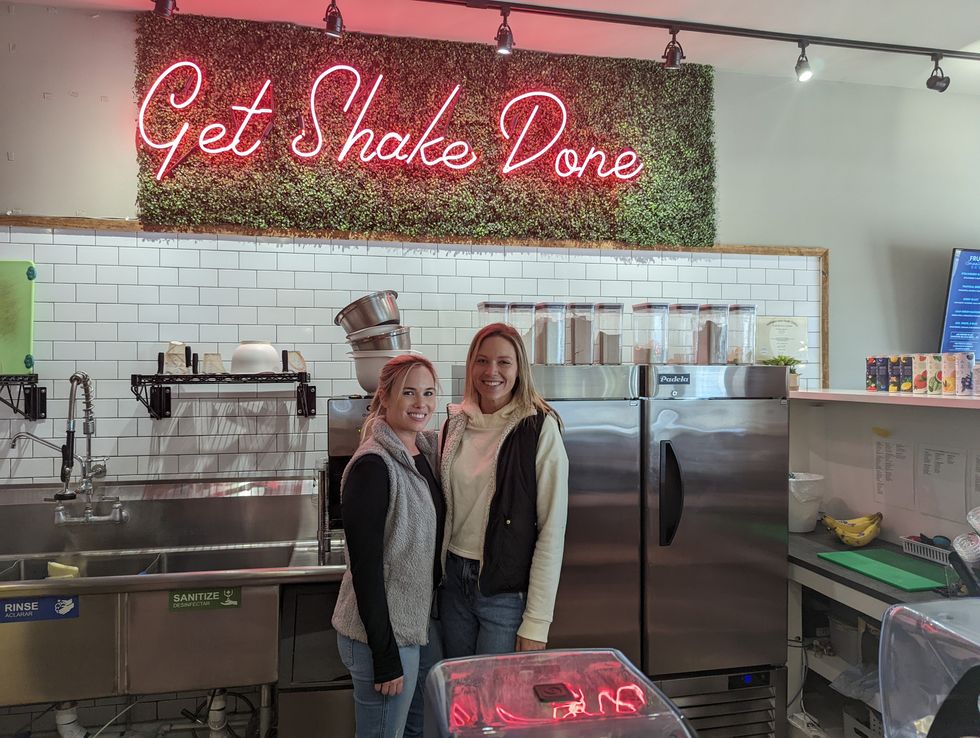
Photo by Riley Klein

NORTH CANAAN —One of the latest examples of revitalization on Railroad Street in North Canaan comes in a tumbler with a straw.
Nutrition on Railroad, a business started in May of 2021 during the pandemic, has become a steady favorite.
It serves up smoothies, protein shakes, acai and oatmeal bowls — the kind of healthy meal alternatives that have become popular in major cities across the nation.
“We wanted to offer something that Canaan didn’t have before,” said owner and North Canaan native Cassidy Considine.
Nutrition on Railroad, located at 5 Railroad Street, first opened its doors after Considine moved back to North Canaan after stepping away from a teaching career.
Since then, area thirst-quenchers have been lining up for all-natural drinks and meals.
“I like that we finally have a healthy option in Canaan,” said one regular customer as she purchased lunch. “I was here for breakfast this morning too,” she added.
Iced teas flavored with all-natural sweeteners are the top selling drinks.
“I’m a diabetic so I like their sugar-free drinks,” said another customer as he sipped his Sweater Weather Iced Tea.
For food, the acai bowls are most popular, particularly the Peanut Butter and Jelly Bowl.
“We strive to be part of people’s daily routine,” said Considine. “For the winter we’ll be offering more hot drinks. And that includes coffee from a new roaster up the street.
Considine’s coffee beans are sourced from ILSE Coffee, which began roasting activities at 35 Railroad St. in August.
About a year after Nutrition on Railroad opened, KayCee & Co. Gift Boutique opened in the attached indoor space.
“The idea behind the boutique was to create a place in Canaan where people could buy gifts and browse while they wait for their order,” said boutique co-owner Kelly Wolfe.
The boutique carries products from local artisans and custom gift baskets are created by Wolfe.
Both shops are open Tuesday through Friday from 7 a.m. to 4 p.m., Saturday 9 a.m. to 3 p.m. and Sunday 9 a.m. to 2 p.m. (closed Mondays).
Online ordering is available for grab-and-go customers. The link to order online (nutrition-on-railroad.square.site) can be found in the bio of their Facebook and Instagram @nutritiononrailroad.

Millerton News
PART-TIME CARE-GIVER NEEDED: possibly LIVE-IN. Bright private STUDIO on 10 acres. Queen Bed, En-Suite Bathroom, Kitchenette & Garage. SHARON 407-620-7777.
The Salisbury Association’s Land Trust seeks part-time Land Steward: Responsibilities include monitoring easements and preserves, filing monitoring reports, documenting and reporting violations or encroachments, and recruiting and supervising volunteer monitors. The Steward will also execute preserve and trail stewardship according to Management Plans and manage contractor activity. Up to 10 hours per week, compensation commensurate with experience. Further details and requirements are available on request. To apply: Send cover letter, resume, and references to info@salisburyassociation.org. The Salisbury Association is an equal opportunity employer.
Gardeners needed for native plant design business: March 15- December 1st. Must be physically fit and dependable. Call for interview 347-496-5168. Resume and references needed.
Weatogue Stables in Salisbury, CT: has an opening for experienced barn help for Mondays and Tuesdays. More hours available if desired. Reliable and experienced please! All daily aspects of farm care- feeding, grooming, turnout/in, stall/barn/pasture cleaning. Possible housing available for a full-time applicant. Lovely facility, great staff and horses! Contact Bobbi at 860-307-8531. Text best for prompt reply.
Hector Pacay Landscaping and Construction LLC: Fully insured. Renovation, decking, painting; interior exterior, mowing lawn, garden, stone wall, patio, tree work, clean gutters, mowing fields. 845-636-3212.
PROFESSIONAL HOUSEKEEPING & HOUSE SITTING: Experienced, dependable, and respectful of your home. Excellent references. Reasonable prices. Flexible scheduling available. Residential/ commercial. Call/Text: 860-318-5385. Ana Mazo.

12 week old black and tan/blue tick coonhound: mix for sale. First set of puppy shots done at 8 weeks. Call 860-248-9947 for more info. and price.
PUBLISHER’S NOTICE: Equal Housing Opportunity. All real estate advertised in this newspaper is subject to the Federal Fair Housing Act of 1966 revised March 12, 1989 which makes it illegal to advertise any preference, limitation, or discrimination based on race, color religion, sex, handicap or familial status or national origin or intention to make any such preference, limitation or discrimination. All residential property advertised in the State of Connecticut General Statutes 46a-64c which prohibit the making, printing or publishing or causing to be made, printed or published any notice, statement or advertisement with respect to the sale or:rental of a dwelling that indicates any preference, limitation or discrimination based on race, creed, color, national origin, ancestry, sex, marital status, age, lawful source of income, familial status, physical or mental disability or an intention to make any such preference, limitation or discrimination.

FOR SALE: 39 Hospital Hill Road, Sharon. 1680 sq.ft. Two family, rare side-by-side units. 4 bed; 2 full bath, 2 half. Great investment, or live in one and rent other side. $485,000. Call/text Sava, 914 -227-4127.
FOR RENT COMMERCIAL KITCHEN IN FALLS VILLAGE: Located in the heart of Falls Village. 425 sf space fully equipped for catering business, wholesale food prep or bakery. Several successful local businesses got their start here! Event space in building could be available. Contact anita@100mainst.com.
Millerton News

Want more of our stories on Google? Click here to make us a Preferred Source.
Dee Salomon
Fireweed attracts the fabulous hummingbird sphinx moth.
You must figure that, as rough as the cold weather has been for us, it’s worse for wildlife. Here, by the banks of the Housatonic, flocks of dark-eyed juncos, song sparrows, tufted titmice and black-capped chickadees have taken up residence in the boxwood — presumably because of its proximity to the breakfast bar. I no longer have a bird feeder after bears destroyed two versions and simply throw chili-flavored birdseed onto the snow twice a day. The tiny creatures from the boxwood are joined by blue jays, cardinals and a solitary flicker.
These birds will soon enough be nesting, and their babies will require a nonstop diet of caterpillars. This source of soft-bodied protein makes up more than 90 percent of native bird chicks’ diets, with each clutch consuming between 6,000 and 9,000 caterpillars before they fledge. That means we need a lot of caterpillars if we want our bird population to survive.
So how do we ensure that there are sufficient caterpillars for them? That is the question, as caterpillars are very particular. Their butterfly or moth mothers cleverly attach their eggs to the very specific plants their tiny babies require. Once they hatch, the caterpillars eat the leaves of these plants until they are either picked off by birds to feed their young or create a chrysalis and turn into a moth or butterfly to repeat the cycle of life.
Some caterpillars are generalists and can survive on a variety of plants, but most — 90 percent, according to scientists — are specialists, relying on only one or two types of plants for survival. In their winged form, dietary restrictions ease as they source pollen more widely, but when it comes time to lay eggs, they use a keen sense of smell to find the specific plants that will help their young survive.
Research by Doug Tallamy shows that 90 percent of butterfly and moth species rely on just 14 percent of native plant species for food, which makes the planting of these “keystone” plants critical. Let’s review a few.
Goldenrod: Not all goldenrod is created equal. Old field goldenrod, (Solidago nemoralis), is a shorter and less aggressive alternative to the tall, aggressive goldenrod we are familiar with, as is wrinkleleaf goldenrod, (Solidago rugosa), a compact species that has arching sprays of bright yellow flowers supporting more than 100 species of insects. This species is deer-resistant with no serious pests or diseases. Last year, Mt. Cuba Center, a conservation center out of Delaware, focused its trials on goldenrod, and its research report, available online, is sortable not just by aesthetic attributes but also by the number of insects seen on each species.
Scarlet strawberry: (Fragaria virginiana), is one of the plants I have had great luck growing in the woodland. When there is a new sunny spot, which happens when a tree or large branch falls, I plant a few strawberries, which I dig out of a spot where they are thriving. These plants make a great groundcover and are especially nice used under trees for caterpillar “soft landings.”
Spotted Joe-Pye weed: We see this plant, (Eutrochium maculatum), on roadsides in late summer, but it looks as sharp as an ornamental in the hands of Michael Trapp, who, in the garden behind his shop in West Cornwall, encloses a bed of Joe-Pye weed with a short boxwood hedge, dignifying this plant that supports between 35 to 40 caterpillar species, including those that become the three-lined flower moth, Clymene moth, ruby tiger moth, Eupatorium borer moth and great spangled fritillary moth.
I am less familiar with fireweed, (Chamaenerion angustifolium), but will be adding it this year, as it may be the prettiest of the keystone plants in our region and attracts the fabulous hummingbird sphinx moth. I will let you know when I find a local nursery that stocks it and, when planted, how it fares here.
Also keep in mind this spring: smooth aster, (Symphyotrichum laeve); white yarrow, (Achillea millefolium); and the beautiful Canadian columbine, (Aquilegia canadensis), which is the first food for hummingbirds’ arrival in the Northwest Corner.
Dee Salomon ‘ungardens’ in Litchfield County.
Brian Gersten
Craig Davis, co-founder and board chair of East Mountain House, an end-of-life care facility in Lakeville, will sponsor a March 5 screening of the documentary “Come See Me in the Good Light” at The Moviehouse in Millerton, followed by a discussion with attendees.
The film, which is nominated for best documentary at this year’s Academy Awards, follows the poet Andrea Gibson and their partner Megan Falley as they are suddenly and unimaginably forced to navigate a terminal illness. The free screening invites audiences to gather not just for a film but for reflection on mortality, healing, connection and the ways communities support one another through difficult life transitions.
East Mountain House grew out of a realization that “there are so many issues with how we are taking care of our dying in our community,” said David. “We wanted to provide a solution for some people where they can die in a serene and calming home-like setting.” This compassionate approach at East Mountain House is carried out with the support of seven staff members and 42 volunteers who do everything from reading to residents, gardening, cooking, communicating with family members and assisting with therapeutic treatments. East Mountain House houses just two residents at a time, and staff and volunteers work around the clock to accommodate their needs.
In a culture where we are trained to panic when a loved one is dying, and where a clinical space like a hospital is the norm for many individuals at the end of their lives, Davis feels that East Mountain House is an alternative with a natural and organic approach to death. It’s a place where death can be celebrated and viewed as something that is simply a part of life. Davis’ vision for East Mountain House is more than a decade in the making, and he is eager to introduce his work and his perspective to locals at the upcoming community screening.
One of the reasons Davis was interested in sponsoring a screening of “Come See Me In The Good Light” was because the film gracefully explores themes of vulnerability, resilience and the search for meaning in the face of death. Through its deeply personal storytelling, the film highlights how people navigate loss, transformation and the desire to be seen for who they truly are. The documentary’s emphasis on compassion and human connection aligns closely with the mission of East Mountain House, making the post-film discussion a natural extension of the evening.
Davis hopes the event will serve as both a cultural offering and a community touchstone — an opportunity for neighbors to gather in a welcoming space, share ideas and reflect on the importance of end-of-life support systems. The screening is free and open to the public, though advance registration is recommended due to limited seating.
For registration, go to themoviehouse.net.
Kerri-Lee Mayland
A tray can help group items in a way that looks and feels thoughtful and intentional.
Winter is a season that invites us to notice our surroundings more closely and crave small, comforting changes rather than big projects.
That’s often when clients ask what they can do to make their homes feel finished or fresh again — without redecorating, renovating or shopping endlessly. My answer: start with one tray.
A tray creates a moment. It gives the eye a place to land and turns everyday objects into something intentional. More importantly, it’s approachable. There’s no measuring, no commitment, no pressure to get it “right.” It’s a small, easy project — affordable, functional and even a little fun — that can be tailored entirely to you.
One of the things I love most about styling trays is that your cozy “moment” becomes mobile. Everything you love is gathered in one place and can be easily moved from room to room as your day unfolds. A tray that starts on an entry table can later migrate to a coffee table or kitchen counter, adapting to how you’re actually living in your home.
In one client’s entryway, we styled a tray that sets the tone the moment you walk in. A simple pair of brass candlesticks adds warmth, a blue-and-white chinoiserie vase brings character, and two vintage books ground the arrangement. It’s not decorative for decoration’s sake — it feels collected, welcoming and personal, all while keeping the surface from becoming cluttered.
In another home, a coffee table tray became the quiet anchor of the living room. We included a strand of wooden beads for texture, the TV remote tucked neatly into a small vintage box, and a plant nestled in a pottery bowl. The tray keeps everyday necessities close at hand while making the space feel relaxed and lived-in rather than chaotic.

Kitchens may be where trays work hardest, especially in winter when we’re cooking inside more and gathering more casually. For one client, we styled a tray with a pepper mill; a shallow bowl for garlic, shallots and onions; and a white Italian ceramic container filled with olive oil. It’s practical and beautiful, and it makes cooking feel intentional instead of rushed. The tray warms up the counter while keeping essentials within reach.
Another version I often create is the cocktail, mocktail or tea-and-coffee tray — endlessly useful for friends popping over to say hello. A few cups, a teapot or carafe, honey or sugar, and a candle create an inviting setup that’s ready at a moment’s notice. It says, “Stay a while,” without any fuss.
What makes trays so effective this time of year is that they respond to winter’s quieter rhythm. Winter decorating isn’t about bold color or dramatic statements — it’s about texture, warmth and restraint: wood, stone, ceramic, linen, candlelight. A tray helps you edit rather than add, grouping items so they feel thoughtful instead of scattered.
When the seasons shift, the same tray evolves with you. Heavier elements can be swapped for lighter ones — fresh flowers, glass, pale ceramics — without starting over. One tray, styled seasonally, becomes a constant that gently changes rather than something that has to be replaced.
Remember, good design doesn’t have to come from big gestures. Often it comes from small moments done well — a surface that feels intentional, a corner that feels cared for. In winter’s stillness, creating a simple tray may be just enough to make your home feel calm, personal and complete.

Want more of our stories on Google? Click here to make us a Preferred Source.

Want more of our stories on Google? Click here to make us a Preferred Source.