Cream of the crop: North Canaan dairy farms trace a rich history
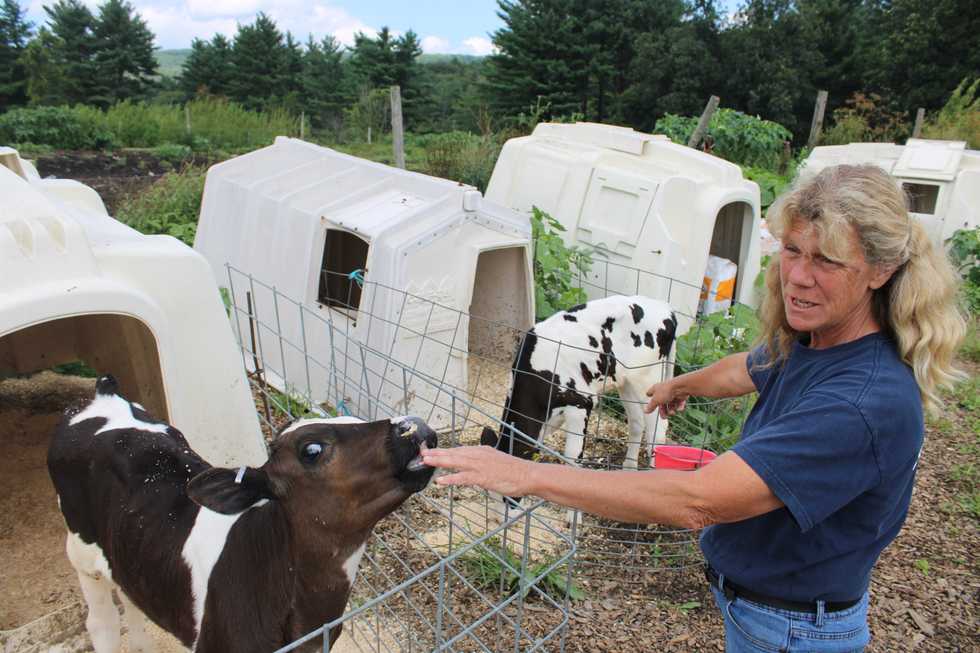
Sandy Carlson tended to her young stock at Carlwood Farm.
Photo by Riley Klein


NORTH CANAAN — Before daybreak over the rolling hills of the Northwest Corner, Sandy Carlson was down in the milk parlor at Carlwood Farm: the last remaining dairy farm on Canaan Valley Road.
“I don’t eat breakfast until after my cows,” she said.
As recently as the 1960s, dozens of dairy farms lined Canaan Valley Road, with many more operating throughout the rest of North Canaan.
The farms may be mostly gone, but the ones that remain are hopeful for the future.
Against all odds, there were more milk cows in North Canaan in 2023 than ever before. Just four dairy operations remain in the small farm town: Laurelbrook Farm, Elm Knoll Farm, Canaan View Farm, and Carlwood Farm.
Combined, their barns house over 2,000 milk cows.
The federal Department of Agriculture’s 2022 Dairy Data report showed that in the last 50 years, Connecticut’s dairy cow population has dropped from about 57,000 in 1972 down to 18,000 in 2022.
Over 10% of the state’s remaining milk cows reside in North Canaan.
Canaan History Center’s Kathryn Boughton said the town’s lactose legacy can be traced back to favorable land evaluations in the 1730s.
“Canaan, when it was sold at auction in New London in 1738, had the highest price-per-acre of all of the five towns here because it had the best soil,” she said.
In the 18th and early-19th centuries, farming in the region was necessary for self-sufficiency. During this period, milk was highly perishable and the surest way to obtain fresh, safe milk was to own a cow.
Boughton recalled about 25 active dairy farms on Canaan Valley Road as late as the 1960s, all of which operated on a much smaller scale than today’s farms in the East Canaan section of town.
Even up to the time when I was born, there were a lot of farms,” said Boughton. “My great-uncle, who farmed very much as his father had farmed at the time of the Civil War, had 12 cows and that supported a family of five people,” she said.
It was not until the mid-19th century that dairy farming became a viable business venture. Large dairy farms with delivery services did exist, but few found success until pasteurization was discovered in 1862.
Arguably the first successful large-scale milk business in the nation was opened in Burrville, Connecticut, in 1851 by entrepreneur Gail Borden.
Borden held a patent on “milk extract” and used this to create condensed milk. A journal entry made by an unidentified Shaker in June 1853, provided courtesy of the Canaan History Center, described Borden’s business model and the process of evaporating milk:
“Inventor of patent milk extract wants our folks to take up the business of making. Be kind of an agent for him. Does down a few gallons of milk in our Laboratory this eve. Pays $7 & half dollars for the milk & privilege. The process as I understand consists in boiling away all the watery principle from the milk. Bottle it up & twill keep forever if you don’t throw it away. Whenever you want it to use add 3 fourths hot water and let it cool. Makes first rate new milk!”
Fueled by demand in the Civil War, in 1862 Borden’s company was producing an average of 16,000 quarts per month. At the turn of the century, the company went public and in 1901 Borden’s company opened a facility in Canaan.
Situated near Union Station in North Canaan, the location offered easy access to New York via the railroad and dozens of dairy farms in the area contributed to milk production.
The beginning of the 20th century also saw the departure of many local crop farmers who went West in search of cheaper land that was better suited to farming.
“They discovered they could make a better living on green fields than they could on New England stone,” said Boughton. “They were all moving out to Ohio.”
In the coming decades, the region’s iron ore industry faded into oblivion and left an economic void in North Canaan. A surplus of available and affordable land created new opportunities for would-be farmers.
“The last furnace went down in ‘23. That was a very dirty, nasty business and the farms were fallow for a while,” said Boughton. “[Farms] were selling for a dime on a dollar and so you begin to get people coming in from the city.”
In the 1930s and 1940s, the opportunity attracted several new farmers to North Canaan who took up dairy farming in town. Each remaining dairy farm in North Canaan today can trace its origins to this period.
Robert and Dottie Jacquier founded Laurelbrook Farm in East Canaan with 18 cows in 1948. Today, their grandchildren Cricket and Bobby Jacquier operate the farm, which now houses well over a thousand milk cows and employs 22 non-family members.
“We milk 1,400 cows three times a day,” said Cricket Jacquier. “Two guys can do 200 cows an hour.”
Like the other three remaining dairy farms in North Canaan, Laurelbrook is an Agri-Mark Cabot Creamery Cooperative farm. Cricket Jacquier is chairman of the board at Cabot.
Laurelbrook grew from about 500 cows in 1991 to become one of the four largest dairy farms in Connecticut.
“In 1992, right after I graduated, we had to make a decision whether we were going to stay farming in East Canaan or we’re going to move to Western New York,” said Cricket Jacquier. “We made a big decision then. Our roots were from here, and we were just going to make it work.”
Laurelbrook has begun to diversify its operation in recent years with a focus on environmental sustainability.
“My brother and I now own and operate Laurelbrook Natural Resources,” said Cricket Jacquier as he showed the composting tents behind Laurelbrook’s corn fields. “These are manure solids. All of this composting is sold to landscapers and nurseries in the area.”
To survive into the next generation, Cricket Jacquier said diversification will be key.
He credited Laurelbrook’s success to adapting to a changing milk market and above all else, happy cows.
“The better you take care of your animals, the more milk they produce,” he said.
Just down the road, David Jacquier, son of Robert and Dottie, owns Elm Knoll Farm. Elm Knoll houses over 300 milk cows in its barns.
After growing up on Laurelbrook Farm, David decided to pursue his own venture in 1968, while he was still in high school. His operation started in a rundown barn just down the road behind the Blackberry River Inn. He had just three cows.
“That barn up there was abandoned in the Depression, so there were no cows in there since the mid-30s,” said David Jacquier. “By the time I left Blackberry in ‘70, I came down with 65 or 70 cows.”
While still a student at Housatonic Valley Regional High School, he ran into trouble with gym coach Ed Tyburski after cutting class to tend to his cows.
“It was almost impossible for me to be there by 7:30 because I had three hours of work before, and I got a little bit torqued off at Tyburski,” he said. “I told him I didn’t have time to play his cow pasture pool.”
He purchased the East Canaan property he is on today in 1970 and created Elm Knoll Farm. Initially, his primary source of income was from crop sales to nearby dairy farms.
“Through the 70s and 80s and almost through the 90s I could make more money selling corn silage than I could milking cows because we had a lot of farmers,” he said “Then in 1994 to 2000, a lot of farmers went out.”
He said the exodus of dairy farmers in the 1990s was caused by a sharp drop in profitability, particularly for smaller operations.
“I dealt to the guys that were milking 30 to 40 or 50 cows,” said David Jacquier. “[Now] everyone’s got to be over 200 to 300 cows to cash flow, unless you have other incomes.”
Today, all of Elm Knoll’s profits are generated from dairy sales. David Jacquier and his right-hand man Logan Cables said they intend to maintain that model into the next generation.
“We’re the only dairy farm in the state of Connecticut that milks cows and that’s the only income,” said Jacquier.
“I’ve been doing this my whole life so I don’t know anything else,” said Cables.
Cables, 20, has worked at Elm Knoll for about eight years and intends to buy Elm Knoll from David Jacquier within the next few years.
“I’m hoping I can make it another two or three years then I’m going to turn it over,” said Jacquier. “But do I really want to sell him a dead horse?”
Jacquier said if Connecticut wants to maintain its dairy farmers, it will require external support. Assistance programs at the state level exist, but David said the farmers have not received their due.
“Every land sale in Connecticut, $15 goes to the dairy farmers. But it never gets to us,” he said. “Eight million dollars goes in the general fund and it never comes our way.”
If dairy farming is to survive in Connecticut, help will need to come from Hartford, he continued.
“All we’ve got to be is honest on the money. If you want open space, every town, 169 towns say they want it. You got to get Hartford to understand ‘give us the money,’” he said.
While thankful that the program exists, David Jacquier said dairy farmers need more advocates both in Hartford and on the farm. He credited Ben Freund, a neighboring farmer, for representing dairy farmers when fighting for state assistance.
“Ben Freund was the one that did 95% of the work,” said David. “We wouldn’t have the million and a half or two million that we’re getting right now if it wasn’t for Ben.”
Eugene Freund, Ben’s father, moved from the Bronx to North Canaan in 1949 and took up farming with his wife Esther. He bought land in East Canaan the following year and now, over 70 years later, approximately 275 dairy cows call Freund’s Farm home.
“The cows in this barn have been part of my family’s multi-generational legacy,” said Amanda Freund. “These are the great-great-great-great-granddaughters of the cows that my grandfather started milking in 1950.”
The Freunds — Ben and his brother Matthew — sold their herd to Ethan Arsenault and his business partners, Lloyd and Amy Vaill, in September of 2022. The trio rents barn space from the Freunds and Arsenault oversees dairy operations on location, renamed Canaan View Farm.
“This has always been my dream. My family’s always been in ag,” said Arsenault. “Personally, I’m very hopeful that we have a bright future ahead of us and that we stick around.”
The Freunds have taken steps to adapt to a changing industry in hopes of thriving into the next generation. CowPots is one such venture that repurposes manure into biodegradable garden planters.
“Fifteen percent of the manure is still in fibrous form and we separate that out,” said Matthew Freund. He added that the final result is “biodegradable, plantable containers that replace plastic.”
The Freunds set environmental sustainability as a top priority and installed solar panels to power the farm’s operation. They have also begun to process methane into biogas to offset the use of propane and heating oil.
“I think that we have to start to realize that climate change is real and that we have to be very aware of what we’re doing on this planet,” said Matt Freund. “We want to leave the next generation, you, something better than we started with.”
Canaan View also has five robotic milkers in its barn, streamlining dairy production on site and providing real-time data and metrics on herd health.
“The mantra with robots is ‘let cows be cows,’” said Arsenault. “When they come in the robot it spits out grain, so that allows us to individually cater to the cow’s nutritional needs.”
The milking robot tests dairy as each cow is being milked and provides Canaan View with live data on the health of each cow.
“We really focus on the cow here and that’s what I like about the robots and all the data I get from them,” said Arsenault, who added that the time saved from robotic milking allows him to spend more time “keeping the cows clean, happy and healthy.”
Of the estimated 25 dairy farms in the 1960s in Canaan Valley, an area that reaches to the Massachusetts border, just one remains: Carlwood Farm.
Carlwood began when Doug Carlson purchased a 42-acre plot in Canaan Valley in 1941. Doug’s son, Doug Jr., inherited the farm at the age of 16 and expanded the operation to about 140-acres.
Sandy Carlson took over the business after her father, Doug Jr., died in 2018. Today, Carlwood Farm milks about 50 Holsteins and Jerseys and has approximately 75 young stock.
Carlson said her relatively small dairy farm has survived by following the blueprint laid out by her father, and his father before him.
“We never had the desire to get bigger, so we don’t have a lot of overhead,” said Carlson. “We didn’t purchase a lot of big fancy equipment because we didn’t need it. My father’s thing was ‘use it and then reuse it’. You make do with what you have.”
She said nearly all milk produced at Carlwood is sent to Connecticut-based companies, with occasional shipments to the Agri-Mark Cabot processing plant in West Springfield, Massachusetts.
Carlwood farm is entirely family operated and Carlson’s daughter, Sheri, has begun the process of taking the farm into its fourth generation.
“Sheri and her husband Greg recently purchased [the farm] and they also have a daughter, Hallie, that’s three and she is around here all the time,” said Carlson.
Carlson said increased regulation in recent years has made it particularly difficult for small dairy operations to stay afloat. She noted considerable documentation requirements that add extra hours to an already busy life on the farm.
“This is something new in the past five years or so. It’s more paperwork. I have enough paperwork to do on a daily basis just opening my mail, paying bills, cow records, and deciding who I’m going to call to order grain from and what fertilizer. I’m just totally overwhelmed sometimes,” she said.
In the winter of 2023, there were five dairy farms in North Canaan. Segalla’s Farm on Allyndale Road began in the early 1900s and became a certified organic farm in 1997.
Segalla’s Farm closed down earlier this year after owner Rick Segalla was faced with financial and health problems.
“I lost my organic marking during Covid, and I had a heart attack last September,” said Segalla. “I was running out of feed. It just wasn’t a paying proposition anymore.”
The roughly 120 cows from Segalla’s Farm were sent to Indiana and New York.
Segalla’s Farm is the most recent North Canaan dairy operation to close the barn doors and drive its cattle West.
As for the four remaining farms, successors have already been identified in hopes of keeping the milk flowing for years to come in North Canaan.
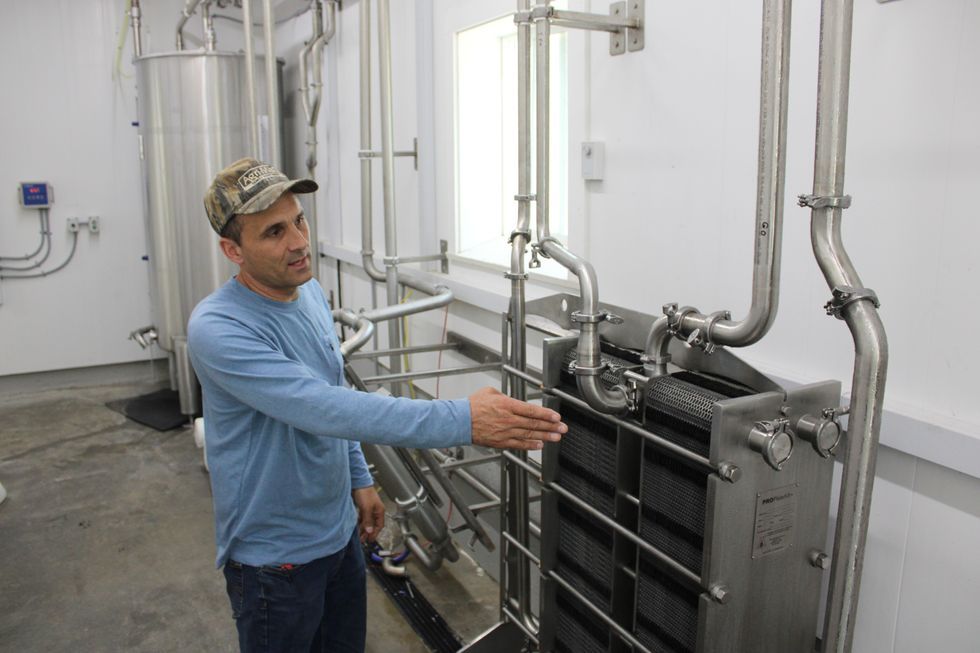
Cricket Jacquier, owner of Laurelbrook Farm, showed how a newly installed plate cooler instantly reduces the temperature of milk from 100 degrees down to 36 for transport. Photo by Riley Klein
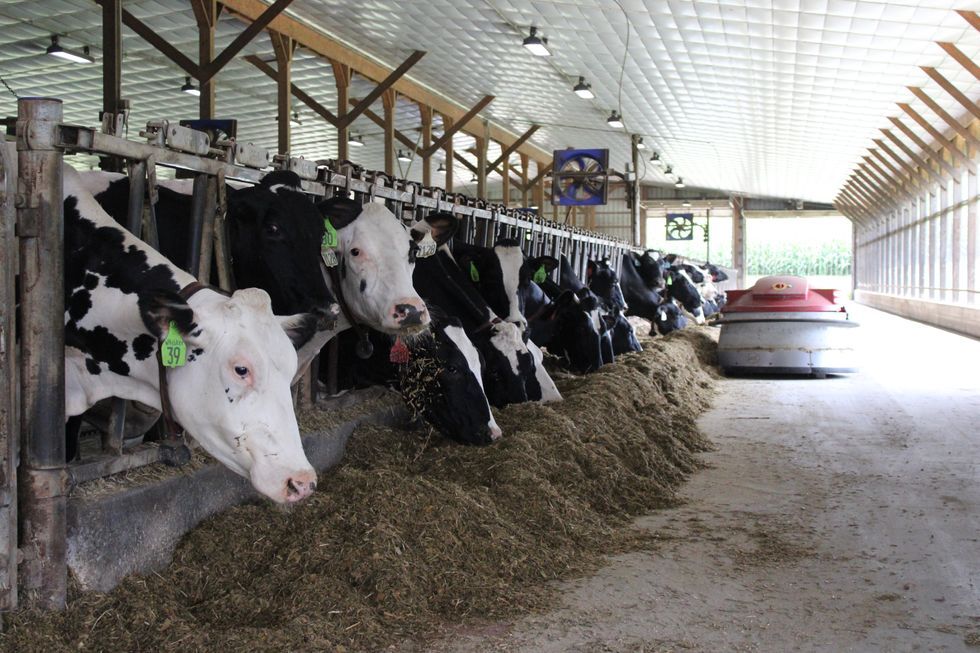
A robotic feeder autonomously roamed the barns of Canaan View Farm dispensing feed to hungry cows. Photo by Riley Klein
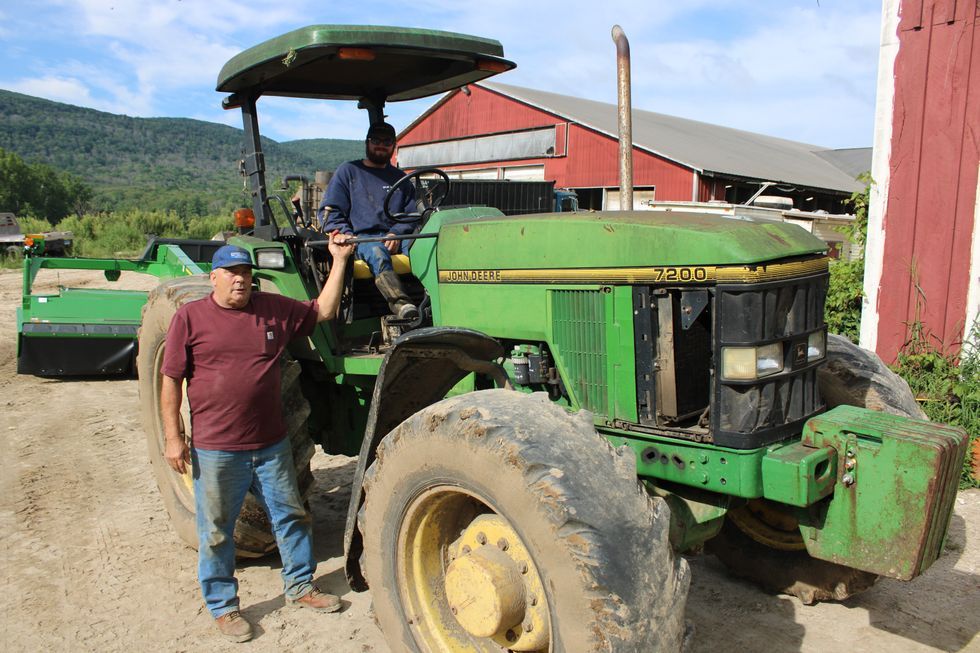
David Jacquier, owner of Elm Knoll Farm in East Canaan, stood alongside his right-hand man Logan Cables as the duo prepared to harvest corn silage in the fields that surround the barns. Photo by Riley Klein
Aly Morrissey
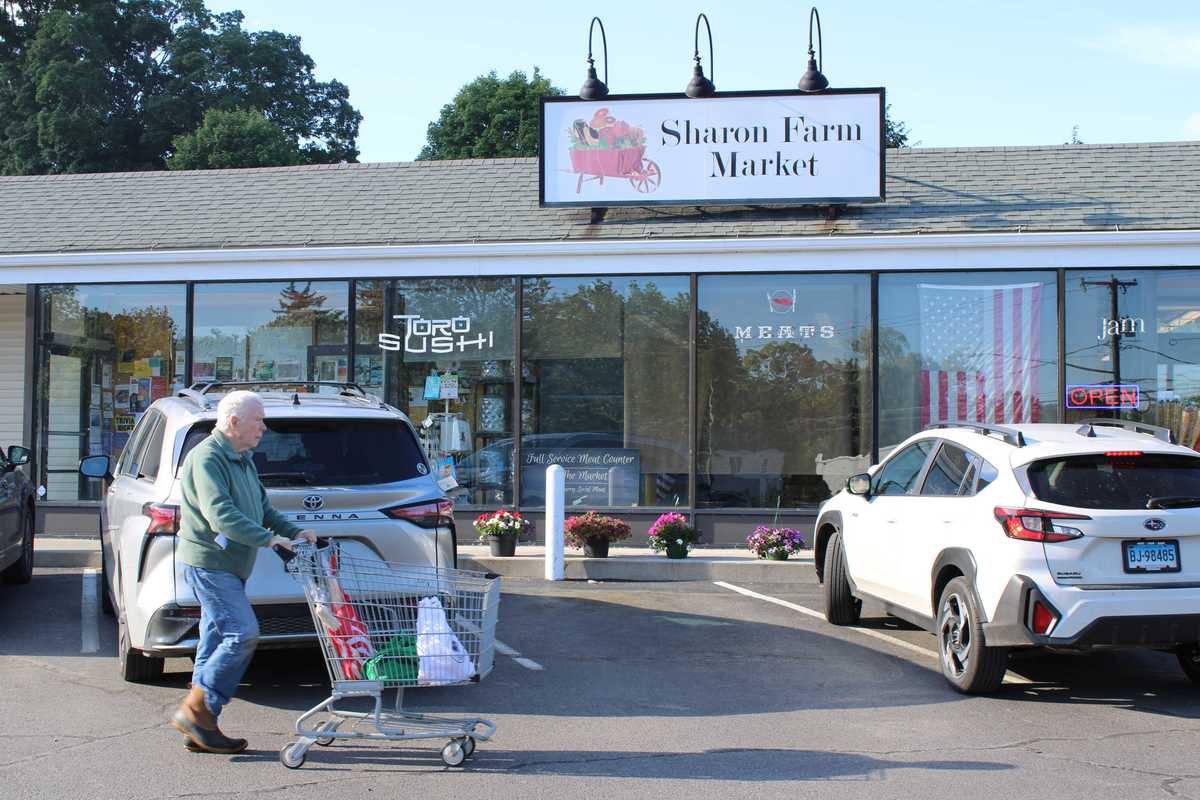
Fernando Nottebohn says he appreciates Sharon Farm Market as part of a weekly circuit he does from his home in Lithgow, New York, that also includes Paley’s Farm Market
"We're going to fix the store."
— Chris Choe, co-owner of Sharon Farm Market
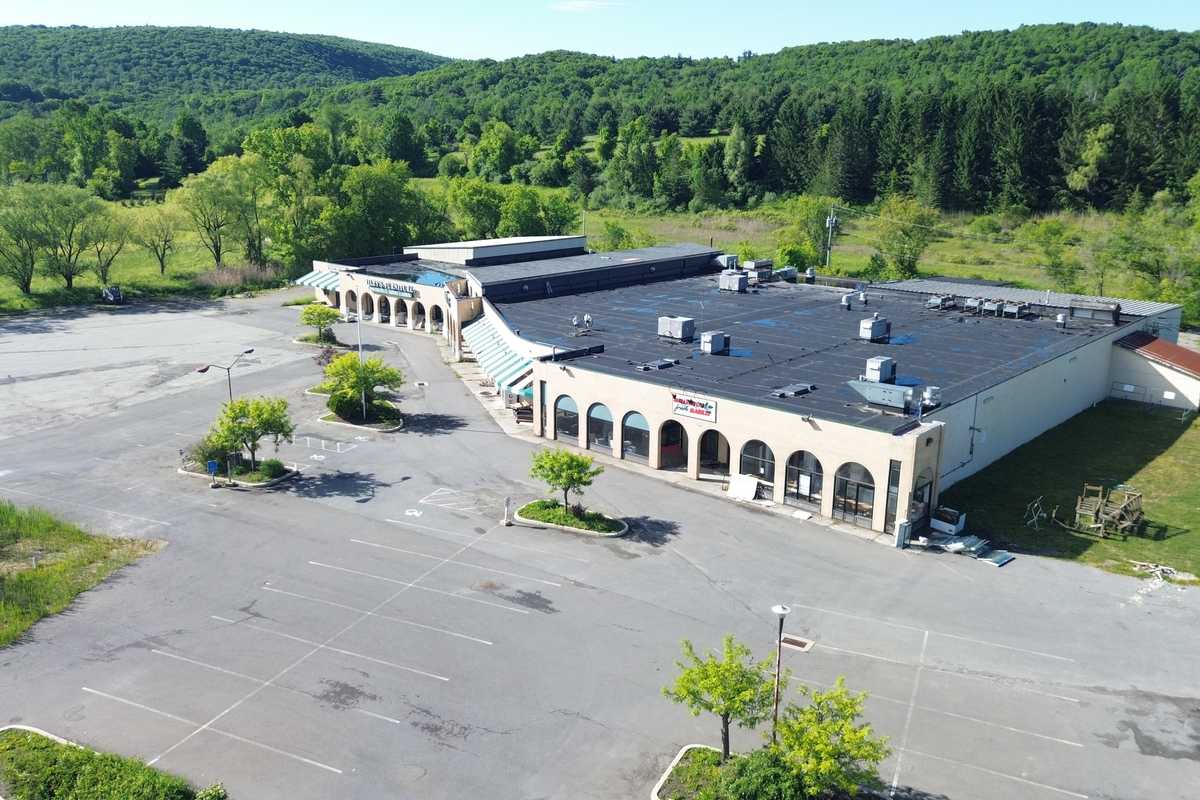
SHARON – Despite months of speculation fueled by half-empty shelves, inventory shortages and the planned departures of two longtime businesses, Sharon Farm Market is not closing, according to owner Chris Choe.
“We’re not shutting down,” Choe said, adding that he and his wife, Kim, are planning a series of upgrades they hope will transform the market over the coming months. Choe said they expect to receive a new 20-year lease from the property’s landlords and are moving forward with plans to revitalize the business.
Asked about the store’s appearance and inventory concerns, Chris Choe acknowledged that changes are needed.
“We’re going to take care of everything,” he said. “We’re going to fix the store.”
Choe said remodeling will take place at night so the market can remain open during normal business hours. He describes a grand vision with a revamped deli, online ordering, home grocery deliveries, and a cafe and bakery serving coffee and organic juice,
“My team is almost ready,” he said of the next iteration of the market. He estimates the updates will take several months, and that shoppers can expect a better store experience that will even allow for Door Dash.
The comments come as rumors about the market’s future have circulated throughout Sharon in recent months. Shoppers have reported difficulty finding common grocery items, while two popular businesses operating inside the market have announced plans to leave at the end of September.
At the end of September, Jam Food Shop, the deli and prepared-food business that has operated inside Sharon Market for 16 years, will relocate to Salisbury.
Jam owners said the company will relocate to 19 Main St. in the location of the former Neo Restaurant & Bar – which closed its doors permanently last month – and that the decision was not made lightly.
In a letter penned to the community (see letter on A6) Jam expressed its gratitude to the Sharon community, while highlighting a years-long dispute with market ownership.
“For years, we have made attempts to gain clarity around our lease renewal at the Sharon Farm Market,” the letter said. “Unfortunately, in the end, we were unable to reach an agreement with the market, leaving us with a short amount of time to find Jam a new home.”
Choe said the departure of Jam comes after 16 years of partnership, and didn’t get into the specifics of the lease negotiations.
“They want their own place, and I want to make it a better store,” he said.
Choe also pointed to Jam’s prices, which he views as high.
Blue Sea Seafood, another longtime fixture inside the market, has also confirmed it will depart at the end of September after 16 years in Sharon Farm Market. Owners Sarah and Chuck Lee said they will officially close down on Sept. 30. The pair said they will not be opening a new location elsewhere.
“We’ll miss it,” Sarah Lee said.
Some residents have pointed to the Choes’ latest venture — Market360, a grocery store near Yale University in New Haven that opened in June 2025 — as a possible factor in the market’s recent inventory and operational challenges.
In an interview with Kim Choe last October, she said the store had required significant time as they worked to find their footing and build a team.
Several shoppers said they have noticed changes at the Sharon market in recent months and worry about its future.
Ann Spindler, a Sharon resident, said she has noticed changes that have sparked concerns throughout town.
“For the last couple months I’ve noticed there are fewer things on the shelves and I’m worried that something is happening and I hope that they’re going to stay around,” Spindler said.
Janay Gregory of Sharon said common items like milk, yogurt and bread have been inconsistently stocked.
“It’s a problem,” Gregory said. “I hear it a lot in the town that there have been a lot of issues, even since Christmas.”
Ellen Moon of Cornwall said she was concerned by an apparent low stock in the store.
“There are blank spaces on the shelves,” she said. “I thought, Oh dear, I hope they’re alright.”
While browsing the shelves Saturday, Sharon resident Michelle McBreairty said she also noticed a lot less inventory.
“I think it would be the demise of this plaza without a grocery store,” she said, recalling the years before Sharon Farm Market opened in 2010.“I hope they do stay,” she added.
Jennifer Naylor, a Sharon resident of 20 years, said she’s concerned for the store’s future. “The seafood’s going, Jam’s going – they’re going to struggle, I think.”
“I would love this to be totally revamped,” she added, noting that she’s always taken issue with what she described as high pricing.
A revamp is exactly what Chris Choe has in mind, and he says he and his wife are hoping to sell their New Haven store just one year after its grand opening to return their attention to Sharon and Millerton.
Across the state border in Millerton, New York, another grocery store owned by the Choes has endured speculation over the last year amid rumors that they had abandoned the venture. Choe disputes those rumors, as well, saying he and his wife plan to open the store later this year.
The store was originally scheduled to open in June 2025, and was pushed to October before the Choes eventually said the timeline was unclear.
The pair, who purchased Millerton Square Plaza on Route 44 in December 2024 from Joseph Trotta, now say the final construction stages are imminent.
“We’re going to start the construction very soon,” Choe said, adding that he has a new business partner for the Millerton store, though he declined to identify the individual or company, citing ongoing negotiations.
“Together we’ll be fast moving,” he said, noting that he hopes to open the store by Thanksgiving, just ahead of the holiday season.
Among the renovations completed so far are a roof replacement and significant HVAC upgrades. Choe said the remaining work includes installing new flooring, replacing the ceiling,reconfiguring the parking lot and upgrading the storefront. Eventually, they plan to stock locally-sourced produce, meat and seafood from Boston and New York City.
Some residents are skeptical that the Millerton store will open in the fall of 2026.
“Chris has said that for years now,” said longtime Sharon resident Mike Rand.“I’ll believe it when I see it.”
Additional reporting by Nathan Miller, Alec Linden and Madi Long.
Nathan Miller
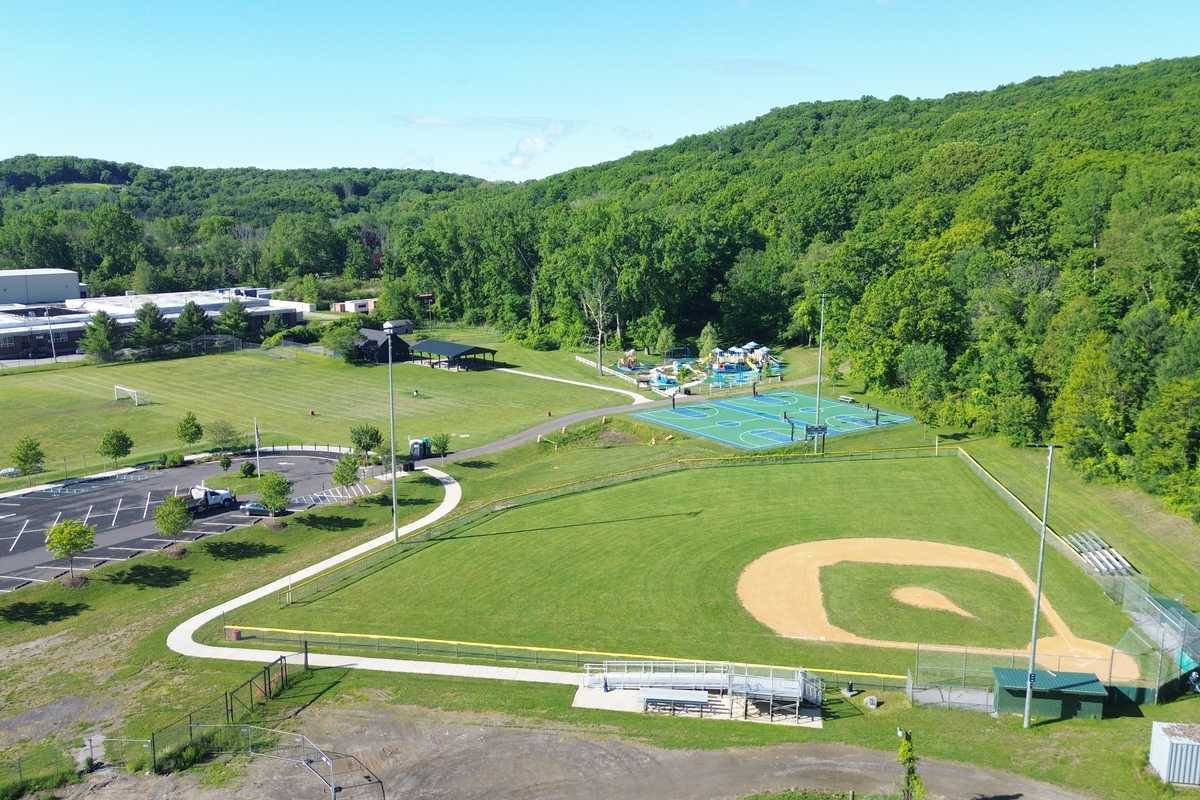
Eddie Collins Memorial Park on Route 22 in Millerton has seen major renovations in recent years. The next phase of renovations will see a pool and poolhouse that will double as a community gathering space.
MILLERTON — The new pool at Eddie Collins Memorial Park is moving forward after village trustees approved the first construction bid for the project.
The Board of Trustees voted unanimously to accept a bid from Key Construction totalling $6.1 million for site work and general construction on Tuesday, May 26.
Millerton Mayor Jenn Najdek said construction is expected to begin in August.
“Aug. 1 is the go day,” Najdek said. “That’s when we’re planning.”
That work will include constructing the 5-lane Olympic-sized pool, poolhouse structure and preparing the site for other elements of the build including electrical installation, plumbing and HVAC. Complete electrical wiring, plumbing and HVAC will need to be completed by different contractors under separate contracts due to New York State requirements.
New York State’s Wicks Law requires municipal projects totalling over $500,000 in cost to create separate contracts for each of general construction, electrical wiring, HVAC and plumbing and gas fitting.
Millerton had received bids for the other necessary contracts, but decided to reject all of them and reopen the bidding period on the recommendation of engineering firm LaBella Associates. LaBella engineers designed the pool and poolhouse and provided consultation services in selecting contractors.
Millerton’s effort to build a new pool at the park started to materialize in 2024 when the village received more than $6 million as part of the New York Statewide Investment in More Swimming grant program, commonly known as NY SWIMS.
Trustees accepted a final design for the pool in March and opened bidding for construction in April.
The Tuesday meeting also featured a whirlwind of resolutions, including entering into a full contract with property restoration company BELFOR for work at the site of the former water department building and village garage.
Millerton’s Department of Public Works building located on Route 22 near Eddie Collins Memorial Park caught fire in February 2025, destroying the structure and all of the equipment inside.
Since then, the village’s Department of Public Works has been using the Town of North East’s old highway garage on South Center Street as a temporary home.
The contract approval on Tuesday represents a more formal and complete contract with BELFOR as the village moves forward with constructing a new building for Water Department operations and to house the village’s municipal well.
A construction timeline has not yet been established.
Leila Hawken
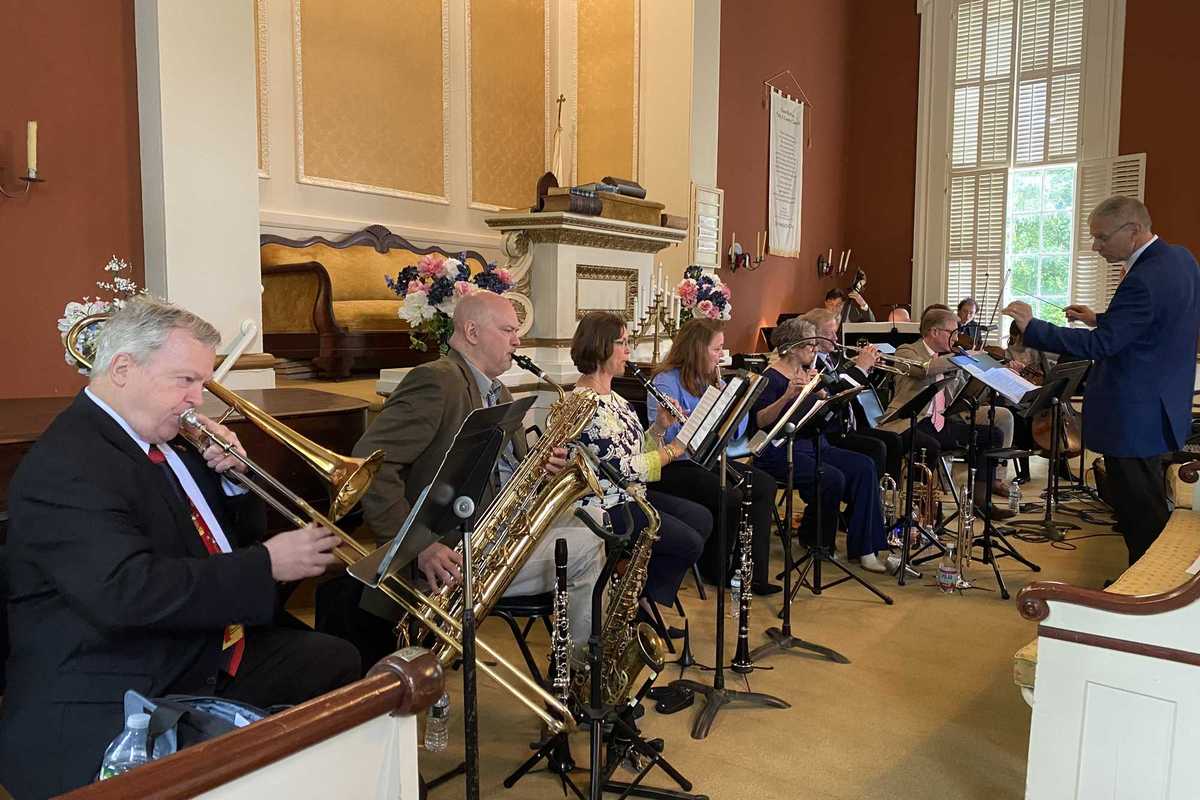
Celebrating the 250th anniversary of the signing of the Declaration of Independence, the 14-member Smithfield Chamber Orchestra presented “Our American Composers,”a Spring Pops Concert at the Smithfield Church on Saturday, May 30. Part of the Bang Family Concert Series, the sixth annual pops concert played to a full house under the direction of Michelle Demko, serving her first year as Music Director.

Want more of our stories on Google? Click here to make us a Preferred Source.
Leila Hawken
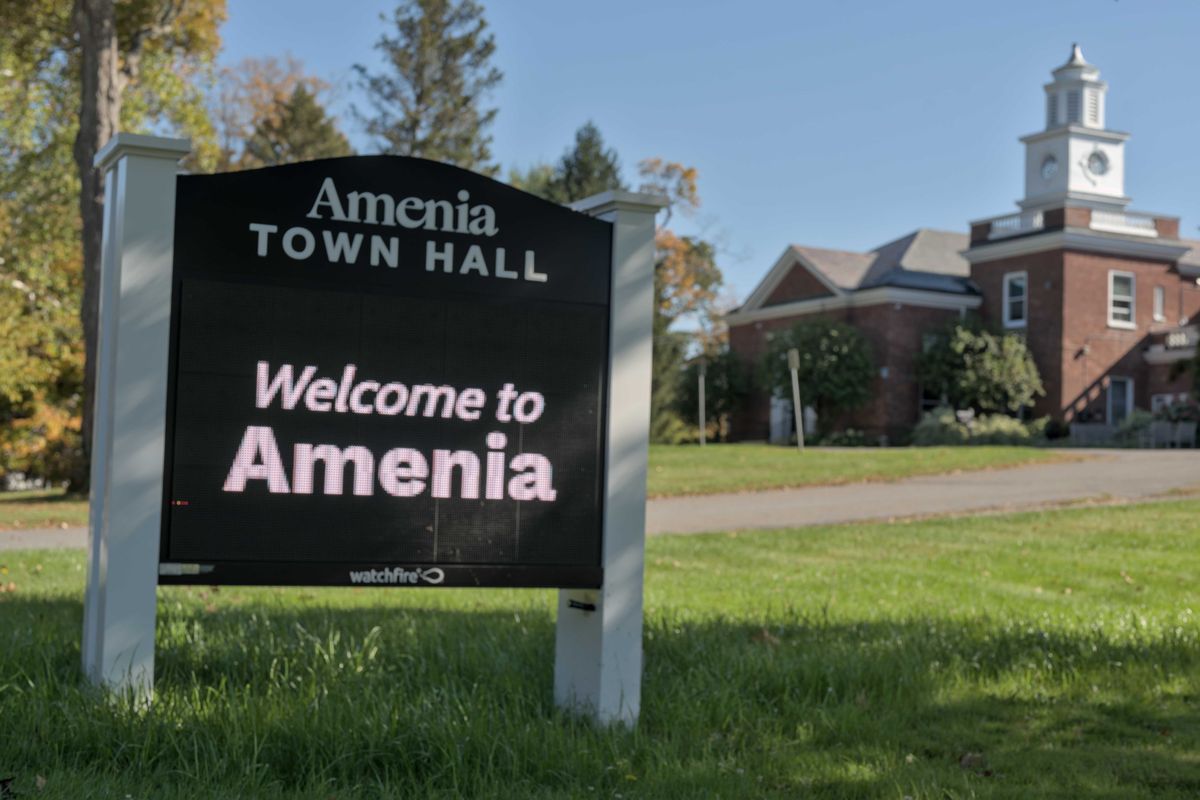
AMENIA — The Planning Board moved closer to completing the environmental review of the proposed Cascade Creek subdivision during its regular meeting on Wednesday, May 27, agreeing to consider a formal environmental determination at its June meeting.
The discussion centered on completion of the Environmental Assessment Form, a key component of the project’s review under New York’s State Environmental Quality Review Act.
“First you have to decide the impact,” board engineer John Andrews said, explaining the process.
While no decision was made, board members agreed to review a draft negative declaration, a finding that would certify the project is not expected to have a significant adverse impact on the environment. If adopted, the declaration would satisfy SEQRA requirements and allow the project to move forward to the site-plan review stage.
The Cascade Creek proposal, first submitted in 2024 by the nonprofit Hudson River Housing of Poughkeepsie, calls for a 28-lot affordable housing subdivision on 24.13 acres. According to project plans, approximately 59% of the property would remain conserved open space.
Since the application was filed, engineers and planners have worked through the conservation review process while the Planning Board has conducted public hearings and meetings to gather community input. Project plans have been revised in response to concerns raised by residents and board members.
Addressing a previous request from the board for updated traffic information and guidance from the New York State Department of Transportation (DOT), Senior Planner Peter Sander reported that the project’s access plan has been revised to include a single entrance and exit on Route 22 directly across from the Old North Road intersection.
Andrews added that the DOT determined neither a traffic signal nor a dedicated left-turn lane would be necessary at the intersection. The agency suggested a marked crosswalk could be beneficial and noted that existing pull-off lanes provide adequate space for pedestrians along the highway.
Board member John Stefanopoulos asked about reducing the speed limit in the area.
Questions about groundwater and well capacity generated significant discussion.
Andrews said that once the environmental review is completed and the project enters the design phase, developers will be required to conduct detailed analyses of well construction and groundwater availability.
“Those results have to be acceptable to the Department of Health,” Andrews said, noting that until that approval is received, the water issue remains open.
Planning Board member James Walsh observed that some residents along Cascade Road have needed to drill their wells deeper over the years.
Board member Ken Topolsky referenced a letter from residents who argued that groundwater testing conducted to date had been inadequate. Topolsky added his continuing concern about stormwater drainage plans and the potential for flooding downstream in an area with a history of flooding.
Topolsky also expressed concern that the development’s housing designs could appear too uniform and may not reflect the town’s character.
But Sander disagreed.
“We’ve added variety, landscaping and buffers,” Sander said, adding that the actual design drawings will illustrate diverse design decisions. He reminded the board that the development will bring people to the town.
“It’s people and families,” Sander said.
Asked about next steps in the process, Andrews explained that if the board adopts a “negative declaration,” the SEQRA review would be complete and the application could advance to site-plan review. A “positive declaration” would require additional environmental analysis before the project could proceed.
Millerton News
SHARON — Yerger Johnstone, former managing director in the mergers and acquisitions department at Morgan Stanley and a decorated veteran of the Vietnam War, died on April 19, 2026, in Chelmsford, England. He was 86.
Born in Mobile, Alabama, on March 7, 1940, Mr. Johnstone was the son of architect Henry Inge Johnstone, architect, and Kathleen Yerger Johnstone, the noted nature writer and civic leader after whom Alabama’s state seashell, Johnstone’s Junonia, is named. He graduated from Murphy High School in Mobile in 1958, received his bachelor’s degree from the University of the South at Sewanee in 1962, and earned his M.B.A. from the University of Chicago Booth School of Business in 1964.
Following his M.B.A., he was commissioned through Officer Candidate School before serving in the United States Marine Corps from 1966 to 1968, rising from First Lieutenant to Captain. Stationed principally at Da Nang, Vietnam, he served as an intelligence officer and was awarded the Bronze Star with combat “V” for meritorious service.
Yerger married Eve Chamberlain, also of Mobile, Alabama in 1963 and they resided in North Carolina during this USMC training. Later moving to Brooklyn, New York, where his first child, Bartley, was born in 1968.
After his discharge, Mr. Johnstone joined Morgan Stanley, working in both Paris and New York City, where he became one of the firm’s first forty partners and served as deputy director of the Mergers and Acquisitions department under Robert Greenhill, at the very dawn of the M&A boom. He later worked in M&A at Blackstone and UBS Warburg Dillon Read. He also served on the boards of Hampshire College and Indian Mountain School at different times in his life.
Yerger was an accomplished sailor, having grown up on boating excursions for shell hunting with his parents in areas of Alabama and Florida, later on receiving certifications in sailing trips around Corsica while working in Paris. While working in banking in the late 1970’s and early 1980’s he spent evenings and weekends reading sailing training manuals, autobiographies of sailors and geographies of various archipelagos, further advancing his skills with a month of yacht chartering each summer in Greece.
Yerger first became enchanted with Litchfield County, when he and his second wife, Marguerite, found their dream weekend escape in Ellsworth in Sharon, Connecticut in the mid 1970’s. A one time builder of hot rod cars in his teens, he enjoyed spirited late night drives from NYC in a friends loaned Ferrari. In Ellsworth the newly weds and then young family (when his second daughter Katherine was born) enjoyed many weekends, hiking, bird watching, star gazing, cross country skiing, growing fresh herbs and gardening and barbecuing Yerger’s famous steaks for guests. Yerger enjoyed exploring the back roads of the area on his BMW motorcycle and the Housatonic River as an avid fly fisherman.
Upon leaving Morgan Stanley, he and his wife Marguerite whom he married in 1975, built the 67-foot ketch Asteroid in Aalsmeer, Holland. They conducted sea trials in Norway, Scotland, Ireland, & England before sailing her around the world, a near 6 year circumnavigation, passing via Suez and Panama canals, spending majority of the time in Pacific Ocean isles from Marquesas to Fiji, New Zealand (where his son Rule was born in 1986) and Micronesia. Encounters with storms, pirates, technical difficulties in remote islands and simply the rigors of daily yachting life were all met with courage, confidence and enthusiasm by Yerger. It became one of the defining adventures of his life.
Returning to America at the end of the sailing trip in 1990, the family settled in Falls Village, Connecticut, where they lived and built a house until Yerger was transferred to London, England
Yerger lived between Salisbury, Connecticut, and the UK for several years before permanently relocating to live between the Cotswolds in the UK and Tuscany in Italy with his third wife, Pamela. They enjoyed an active retirement with regular travels in Asia, New Zealand and Greece. In his final years, he was mainly in his homes in Italy and UK, with short trips in France, with his second daughter. In Trequanda, Italy he enjoyed cycling, feasting at home and throughout Tuscan villages with his and Pamela’s many friends, and soaking up the Tuscan sun. In his home village of Stebbing, UK, he headed the local pond fishing club and took short trips to London to hear his daughter Katherine sing in her many choirs.
Mr. Johnstone is survived by his wife, Pamela Johnstone; his daughters, Bartley Inge and Katherine Inge; his granddaughter, Evie Inge Scofield; his son, Rule; his former wife, Marguerite; his brother, Justice Douglas Inge Johnstone. He is predeceased by his first wife, Eve Chamberlain Purdy.
Cremation took place May 18, 2026, at Dunmow Crematorium, Blatches Farm, Stebbing CM 6 3AL England.
There will be a Requiem Mass said on June 7th, at St George’s Aubrey Walk, W8 7JG England.
Millerton News
WEST CORNWALL — Richard R. Stover, 82, of West Cornwall, died peacefully at Noble Horizons on May 26, 2026.
Son of the late Robert and Leona (Heinbockel) Stover, Rick was born Feb. 6, 1944 in Edina, Minnesota. He attended the University of Pennsylvania where he majored in Economics and was a member of Sigma Alpha Epsilon fraternity.
After graduation, Rick began a long career as a financial and pharmaceutical analyst working at Mitchell Hutchins, Smith Barney, Alex Brown & Sons, Pfizer, and Arnold and S. Bleichroeder. He was then President and CEO of PeriCor Therapeutics, a bio tech company he founded in Manhattan.
Rick was an avid golfer and skier, and he liked nothing better than wrestling with the wilderness. After he and Marnell bought their home in West Cornwall, he enjoyed clearing brush, felling trees, and splitting logs. He was the proud owner of every tool and machine necessary for landscape maintenance.Rick was a parishioner at St. Bridget Church where he worked on the building and grounds committee and served as Chairman of the Finance Council.
Rick is survived by his wife Marnell (Bukovac) and his four daughters and their families; Shaw (Christofer) Ruder and Beckett, Elliot, and Hattie; Sara Stover (Chris Sherwin); Christian Stover (Jeffrey Knutsen); Anne (Andrew) Ruder and William, Charlie, and Sadie. He is also survived by his stepchildren and their families: Mary Brunelli (Christopher Edgar) and Alexander and Catherine; and Michael (Ellen) Brunelli.
Rick was preceded in death by his sister Barbara McCurdy.
A Mass of Christian burial was held at St. Bridget Church (St. Kateri Parish) 7 River Road, Cornwall Bridge, on Saturday, May 30, 2026 at 11:00. Burial followed at St. Bridget Cemetery.
Contributions in Rick’s name may be made to St. Kateri Parish (St. Bridget Church), PO Box 186, 90 Cobble Road, Kent, CT 06757.
The Kenny Funeral Home has care of arrangements.

Want more of our stories on Google? Click here to make us a Preferred Source.

Want more of our stories on Google? Click here to make us a Preferred Source.