An increasing number of ticks in the Hudson Valley are carrying more than one disease-causing germ that can make people sick, according to a new study from the Cary Institute of Ecological Studies in Millbrook. Researchers say the trend could complicate diagnosis and treatment in humans after a tick bite.
Details of the study were released by the institute, and additional insights were provided in an interview with lead researcher Shannon LaDeau.
The findings are part of a long-running research effort in Dutchess County, where scientists have been collecting and tracking ticks for decades. The current analysis draws on nearly 10 years of samples, part of a 35-year monitoring project led by Cary Institute disease ecologist Richard S. Ostfeld. Ticks collected from forested plots on the Cary campus were frozen and later tested for a wide range of pathogens using updated laboratory methods.
According to the report, more than 38% of the ticks tested were capable of spreading at least one disease-causing pathogen to people.
“The probability of being exposed to a pathogen by a single bite from a nymphal tick is approaching 40%,” said Ostfeld in a statement. “That seems uncomfortably high. These ticks are so small, most people don’t even realize when one is feeding on them.”
Lead researcher Shannon LaDeau, a disease ecologist at the Cary Institute, has spent her career studying how diseases move through ecosystems. Her early work focused on tracking the spread of West Nile virus through bird populations using large datasets, before turning her attention to ticks and tick-borne illness in the Northeast.
The latest study analyzed more than 2,000 blacklegged ticks collected over nearly a decade in Dutchess County and found that roughly 1 in 10 ticks in their nymph stage – the small, hard-to -see phase most likely to bite humans – were carrying at least two pathogens.
“That means a single tick bite could expose someone to more than one illness,” LaDeau said in an interview.
The ticks themselves are not born carrying disease, she added. Instead, they pick up pathogens during their first blood meal as larvae, when they are extremely small and remain close to the ground in leaf litter. At that stage, they typically feed on small rodents, such as mice and chipmunks. If the host animal is infected, the tick can acquire more pathogens.
Lyme disease, once acquired by a tick, stays with it for life, while other pathogens like Babesia may clear over time.
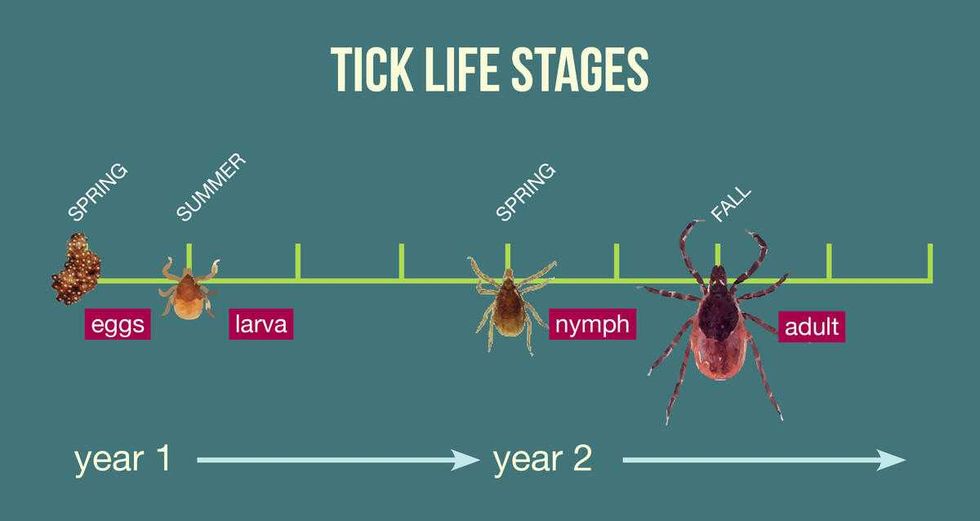 Life cycle of the blacklegged tick. Ticks take a blood meal at each life stage: larva, nymph, and adult. Ticks acquire pathogens by taking blood meals from infected animals (often rodents). The study focused on nymphal ticks, which are poppy seed sized. Their small size makes them hard to detect and remove, and more likely to pass pathogens to people. Illustration by Leslie Tumblety/Cary Institute of Ecosystem Studies
Overall, researchers found that more than a third of ticks tested were carrying at least onepathogen, with Lyme disease remaining common. About 20% of ticks carried the bacterium that causes Lyme disease, while lower levels of other known illnesses, such as anaplasmosis, were detected.
One of the more striking findings was the rise of babesiosis, an illness caused by a parasite that requires different treatment than Lyme disease.
“Babesia has been increasing over time,” LaDeau said, noting that in some years it was even more common in ticks than the bacteria that causes Lyme disease. “There’s a lot of year-to-year variation, but over the longer term, it’s increasing.”
These results have important public health implications, LaDeau said, because the two pathogens require different tests and treatments. Lyme disease is treated with antibiotics such as doxycycline, while Babesia infections are treated with antiparasitic medications.
“This particular co-infection does represent a new risk in the sense that Babesia and Lyme do not respond to the same treatment,” LaDeau said. Anaplasma, which has been around for a long time and has historically had a co-infection with Lyme disease, does respond to the same treatment.
“In the Northeast, when someone gets sick after a tick bite, medical professionals should be testing for both pathogens to ensure proper diagnosis and treatment,” said LaDeau.
How to protect yourself from tick bites
For residents spending time outdoors, LaDeau said prevention starts with awareness. Wearing light-colored clothing can make ticks easier to spot, and checking yourself regularly – both while outside and after coming indoors – is key. Tick activity also varies throughout the year, with certain times, particularly late spring and late summer, posing higher risk.
Just as important is knowing your surroundings. “There are places where you go out and get ticks every time, and other places where you don’t,” LaDeau said, noting that ticks come from the ground and typically latch on from leaf litter as they climb upward.







 Justine and Victor Valla in their studio with a painting of Victor’s,”Jonah and the Whale.” Robin Roraback


 A ceramic vase by Kathleen Heidemann.Provided
  Joy Brown’s delightful ceramic sculptures.Provided