New Sharon Land Use Director to begin July 1

In July, Nikki Blass, right, will take over as Sharon’s Land Use Administrator when Jamie Casey retires after more than three decades in Town Hall.
Alec Linden


In July, Nikki Blass, right, will take over as Sharon’s Land Use Administrator when Jamie Casey retires after more than three decades in Town Hall.
SHARON – Nichole “Nikki” Blass of Sharon will take over as Land Use Administrator on July 1, following the retirement of longtime town employee Jamie Casey. Blass is a seven-year veteran of the Land Use Office and also serves as the second lieutenant and secretary for Sharon Ambulance.
Casey said Blass’ experience working as the Office’s assistant has set her up well to succeed in the role.
The Land Use Administrator is the town’s zoning enforcement officer, responsible for handling all applications related to construction, development and landscape alterations and issuing citations when zoning code is broken. It is a paid role that is appointed by the First Selectman.
“To me, she was the only choice for the job,” Casey said. “She knows the town inside and out, and she grew up here. That’s important, too.”
Blass’s appointment was announced during the Board of Selectmen’s May 26 meeting. In previous weeks, selectmen interviewed Blass and another candidate for the position.
Blass said she was first introduced to Casey and the Land Use Office through her involvement with Sharon Ambulance. She was initially hired to handle filing duties but quickly took on additional responsibilities as the workload increased during the COVID-19 pandemic.
“When Covid hit, we were so inundated with projects and work that I just jumped in,” Blass said, saying that she and Casey worked naturally together. “It was sink or swim.”
Blass said when she takes office in July, she plans to focus on organization to support several large-scale projects that are ongoing or pending review. Those include the development of an office facility for Jasper Johns-affiliated nonprofit Low Road Foundation and a controversial housing development on Hospital Hill Road which is currently facing litigation from neighbors.
She said replacing Casey will be a challenge. Still, she said her time working in the office with Casey has prepared her well for the flexibility and depth of knowledge the position requires.
“Every situation that comes through the door is not the same as the one that was before it,” Blass said. “Being able to handle that kind of thing is the most valuable lesson she could have taught me.”
Blass is stepping into a complex role, Casey said, “but I know she’s more than capable of doing it.”
Plus, “she’s a Sharon girl,” Casey said.
Meanwhile the Selectmen have been conducting interviews to replace Stanley MacMillan Jr., the town’s building inspector and fire marshal of three decades, who is also retiring at the end of the month.No hire had been announced as of June 4. Town Hall is also seeking to hire a replacement for Blass’ current position to assist both the Land Use Administrator and Building Inspector, and will be soliciting candidates this month.
Patrick L. Sullivan
Successful fly-fishing involves research and development.
A few weeks ago, on a chilly, raw morning on a somewhat swollen Beaverkill River in New York, Gary Dodson and I rolled up expecting to have the area to ourselves.
We did not.
There were four anglers clumped together right under the covered bridge where famed angler and fly-tier Theodore Gordon did a lot of his research and development. Gordon did his in the late 19th century, when R&D was a little easier in the sense that getting to the river meant walking or catching a ride from a passing horse and buggy. It would have been unusual to see four anglers anywhere, never mind in a bunch.
We bypassed these researching developers and made our way downstream. The river was high enough to make wading tricky and cold enough, at 48 degrees, to make the trout sluggish and uninterested in participating in R&D.
I managed a couple of bumps on small, heavy nymphs, and Gary caught a handful of dinker browns who, he said, had trouble getting their little mouths around a size 12 soft-hackle wet.
The important thing here was that my new right hip didn’t give me any trouble.
“Let pain be your guide,” said the doctor, Yoda-like, when he took me off the injured reserve list.
And by golly, he was right.
It is traditional to complain about the weather. It is also boring, so I won’t do it, except to say that in the last few weeks sometimes it was cold and sometimes it was unusually hot, and none of it helped.
But it was good R&D.
Example: I was wet-wading the Housatonic and environs by the third week of May. This is the earliest I can recall doing this.
The Hous water temp was at or near 70 on May 20, which made me think it was time to deploy the Woolly Buggers in search of smallmouth bass. Since I had the wrong rod for the job, this was a sloppy and cumbersome maneuver. It resulted in one rainbow trout of modest size, no doubt a recent arrival from the hatchery, and precisely what I was trying to avoid.

But it was momentarily satisfying to have some development to go along with the research.
My friend Dave Edgerly came up, and we took a whack at the Blackberry, where the water temps hadn’t reached the danger level, and we plucked a few from the foamiest, most aerated water we could find.
Years of R&D have taught me that, given the choice between breathing and any other activity, trout opt for the former.
So if things are slow in the long, slow, deep pools, find the white water and watch for a few minutes. Chances are you’ll see trout sticking their heads up, grabbing whatever bugs are coming down the pike.
In a situation like this, I take it straight to them, with a couple of heavy nymphs — one drab, one gaudy — launched straight into the foam.
How big and how heavy?
“Let pain be your guide.” Or, in this case, “let getting hung up on a rock and having to rerig be your guide.”
Start with the big ones. If you’re getting snagged, switch out to the smaller ones. Eventually, through careful application of research and development, you will find the answer.
Or not.
Failure is a big part of R&D. If it starts to get on your nerves, just remember this:
In most endeavors, if you fail 70% of the time, someone will suggest a new line of work.
In baseball, a hitter who fails 70% of the time over a 20-year career goes in the Hall of Fame.
Fly-fishing is like baseball in this sense.
So relax and get on with the R&D, en route to the HoF.
Kerri-Lee Mayland
Modern farmhouse designed by Tina Anastasia.
The best farmhouse spaces feel rooted in warmth and history, even when they’re newly built.
— Tina Anastasia
They dot the landscape, standing beside winding country roads and rolling fields, their silhouettes as recognizable as church steeples and old stone walls. For hundreds of years, the American farmhouse has held an important place in the country’s architectural history, especially in New England, where these homes feel deeply connected to the land itself.
Their enduring appeal may have less to do with the trends farmhouse style inspired and more to do with the comfort these homes create. Farmhouses offer a sense of warmth and authenticity, along with a design style that feels approachable rather than forced.
Maybe it is the worn stone paths leading to the back door, the creaky screen doors or the perennial gardens that grow a little wilder every year. Or perhaps it is the everyday, useful objects gathered naturally over time — mismatched chairs, weathered tables and open shelving lined with practical pieces never intended to be decorative.
Whatever the reason, authentic farmhouse style continues to resonate even as the mass-produced version of the trend fades from design circles, chain stores and Pinterest boards.
Classic farmhouse design has endured for hundreds of years because it was never rooted in excess or perfection. Authentic farmhouse homes were built around practicality, comfort and resourcefulness — qualities that naturally made the style budget-friendly long before DIY projects and “the collected look” became part of the design conversation. Furniture was repaired instead of replaced, family pieces were reused for decades, and simple materials like wood, stone and iron aged beautifully over time.
The more recent mass-market version of farmhouse style often turned those authentic elements into a formula. Barn doors, overly distressed furniture, word signs like “Fresh Eggs,” and factory-made “rustic” decor flooded stores and social media feeds. What once felt collected and organic eventually became overly themed and predictable.
Now, many homeowners seem to be gravitating back toward spaces with more individuality and character — homes that feel layered, lived-in and connected to real life rather than carefully staged.

Historically, New England farmhouses were designed around utility and survival. Large kitchens served as gathering places and workspaces. Mudrooms handled snowy boots and muddy shoes after chores. Wide porches offered a place to gather after long days outdoors, while barns, sheds and stone walls became extensions of daily life on the land.
That practicality still resonates today.
Some of the most timeless farmhouse details are the ones that cannot be replicated overnight: a scratched pine table handed down through generations; vintage crocks discovered in an old barn; worn baskets from the town dump swap shop; iron hooks, enamelware and garden furniture softened by years of New England weather.
Interior designer Tina Anastasia offers ways to create a more classic farmhouse design.
“The best farmhouse spaces feel rooted in warmth and history, even when they’re newly built,” Anastasia said.
For a farmhouse project she designed in Kent, Connecticut, Anastasia layered weathered stone, antique barnboard and touches of plaid and metal to make the home feel connected to its surroundings.
“It’s all about bringing in materials that contrast with the newness of a space and give it depth and character,” she said.
According to Anastasia, farmhouse style works best when homeowners steer away from trends and focus instead on unique finds with texture, age and practicality.
“These are the pieces that will give the home soul,” she said. “Not everything should look brand new.”
Farmhouses were never created to follow trends or become one; they evolved gradually over generations, building layers of history along the way.
Elena Spellman
Taiga is located at 119 Warren St. in Hudson.
We never wanted Taiga to feel like a traditional restaurant. We wanted it to feel emotional, immersive and deeply personal — almost like stepping into another world for a few hours.
— Vlad Larvin
Walking into Taiga in Hudson for the first time did not feel like walking into a restaurant — it felt like stepping into a memory. As a Russian immigrant who grew up between cultures, I did not expect to find a place that evokes such a specific emotional response, both familiar and cinematic. Candlelight flickered against dark wood and vintage wallpaper while old Soviet-era music played softly in the background. The scent of herbs, smoke, tea and fresh blini filled the air — at once unfamiliar and deeply nostalgic. It became clear almost immediately why people speak about Taiga as more than simply a place to eat.
What makes Taiga unusual is that the food is only part of the experience. The restaurant was created by Vlad Larvin and his partner, Waldemar Sirko. Larvin, originally from Biysk, a small town in Siberia’s Altai region, worked in photography and fashion design before opening Taiga — fields that continue to shape every part of the restaurant today. Every detail — the lighting, photography, textures, music, pacing of the evening and even the scent in the air — feels intentionally designed to create emotion and atmosphere, not just visual style.
“We never wanted Taiga to feel like a traditional restaurant,” Larvin said. “We wanted it to feel emotional, immersive and deeply personal — almost like stepping into another world for a few hours.” That philosophy becomes immediately apparent the moment dinner begins.
Nearly everything at Taiga is made from scratch by Larvin, from delicate handmade dumplings to traditional blini and seasonal dishes inspired by Russian, Slavic and Central Asian influences. The menu changes frequently and reflects Larvin’s Siberian upbringing near Kazakhstan and Mongolia, where food culture naturally blended European and Asian traditions. Many ingredients are sourced locally from Hudson Valley farms, while certain teas, herbs, honey and spices come directly from the Altai region of Siberia — creating a menu that feels simultaneously rooted in two different worlds.
As someone who grew up around Russian food, I expected familiarity. What surprised me was the emotional accuracy of the experience. The dishes had the warmth and intimacy of home cooking while still feeling refined and modern. Larvin credits his grandmother, who taught him to cook from a young age, with instilling an emotional foundation around food. “In our culture, food was never just food,” he said. “It was love, care, generosity, conversation and connection.” That idea seems to define the entire atmosphere of Taiga.

Unlike many restaurants designed for quick turnover, Taiga encourages people to slow down. Tables glow under candlelight while guests linger for hours over wine, conversation and shared dishes. The restaurant’s Thursday movie nights further deepen that atmosphere, transforming the dining room into what Larvin describes as a “candlelit cinema,” where carefully selected American, European and Russian films play softly in the background. The effect is surprisingly transporting.
At one point during my visit, I looked around the room and realized almost nobody was looking at their phones. People were talking slowly, laughing, sharing plates and leaning into conversations. That sense of emotional presence is precisely what Larvin hoped to create.
“We want people to slow down, disconnect from the outside world and feel warmth, comfort, curiosity and connection,” he said. “Ideally, dinner at Taiga feels less like going to a restaurant and more like being invited into someone’s home late at night.”
Much of the restaurant itself was restored and designed personally by Larvin and Sirko. Vintage furniture, antique objects and much of the photography throughout the space were collected over years of travel or created by Larvin himself.
For many Americans unfamiliar with Russian or Eastern European culture, Taiga offers an introduction that feels intimate rather than stereotypical. But for Russian-speaking visitors, the experience can feel unexpectedly emotional.
There is something moving about hearing familiar music while eating handmade dumplings in a candlelit room in the Hudson Valley. Something about it collapses distance. For a few hours, Hudson felt connected to another world entirely — one built around hospitality, memory and gathering around a table. And perhaps that is what makes Taiga so compelling. It is not simply serving food. It is creating atmosphere, emotion and human connection in a time when many people seem desperately hungry for exactly that.
Taiga is located at 119 Warren St., Hudson. For menus and reservations, visit
taigarestaurant.com

Want more of our stories on Google? Click here to make us a Preferred Source.
Natalia Zukerman
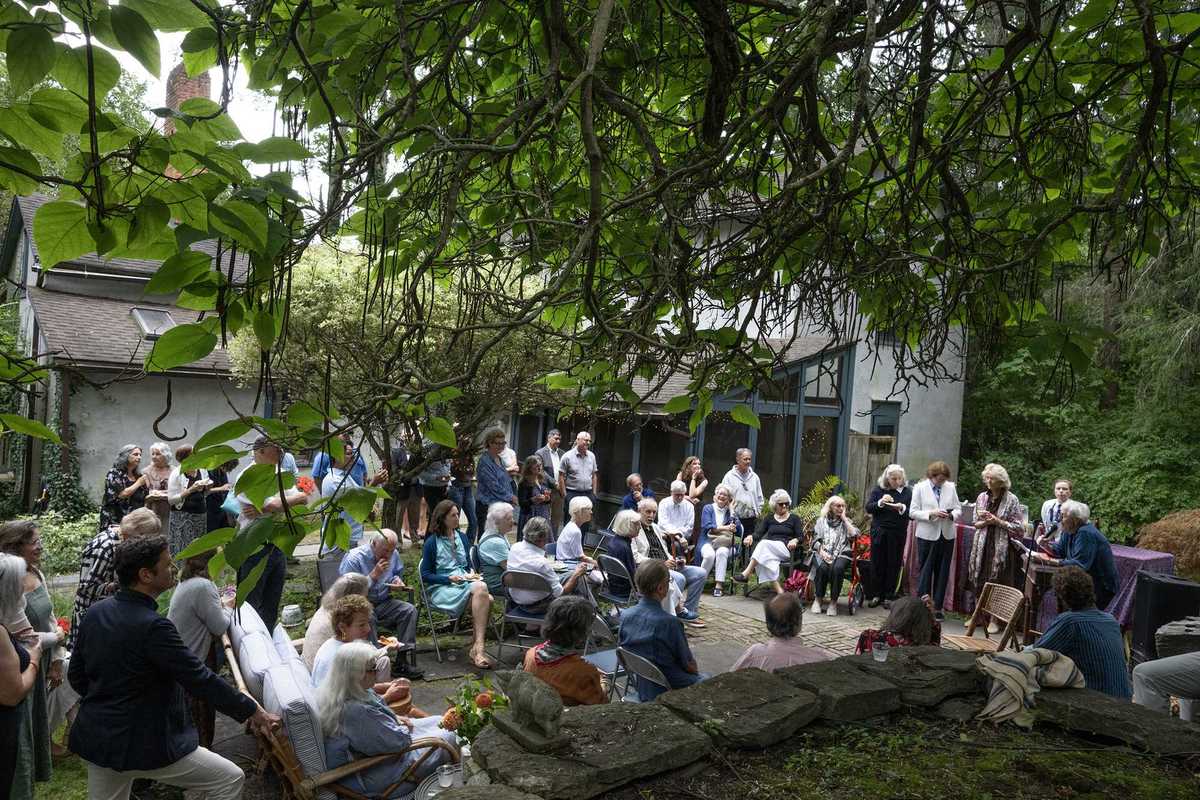
The ribbon-cutting ceremony for the opening of The Annex at Ancram Center of the Arts. From left, Dan Sternberg, Ancram Center board member; Stephen Futrell, Ancram Center board member; Mary Barthelme, HCR; Kit White, APG; Andrea Barnet, APG; Crystal Loffler, HCR; Assemblymember Didi Barrett; Paul Ricciardi, Ancram Center Co-Director; Cathy Redlich, Ancram Center board president; Jeff Mousseau, Ancram Center Co-Director; Colleen Lutz, Ancram Town Supervisor; Jane Plasman, Ancram Center board member; Ivy Epstein, Ancram Center board member; Sheryl Boris-Schacter, Ancram Center board member; Lindsay Turley, NYSCA
The Ancram Center for the Arts marked a major milestone May 22 with a ribbon-cutting ceremony celebrating the opening of The Annex, a restored 1780s building adjacent to the organization’s original Opera House theater in Ancram’s Historic Hamlet District.
Founded in 2016, Ancram Center for the Arts has built a reputation for presenting adventurous contemporary theater and community-centered programming in an intimate setting.
The newly renovated building expands the arts center’s footprint with housing for visiting artists and interns, along with additional classroom and gathering space for community programming and educational workshops. Upgrades to the overall complex also include ADA-accessible entrances and restrooms, reserved parking for patrons with limited mobility and a new outdoor seating area.
More than 60 people attended the celebration, held inside the theater against a backdrop of projected images documenting the restoration process, from demolition and foundation work to the final stages of construction.
Board Chair Cathy Redlich described the opening as a “pivotal moment” in the organization’s 10-year history and credited co-directors Paul Ricciardi and Jeffrey Mousseau with helping shape a vision that connects art and community.
Among those attending the ceremony were representatives from the New York State Council on the Arts, New York State Homes and Community Renewal and the Ancram Preservation Group, all of which helped support the project through funding and preservation efforts.
In a statement, New York State Assemblymember Didi Barrett praised the project’s impact on the wider community, noting that the Annex will provide housing, classroom space and expanded opportunities for residents and visitors alike.
The restoration project received support through the New York Main Street program, administered by New York State Homes and Community Renewal, along with additional funding from NYSCA, the Dormitory Authority of the State of New York and the Ancram Preservation Group.
The opening comes as Ancram Center launches its 2026 season, which includes performances of “Letters from Max” by Sarah Ruhl in July, Todd Almond’s musical memoir “I’m Almost There” in August and Caryl Churchill’s psychological drama “A Number” this fall. The center will also continue its popular “Real People Real Stories” storytelling series this summer.
“As Ancram Center enters its second decade, we are more than ever embracing our commitment to produce powerful works of theater that speak to this moment,” said Mousseau.
“The times we are in call for questioning conventions and creative courage,” added Ricciardi. “We also lean in on the unique shared experience that theater offers to take stock and reflect on what keeps us open and humane while living in uncertain times.”
For more information and tickets to upcoming performances and workshops, visit ancramcenter.org
D.H. Callahan
Flynn Ryan on the Range.
Before Flynn Ryan, the owner of the Millerton Driving Range, moved from Arizona to Lakeville as a high school freshman in early 2020, he had only a passing interest in golf. He was a football guy in Arizona, but when he found out practice for the Housatonic Valley Regional High School athletes was an hour away, he joined the golf team.
A couple of years later, while working on a school assignment to improve the community, Ryan noticed the old driving range. The weeds and grass were up to his eyes. With no connections and no experience, he walked into Talk of the Towne Deli next door, asked for the landowner’s number and called him right there from the parking lot.
What he got was one heck of a deal.
The owner, who didn’t like seeing the range fall into disrepair, was thrilled that a local kid wanted to revitalize the business. He gave Flynn the first year rent-free, use of all his equipment, a little knowhow and, just like that, the high school junior became a business owner.
That’s where it stopped being easy.
At first, Flynn wasn’t very good at golf. But his personality compels him to dive deep into his interests and make himself an expert. It’s the same drive that pushed him to learn how to trade stocks, futures and cryptocurrency as a teen, spending years failing before turning a profit. That first year on the golf team, he earned the honor of most improved.

If you’ve ever been to the range, you know how wonderfully casual it is. It’s the kind of place where nobody cares how good you are. Where people intimidated by the sport can pick up a club and have a great time right next to a seasoned pro. Classic rock pumps through the speakers. There are chairs and a coffee table for people who bring their own picnics and parties. A ragtag collection of clubs invites you to try them out for size. The balls come out of a vending machine. The place is the definition of laid-back.
Flynn’s job seems like the easiest in the world. It is not.
During the warmer months, Flynn gets to the range at 6 a.m., picking up balls in his golf cart. Of course, the back field, where the long balls end up, has to be picked up by hand, one ball at a time. On busy days, that can mean as many as 6,000 balls. Once a week, he mows the whole thing.
It might not sound like all that much, but consider that for most of the year Flynn is working toward a business degree at Old Dominion University in Virginia. When he’s away, his family picks up the slack. His mother, Jennifer, chips balls into the center of the field with a pitching wedge before gathering them up, and his father, Michael, takes care of the mowing. Flynn keeps offering to hire workers, but his parents seem to love working for their entrepreneurial son.
While there’s nothing solid on the books, Flynn dreams of expanding his business with more ranges in the future, as well as hosting events on the Millerton grounds. Until then, he’ll keep the Zeppelin pumping, the ball machine loaded and the grass nicely shorn.
Andrew Bavis
Author William Kinsolving explores race, class and privilege in his new historical novel, “Black and White and Read All Over.”
What historical fiction allows is [to imagine] what’s between the lines of history, what the historian is forbidden to do.
— William Kinsolving
A century ago, the infamous case of Rhinelander v. Rhinelander, also known as the Rhinelander Affair, shook American society. The trial pitted mixed-race maid Alice Jones against the Rhinelanders, one of New York’s oldest and most powerful old-money families, drawing national attention. Now, 100 years later, the trial and the lives of those involved are brought back into focus in new ways in William Kinsolving’s latest novel, “Black and White and Read All Over.”
The book explores the dynamics of power and privilege within a deeply racist and classist society through the lens of what the author describes as “a uniquely American Cinderella love story done in by money and family power.”
It’s important to note that this book is not a biographical account of the Rhinelander Affair, nor does it pretend to be. Instead, it is openly and proudly a work of historical fiction that, rather than being restricted by the historical facts of the events it covers, integrates them into a story focused on the imagined emotions and inner lives of Alice Jones and her family. When asked about this creative decision, Kinsolving said that “what historical fiction allows is [to imagine] what’s between the lines of history, what the historian is forbidden to do.”
The book uses fiction to fill the gaps that court records and New York Times articles do not cover, and in doing so breathes new life into this slice of history. The result is a compelling love story between two people brought together by chance and torn apart by forces of race, class and power beyond their control, alongside a moving portrait of a family’s resilience in the face of a legal system designed to work against them.
One of the core aspects of “Black and White and Read All Over” is its examination of the racism and class politics that defined the period in which the book is set. Because of its subject matter, the book’s central conflict is inherently intertwined with the society of the early 20th century, a time when old-money families held enormous influence in New York and the now-infamous one-drop rule — which classified anyone with African ancestry as Black — shaped racial identity and social standing. The novel leans into this reality, making the Jones family’s status as a working-class, mixed-race household a prominent aspect of their identity and contrasting them with the white, aristocratic Rhinelander family, who serve as embodiments of the privileges and prejudices that dominated society.
The book uses Alice’s experiences, as well as those of her family, to show firsthand the realities of living in a white supremacist society and under a legal system dominated by wealth — realities that will likely resonate with many readers a century later.
Ultimately, “Black and White and Read All Over” is an engaging and thought-provoking novel that uses a tragic love story rooted in history to examine the enduring roles of race, class and power in American society.
For more about the author and to order the book, visit williamkinsolving.com

Want more of our stories on Google? Click here to make us a Preferred Source.

Want more of our stories on Google? Click here to make us a Preferred Source.