MILLERTON — Millerton’s Police Department has requested more funding for its firearm budget.
“The county is switching over to different firearms, and we could possibly piggyback onto that as well, without any cost to the village of Millerton,” said Joseph Olenik, Chief of Police.
Millerton’s police department is currently staffed by seven officers, including Olenik, who have to provide their own firearms and equipment. They get paid $26 or $26.50 an hour, and Olenik said that purchasing a firearm and a gun belt can cost one officer around $1,200.
When a personal weapon is being used by an active officer, it becomes more difficult to take away than a provided weapon.
“It is better when it is a town-issued weapon, and we have more control over it,” Olenik said. “So I asked the district attorney if there are any funds possible or some type of grant to get the weapons purchased through the town… and he is working on it.”
Personal guns have to be authorized by the chief and the firearms officer, checked twice a year, and qualified twice a year. All guns must be approved to be carried and used while on duty, and if they do not pass, the officer is not allowed to carry them. The chief hopes to receive $8,000 or $9,000 to help aid officers with firearms and avoid potential future issues.
“I think the department purchasing the weapons is essential,” Olenik said. “No one should use their own personal weapons.”





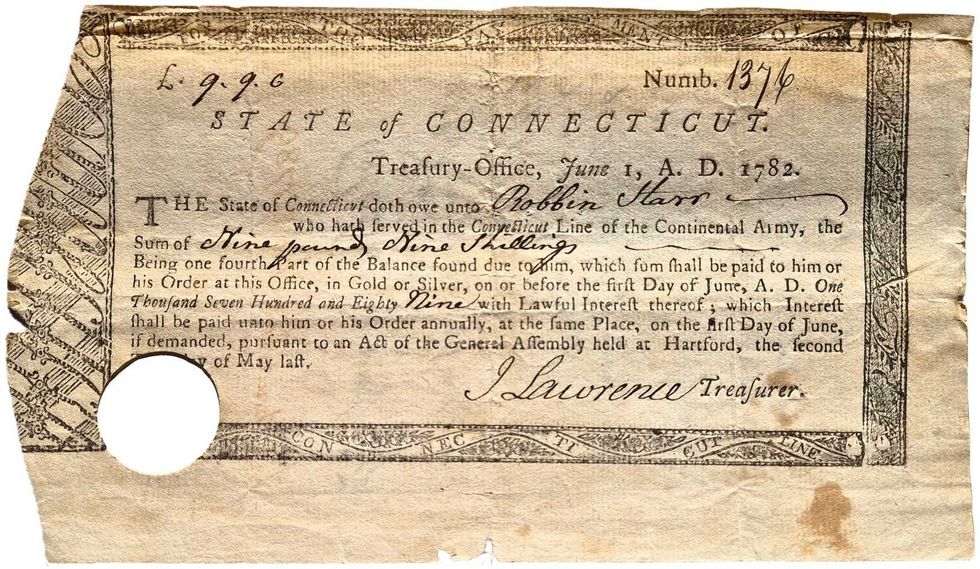 Pay Bill for Robin Starr’s service in the Continental Army.Courtesy the Alex Breanne Corporation
 John Mills speaking at Quinnipiac University.Courtesy the Alex Breanne Corporation

 Stephanie Saetta,with her rescue dog George and Blue (left), a shepherd mix awaiting his forever home.Madi Long