MILLERTON — The Millerton Planning Board made no ruling after it completed parts one and two of the Environmental Assessment Form (EAF) for the Millerton Overlook project at its workshop meeting Wednesday night.
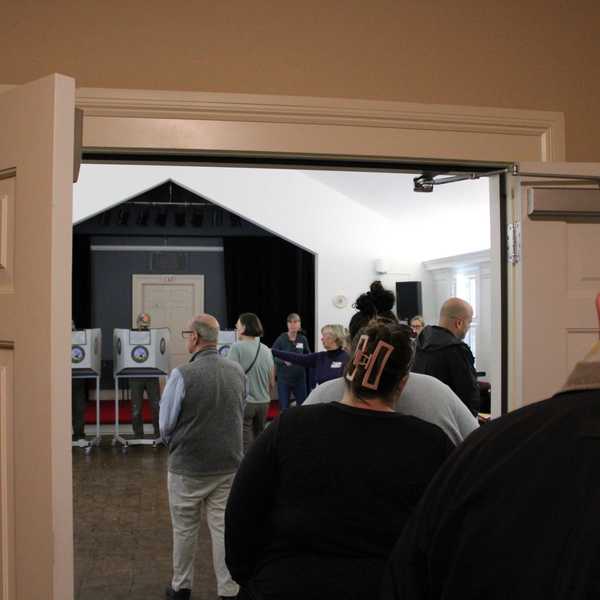
The March 10 meeting brought a standing-room only crowd to Village Hall, to watch and listen to Planning Board members, the board’s attorney, Michael Hayes, and the board’s engineer, Paul McCreary, as they made their way through the document regarding the proposed affordable housing complex.
Planning Board Chairman Greg Lanphear asked the audience to refrain from making comments as the board had to get through its work. He also remarked that McCreary would “take the lead� at the meeting while making note of the things that still have “gray areas� he would have to get back to the board on.
Part one of the EAF had to do with the project information itself and the site description. After completion of the project, which is located at the head of Main Street and Route 22, there will be .11 acres of forested land, 1.33 acres of roads and 2.28 acres of lawns. The soil type will be 100 percent well drained. The percentage of the project site with steep slopes is nominal, with nothing greater than 15 percent.
The project is not listed as a state historical site, although there was some discussion that it’s contiguous to a historical area — the village of Millerton.
Lanphear said that was newly designated. Hayes said that needs to be investigated and that McCreary should look at the issue.
Another issue arose when the board discussed whether the project sits on top of an aquifer.
“They say ‘No,’ I say ‘Yes,’� board member Patti Lynch said.
“The primary management area is, specifically where the site is located and it relates to the area where the well head area is protected, so that should be a yes,� McCreary said. “There are distinct definitions for different types of aquifers.�
“So this is something that we feel needs further clarification from Paul?� Lanphear asked his board.
There was consensus it was; the engineer said he would be happy to do so.
The question of whether the site has threatened or endangered species that may be threatened by the project was also on the EAF. At this point it was noted that different board members had different versions of the EAF. Some were market “no� on this question, others were left blank. It was decided that Hayes would look at the inconsistencies between the two as part of the process and resolve them.
The possible presence of bog turtles, an endangered species, was noted. Hayes said he would update the EAF and check the final version for accuracy.
A question regarding streams or rivers was on the form. When he looked at the maps there was “some indication of a tributary to Webutuck Creek,� Hayes said. “I didn’t see it when I was walking around the property but it shows it on the map.�
Lanphear then mentioned the wetland, which is a known portion of the site.
Critical areas
McCreary next spoke about critical environmental areas that can be critical habitats, which he said would have to be designated.
“We can safely give the answer ‘No,’� Hayes replied.
“No� was also the answer when the question of if the site was ever used for the disposal of hazardous waste was raised.
That concluded the first section of part one. The board then moved on to tackle part B
There were some discrepancies among the different EAF forms as far as the size of the site. It was then discovered there were three versions among those present. They ranged with answers of site sizes from 3.36 acres to 3.4 acres to 3.7 acres, which was the size settled on.
The number of off-street parking that existed was zero, the amount to be created is 44. The application calls for the creation of three buildings with two apartments and four buildings with three or more apartments, with a total of 20 apartments. There is to be 135 feet of frontage on Route 22.
When the question of whether any mature forest or locally important vegetation is being removed was asked, there was some debate. Lanphear initially said ‘No.� Board member Lance Middlebrook objected.
“That is wrong, there’s the Christmas tree,� he said. “That fits right into that.�
“They have offered to replace that tree in another location,� board member John Gilmor said.
“I would say it’s legitimate to revise that to a ‘Yes,’ for the tree,� McCreary said. “As far as locally important vegetation, I’ve heard that argument many times.�
There was a question about whether the project was single phase construction to be completed within 12 months.
“I think that’s ambitious,� McCreary said.
“If they say 12 months and it takes 16, what happens?� asked Middlebrook.
“Nothing,� he was told.
It was stated that 12 temporary jobs will be created during construction and .7 after construction is complete. Zero jobs will be eliminated by the project, according to the EAF.
Solid waste
The project will generate solid waste, approximately 2.5 tons, which will be carted off to the Dutchess County Resource Recovery Agency (RRA) in Poughkeepsie. There will also be an increase in water use; an estimated 4,510 gallons of water will be used per day.
The action involves the Planning and Zoning Board of Appeals, as it will call for a site plan and a special use permit. The site’s zoning is medium density residential, with a maximum of 32 units allowed under current zoning. It is consistent with land use plans, according to Hayes. The completion of the project will create a demand for community services, such as police, fire, recreation and schools.
That concluded part B. The board then started part two.
“Will the action bring physical change to the site?� asked Lanphear. “Yes,� was the obvious answer.
After other basic questions were asked and answered. Members asked if any waters need protecting. Wetlands and aquifers were immediately mentioned. A 300-foot buffer for the wetland was suggested, especially considering the possible habitation of bog turtles. That suggestion came from a letter Middlebrook received from the county, based on an inquiry he made on behalf of taxpayer Jeanne Rebillard, who owns property adjacent to the Millerton Overlook site.
“Ultimately it’s the wetlands we’re trying to protect,� Middlebrook said. “I feel personally that comes first. If they [Housing Resources] want to redesign in that 300-foot buffer that’s up to them.�
“Can we table that motion until we’re as well educated with that document as you are?� asked Lanphear, as none on the board was given a copy of Middlebrook’s letter.
Hayes recommended the board refer to Erik Kiviat, executive director and cofounder of Hudsonia, a non-profit environmental research institute which educates and provides technical support to municipalities, for his expertise on the issue. Kiviat has advised the board in the past. Middlebrook said he’s had talks with Kiviat, who said he “didn’t really know� the solution.
The board then took a vote for its next move. Middlebrook, Lynch and member Carol Gribble all voted in favor of instituting a 300-foot buffer around the wetland; Lanphear and Gilmor voted against the buffer. The “ayes� won the vote and the buffer was adopted.
The rest of the form was subsequently addressed. There was a question if the action will affect the ground’s surface, to which the answer was “Yes,� because the proposed action will require a discharge permit. The question of whether the construction will contaminate any supply of water is to be determined, as was the separate question if the action will adversely affect ground water. The board asked McCreary for further information on those two points.
No conclusion was drawn after the EAF was gone through. The Planning Board expects to do so, however, at its next meeting on Wednesday, April 14, at 7 p.m.
The following night, Thursday, March 11, the North East Town Board discussed the Millerton Overlook project. For that story, turn to page A3.





 Farm & Friends 2025.Provided

 Mark Stonehill and Miriam Goler with their winter greens at Full Circus Farm in Pine Plains. L. Tomaino


 Provided