Part of the problem we all face in this new age with 90% of commerce being totally dependent on the internet is the connection we all need (I do not use the word enjoy for a reason) to survive and prosper. There is no phone call, no email, no SMS, no Facebook, no TikTok, no factory systems control, nor any Instagram or any other means of communication that is not 100% dependent on the internet.
If you need an analogy consider this: Without water you cannot exist. Without the internet and a decent connection, similarly, you cannot exist in the modern world.
With new devices coming from all the major companies — virtual reality, 3-D design and sharing, constant connection glasses, Zoom meetings, distance learning, expandable cell phones, amongst a thousand new inventions — the need for faster, more reliable connections becomes critical. It’s like a water pipe. Currently we’re at the trickling stream going past your house stage — every once and a while you go out, dip a bucket in and carry water to the sink or bath. The internet connection we need is in-house plumbing: limitless, on tap in every room, full pressure.
Several companies are working on this. Elon Musk’s Space X is launching thousands of satellites that not only promise but — in early connections — deliver 1,000 megabits or 1 gigabits of download and uploads of 20 megabit (MB). Where? Everywhere, every farm, every road, every field, every town, every city.
They got $886,000,000 from Congress some years back (heavy lobbying ensued) to set this up, to help solve the “rural connectivity” issues.
Space X is manufacturing 120 satellites a month (yes, a month) to achieve low earth orbit blanket coverage. As the older satellites’ orbits decay and fall in a fiery ball to earth, they simply launch more.
In all, there are 180 companies that dipped into the Fed’s $9,200,000,000 fund to bring connectivity to rural areas in the U.S. and Pacific Islands. Space X wasn’t the largest beneficiary either. Meanwhile, while these new means of connectivity grow, the current internet providers like Verizon, AT&T and Comcast are making every effort to up their speeds, revise their exorbitant monthly charges and — in desperation — incentivizing existing customers to keep on paying through the nose. We’ve all seen this before with the TV-only cable companies. Along came DISH and Direct TV and cable companies had to either lower process or provide DVR capability and other gimmicks (like “bundling” services) to keep their customers. Now the internet free access to television and movies and subscriptions with producing entities (like Hulu, PrimeTV, HBO and Netflix) are closing down cable companies’ marketing schemes for that set-top box they always rented.
Where will it all end? Sadly, as long as commercial enterprises have an edge, they’ll overcharge, even if their entry into the market was paid with taxpayer dollars. There will continue to be something unsavory about Space X, Verizon, Comcast, AT&T and others charging for your connection to the internet — originally developed and backboned by taxpayer dollars decades ago. Their leverage? They know you cannot survive without their “water” supply. You’d die of thirst without them and they know it.
Writer Peter Riva, a former resident of Amenia Union, now resides in New Mexico.








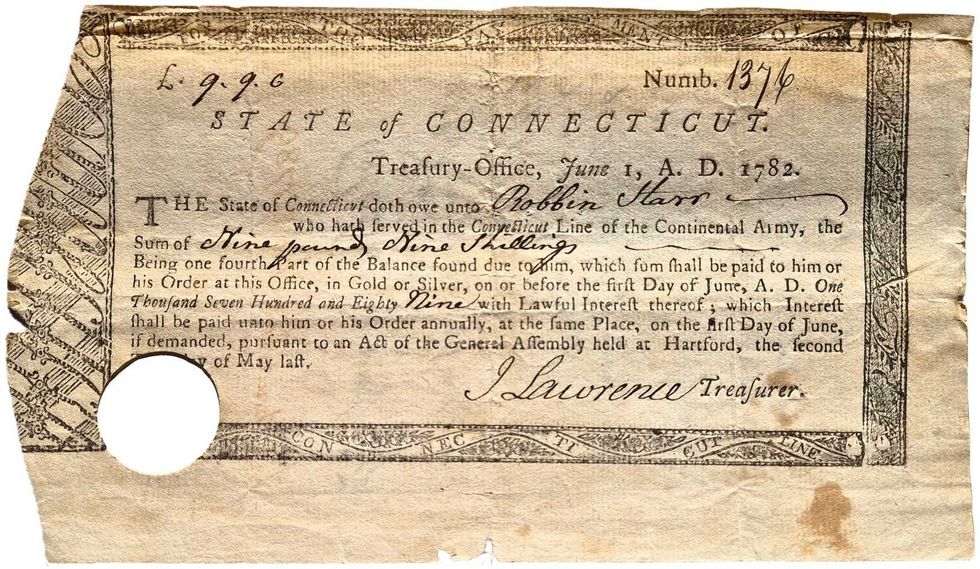 Pay Bill for Robin Starr’s service in the Continental Army.Courtesy the Alex Breanne Corporation
 John Mills speaking at Quinnipiac University.Courtesy the Alex Breanne Corporation

 Stephanie Saetta,with her rescue dog George and Blue (left), a shepherd mix awaiting his forever home.Madi Long