Latest News
Ed Sheehy and Tom Taylor of Copake, New York, and Karen and Wendy Erickson of Sheffield, Massachusetts, traveled to Salisbury on Saturday to voice their anger with the Trump administration.
Photo by Alec Linden
SALISBURY — Impassioned residents of the Northwest Corner and adjacent regions in Massachusetts and New York took to the Memorial Green Saturday morning, Jan. 10, to protest the recent killing of Minneapolis resident Renee Nicole Good at the hands of a federal immigration agent.
Good, a 37-year-old mother of three, was shot at close range by an officerwith Immigration and Customs Enforcement, commonly known as ICE, on Wednesday, Jan. 7. She and her wife were participating in a protest opposing the agency’s presence in a Minneapolis neighborhood at the time of the shooting.
The incident sparked protests and vigils nationwide, both in remembrance of Good and in opposition to what demonstrators described as a broader pattern of government overreach.
In Hartford on Thursday evening, Jan. 8, two vehicles that authorities believe were operated by ICE officers drove through a crowd that had gathered in memory of Good. Connecticut Public Radio reported that at least one person had been struck by the vehicles and that police are investigating potential charges.
In Salisbury, the protest unfolded calmly but with a palpable sense of urgency. Just before noon, roughly 160 demonstrators lined Route 44, holding signs and cheering as passing motorists honked their horns.
Organizer Sophia deBoer stood alongside her husband, Lee deBoer, and fellow activists Kathy Voldstad and Amy Lake to greet demonstrators as they arrived. Along with Al Ginouves, the group has organized weekly protests against the Trump administration since April 2025’s nationwide “Hands Off” movement.
“It’s time that people stood up to this lawless administration,” Sophia deBoer said as the crowd waved their signs.
Local immigrants’ rights advocate John Carter echoed that sentiment. “I need to put my body where my soul is,” he said.
Attendees cited a range of emotions for turning out, from anger and fear to cautious optimism
Joan Gardiner said it was “outrage and fear” that brought her to the protest, while Christine Clare said, “Being out here today, this makes me hopeful.”
Calls for justice dominated many of the messages displayed on protesters’ signs. Asked what motivated him to attend, Salisbury resident Louis Tomaino pointed to the words on his sign: “We all saw Renee Good murdered. And we all saw murder excused.”
Keep ReadingShow less
Area ambulance squad members, along with several first selectmen, attend a Jan. 5 meeting on emergency service providers hosted by Nuvance/Northwell.
Photo by Ruth Epstein
FALLS VILLAGE, Conn. — Paramedic coverage in the Northwest Corner is continuing despite concerns raised last month after Sharon Hospital announced it would not renew its long-standing sponsorship agreement with Northern Dutchess Paramedics.
Northern Dutchess Paramedics (NDP), which has provided advanced life support services in the region for decades, is still responding to calls and will now operate alongside a hospital-based paramedic service being developed by Sharon Hospital, officials said at a public meeting Monday, Jan. 5, at the Falls Village Emergency Services Center.
“We haven’t missed a beat; we’re still taking calls,” said Andrea Downs, president of the Falls Village Volunteer Fire Department and an employee of NDP, speaking at the meeting, which was attended by ambulance squad members, first selectmen and representatives of Sharon Hospital.
Sharon Hospital announced Dec. 11 that it would not renew its annual agreement with NDP, ending a 28-year relationship and initially stating that service would cease Jan. 1. Hospital President and CEO Christina McCulloch said the decision was based on compliance concerns tied to the hospital’s role as sponsor.
“Being a sponsor is a big deal,” McCulloch said. “Our concerns were big enough that we couldn’t sign. It was a difficult decision.”
She said the hospital had discussed the issues with NDP representatives and cited unmet state requirements.
Without a sponsoring hospital, NDP could not operate in Connecticut. That issue was resolved when NDP finalized an agreement with Stamford Hospital, allowing it to continue providing services in the Northwest Corner.
At the same time, Sharon Hospital is establishing a hospital-based paramedic service through Nuvance/Northwell, owner of the hospital. Under the current model, the service consists of a single paramedic, who begins the day at New Milford Hospital before traveling to Sharon, prompting concerns from some volunteer ambulance crews about response times while that paramedic is in transit.
Addressing those concerns, hospital officials said while the new paramedic service covers a wide area, so too does NDP, which is based out of Rhinebeck. Some volunteer ambulance crews also said their concerns relate to the transition to two providers, with Sharon Hospital’s service still being built out and not yet fully stationed in Sharon.
Falls Village First Selectman David Barger asked whether more than one paramedic service could operate in the region.
“There could be more than one,” McCulloch said.
Matt Cassavechia, director of emergency services for Sharon Hospital, said Litchfield County Dispatch, which handles all ambulance and fire dispatching for the region, will call whichever paramedic service is available at the time of an emergency.
He acknowledged that the current arrangement could be improved and said the hospital hopes to expand on-site paramedic coverage in Sharon. Doing so would require state approval through a need-for-service application, which Cassavechia said would benefit from letters of support from the community and area first selectmen.
Several volunteer ambulance representatives expressed concern about how changes could affect basic life support services and volunteer operations. Cassavechia said the hospital does not intend to replace volunteer squads.
“We’re not snapping up patients,” he said. “That’s not what we do. We are deliberate and purposeful. We have zero intent of putting volunteers out of business.”
Questions were also raised about possible delays in transferring patients from Sharon Hospital to other facilities.
Keep ReadingShow less
Gabrielle Tessler, of Copake, writes on a large sheet of paper expressing her opposition to the project as speakers address more than 100 attendees at a community meeting Saturday, Jan. 10, at Copake’s Memorial Park Building.
Photo by John Coston
COPAKE — There was standing room only on Saturday, Jan. 10, when more than 100residents attended a community meeting to hear experts and ask questions about the proposed 42-megawatt Shepherd’s Run solar project that has been given draft approval by New York State.
The parking lot at the Copake Memorial Park Building was filled, and inside Sensible Solar for Rural New York and Arcadian Alliance, two citizen groups, presented a program that included speeches, Q&A, videos and workshop-like setups.
Speakers urged everyone to attend public hearings on the Hecate Energy LLC plan that are scheduled for Wednesday, Jan. 21, and Thursday, Jan. 22, in person at the Copake Town Hall, and in a virtual setting on Tuesday, Jan. 27.
There were representatives from local, state and county government on hand, including from State Sen. Michelle Hinchey’s, D-41, office. Hinchey has expressed concerns about the project. Assemblywoman Didi Barrett, D-106, plans to attend one of the in-person hearings. Sam Hodge, chair of the Columbia County Democratic Party and a potential primary challenger to Barrett, was also present, as were Columbia County Clerk Holly Tanner and Copake Town Supervisor Richard Wolf.
“The vast majority of Copakians don’t want this project,” Wolf said as he began to talk, arguing that the local environment would be damaged, no permanent jobs would be created and the electricity generated would be transmitted downstate.
The state has overridden 16 of the town’s zoning regulations, he said.
“I encourage people to come to the hearings,” he said. “Make your opinions and voices heard.”
Wolf has been frustrated in dealing with the Chicago-based solar developer from the start and asserts that Hecate has “no interest in Copake.”
“I haven’t heard from anybody at Hecate in 20 months,” he said.
Lindsay LeBrecht, a Copake Lake resident, spoke as a member of a panel and questioned why prime farm land is being taken for this so-called solar farm. “It’s not a farm,” she said. “It’s an industrial site.”
One concern cited by the project’s opponents is the adjacency to Taconic Hills Central School in Craryville and the prospect of fire risk. William Murphy, a retired Battalion Chief with the New York City Fire Department, spoke about the fire threats, and said there isn’t enough fire-fighting capacity in the Craryville, Copake and Hillsdale area to adequately respond in the event of a fire. In New York in 2023, he said, there were three large solar facility fires. He also said they are increasing in number and often are unreported.
When he was asked by the school to develop an evacuation plan, he said he declined.
“No plan is fast enough to keep the students safe,” Murphy said.
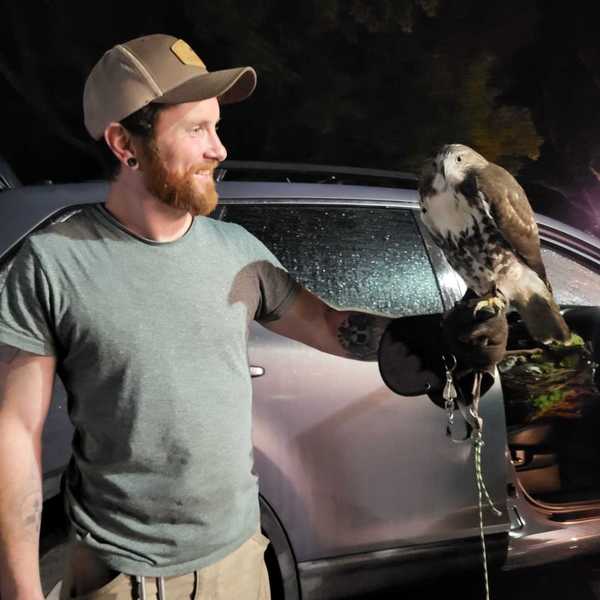
Animal expert Nick Jacinto, who is based on Long Island and who brought two live owls and a falcon to the community meeting, expressed concern about probable breeding pairs of peregrine falcons and bald eagles that could be threatened by the project.
“Will solar panels become this generation’s DDT,” he said, in a reference to the pesticide that nearly devastated bald eagle populations in the U.S. in the 1960s.
Questions from attendees focused on ways to stop the project, such as banding together to raise funds that could be used to buy out the lease options on the land, or having the town bring a lawsuit. Supervisor Wolf said there is a contingency plan that could bring this into court, but he didn’t believe the lease options can be touched at this point.
There was a lot of community spirit to go around. After the two-hours elapsed, people clustered together to continue discussing the project that has been in the wind in the agricultural hamlet since 2017.
Vicki Sander, a member of Sensible Solar who helped organize the meeting, said she invited Hecate to come. But “I didn’t hear back.”
Keep ReadingShow less
Millerton’s North East Community Center was among 27 nonprofit organizations awarded funding through the 2026 Dutchess County Agency Partner Grant program, receiving $128,822 to support three programs. Cornell Cooperative Extension of Dutchess County also received county funding, with four grants totaling $278,064.
In a statement shared with The News, Dutchess County Executive Sue Serino said the NECC and CCE Dutchess County are “tremendous partners in the community, and Dutchess County is proud to support their work addressing priority community needs with funding through our Agency Partner Grants.”
The NECC grants will support the organization’s teen jobs program, food access initiatives and out-of-school-time programming.
“We are so grateful to Sue Serino and the Dutchess County Legislature for once again funding these important NECC programs,” said Christine Sergent, executive director of NECC. “The County’s support is important to our work in this rural community, where resources are limited.” Sergent added that the funding will help meet the increasing need in NECC’s service area.
NECC’s Teen Jobs program places youth ages 14 to 18 in paid internships with local businesses, with NECC covering wages while employers provide on-the-job training. Participating businesses have included Agway of Millerton, Cornell Cooperative Extension, Four Brothers Pizza, The Moviehouse, Oblong Books, Pine Plains Barber Shop, Rock Steady Farm and the Wassaic Project.
The organization’s after-school program serves students at Webutuck Elementary School, providing an environment focused on social-emotional learning, recreation, community service and crafts. During the summer, the Summer Enrichment Program offers day camp programming for children entering grades 1 through 6.
NECC’s food access efforts include a weekly food pantry and the Community Food Access Hub, which distributes fresh, culturally responsive food throughout northern Dutchess County in partnership with the Regional Food Bank of Northeastern New York, the Glynwood Center for Regional Food and Farming, TriCorner FEED and Community Foundations of the Hudson Valley. The organization also operates a “Food Futures” paid summer internship for teens.
Cornell Cooperative Extension’s funding will support four programs focused on youth development, environmental education, parenting education and support for relatives raising children.
“Dutchess County’s investment in Cornell Cooperative Extension Dutchess County is an investment in people, families, and the future of our community,” said Jessica Canale, Interim Executive Director of Cornell Cooperative Extension. “These four grants allow us to reach youth, parents, caregivers, farmers and educators in meaningful, hands-on ways.”
The APG program is a competitive grant process run by the county Department of Planning & Development for local 501(c)(3) non-profits. For 2026, $1.5 million in grants have been awarded under the traditional APG program, with an additional $502,583 coming from the Department of Community & Family Services and the Department of Mental Health.
Keep ReadingShow less
loading