Dutchess County Executive Marc Molinaro announced on Tuesday, July 26, that the county will be injecting more than half a million dollars — $526,763 to be exact — into three of our Harlem Valley communities shortly, thanks to the Municipal Investment Grant (MIG) Program. In total, Molinaro helped secure a whopping $4.6 million in funding for 38 projects county wide, with the majority of the monies going toward “projects [to] promote efficiencies and long-term sustainability, agency capacity and capability, shared services and community development, while ultimately generating savings for taxpayers,” with a focus on our local fire departments and rescue squads.
Molinaro’s eyes were clearly looking toward protecting the residents of Dutchess and to addressing “health and safety issues,” as his office worded the announcement of what is the “highest award total” in the program’s history. That dates back to 2013, when the MIG Program was first launched.
Considering how essential our emergency services are, and that here in the Harlem Valley our towns and villages rely on volunteers to staff, maintain, operate and administrate our local firehouses and in some places still, our EMT services, we really appreciate — and rely on — such awards. Every penny garnered through precious grants, like those distributed through the MIG Program, can make all the difference in the world.
As North East Fire District (NEFD) Commissioner Joshua Schultz explained, the $94,996 MIG award bestowed upon the NEFD will help buy those who volunteer in the Millerton Fire Company and its Rescue Squad essential Personal Protective Equipment (PPE). That PPE, said Schultz, could not only “reduce the turn-around time of readiness of our firefighters in the event of multiple calls in a small time frame,” and “off-set the financial burden” the NEFD faces to equip all of its volunteers, it could “potentially reduce downtime of [cleaning and turning around] a firefighter’s gear and their ability to respond to alarms.”
And that, it turns out, could save lives.
So the money that Molinaro and his MIG Program has awarded to not only the NEFD, but to the town of North East ($140,000) and to both the town and the village of Millerton ($200,000), plus to the Amenia Fire Company ($74,767) and to the Pine Plains Fire District ($107,000) as well as to the town of Pine Plains ($50,000) will go a long way in making Harlem Valley residents a lot safer, and their lives a lot better. To read the specifics on what the MIG awards will go toward, and how they will help improve your community, be sure to read this week’s front page.
In addition to the grants mentioned above, many dozens of Dutchess communities, including a number located elsewhere in the Harlem Valley, received MIG funding. In fact, there were a number of additional grants awarded through the program in our neck of the woods we think are worth noting here:
• J. H. Ketcham Hose Company Fire and Rescue UTV and Transport Trailer Project Award, $40,469
• Town of Dover, Senior Recreation Center and Town Library Access Improvement Project Award, $40,000
• Milan Fire Department Critical Upgrades to Lifesaving Tools and Equipment for First Responders Project Award, $125,354
• Town of Stanford Replacement of Swimming Dock System Project Award, $100,000
As the county noted, it awards the MIG funds on a competitive basis to entities with taxing authority (i.e., cities, towns, villages, fire districts and water and wastewater public authorities) that “address its priorities and needs, promote shared services and consolidation efforts and implement accessibility improvements.”
The over-arching goal of the MIG Program is to support the efforts of local government while reducing the property tax levy. The fact the county does so while also accomplishing other vital work, such as improving and saving lives, just goes to show how forward-thinking our county executive and his team are. It also goes to prove how much can be done when people, governments, communities and all other sorts of organizations are willing to work together.




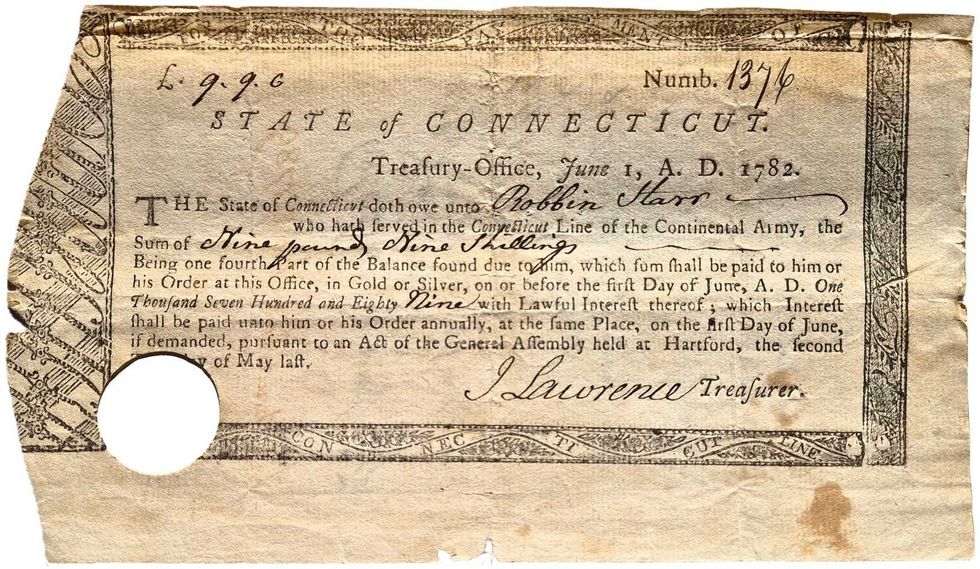 Pay Bill for Robin Starr’s service in the Continental Army.Courtesy the Alex Breanne Corporation
 John Mills speaking at Quinnipiac University.Courtesy the Alex Breanne Corporation
 Stephanie Saetta,with her rescue dog George and Blue (left), a shepherd mix awaiting his forever home.Madi Long