Earlier this month at Indian Mountain School in Lakeville students conducted a trash audit to see what was thrown away over the course of a few days. Of course, the sorting of garbage and refuse revealed a lot of plastic waste, including one-time food items in permanent plastic wrapping. The next day, students and parents from IMS along with community members watched a documentary film — “Junk” — at the Moviehouse in Millerton. The 2009 film is about a voyage from California to Hawaii on a raft made of 15,000 water bottles secured by discarded fishing nets and plastic waste. The film spurred concern by both students and parents about the five gyres in the world’s oceans — large systems of circulating ocean currents. Those slowly moving whirlpools also draw in the pollution released in coastal areas, known as marine debris. There are five gyres: the North Atlantic Gyre, the South Atlantic Gyre, the North Pacific Gyre, the South Pacific Gyre, and the Indian Ocean Gyre. In the North Pacific Gyre, a Great Pacific Garbage Patch persists in an area between Hawaii and California. The vast patch is made up of tiny micro plastics along with larger items of debris.
More than five decades ago, it was students behind the anti-war movement who helped inspire the Earth Day movement. Senator Gaylord Nelson of Wisconsin, seeking to ignite consciousness about air and water pollution, announced the idea of a teach-in on college campuses. The day that ultimately was chosen was April 22, 1970, the first Earth Day — a weekday falling between spring break and final exams.
The grandparents of today’s IMS students may remember the first Earth Day. At the end of it, Walter Cronkite anchored a CBS News Special. “Good Evening,” he began. “A unique day in American history is ending. A day set aside for a nationwide outpouring on mankind seeking its own survival.”
Student groups in 2,000 colleges and 10,000 lower schools and citizen groups in 2,000 communities planned to participate in the first Earth Day. Cronkite went on to say it was unclear how many actually participated, but the network’s correspondents nevertheless reported on the day’s activities across the nation. Today, by some estimates, one billion people get mobilized for Earth Day.
Our communities in the Northwest Corner and across eastern Dutchess County also mobilize around Earth Day. This coming Saturday, April 22, it will be hard not to come across an Earth Day event or exhibit or activity in town after town.






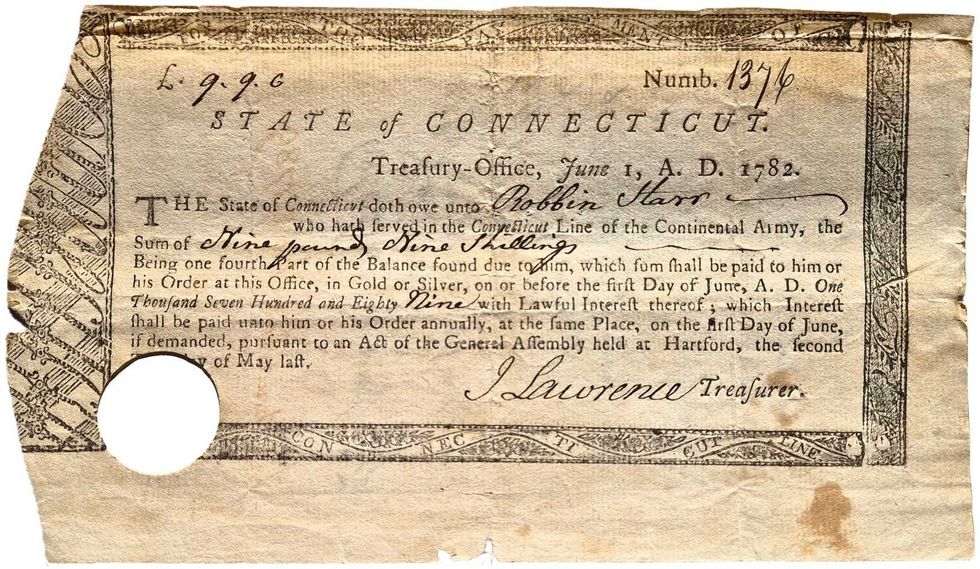 Pay Bill for Robin Starr’s service in the Continental Army.Courtesy the Alex Breanne Corporation
 John Mills speaking at Quinnipiac University.Courtesy the Alex Breanne Corporation

 Stephanie Saetta,with her rescue dog George and Blue (left), a shepherd mix awaiting his forever home.Madi Long