Those of us old enough, we remember our parents and our siblings asking questions about the world we lived in. “Where is Anzio and Normandy?” “Where is Inchon?” “Where is Cambodia and what’s the Gulf of Tonkin?” And “Kuwait? What’s Kuwait?” “Kabul? Where is that?” Sadly, you will be asking these questions again all too soon.
American youth, woefully undereducated, were always being sent “over there” to fight battles vital for our national interests and security. Parents desperately try to find out how far away they were going to be, what were the strange lands, strange peoples, strange customs they were going to encounter. And if all this is about to happen again, US education is still lacking in every possible geographic way.
In 1890-1910 the disparity between the worker and the very rich in all industrial societies including America was desperately evident. Natural resources (metals, oil, power, engineering) outstripped social balancing, allowing a handful to become so wealthy they make today’s billionaires look like paupers. Meanwhile, new inventions across the world as a result of the industrial revolution made those very wealthy here and especially in Europe, to want to keep their power by expanding control and territory. Countries fought such unopposed expansion until, finally, they became embroiled in an all-out war — the first world war in 1914 (WWI) — to stop the expansion of these powers. American elites and the most wealthy, desperate not to chose sides and lose their own positions of power and wealth, kept us out of the conflict until 1917 when American interests across the globe were threatened and we joined in to stop the Kaiser and his allies. That war was fought in 17 countries in Europe (can you name any of them?), 12 countries in Asia, 26 in Africa, and 12 in the Pacific basin. WWI killed about 40,000,000 people — about half of all the people in the USA at the time.
Just 20 years later, after the Great Depression, new inventions and manufacturing capabilities allowed nations to seek to return to strength through dominance — especially seeking to control oil, resources, and labor. The 3rd Reich started by building the industrial base, annexing neighbors, changing the social norms and birthright of its citizens to favor those in support of its moral codes. Japan invaded Korea and China. Soon, joined by other nations also wanting dominance over their neighbors, they were joined by Italy, and Russia and kicked off WWII. America, once again to protect the financial elite, stayed out of WWII for two years until Japan’s direct attack on our protectorate of Hawaii (not yet a state). In the end, across the globe, on every continent, in almost every country, millions perished, were tortured, executed, and died in battle. 70,000,000 to 85,000,000 people were killed — more than half of all the people in the USA at the time.
Korea, Vietnam, Kuwait, Afghanistan, Iraq — all followed since 1945. Why? Study history, but it usually boils down to powerful cabals wanting more.
Now, once again, there are potentates (domestic and faoreign) and several governments that seek superiority over their fellow citizens, are re-writing the moral codes of civilization, and are seeking to protect the wealth and prestige of the most wealthy. This time around it may be the rest of the world against a new cabal of financially elite rulers, desperate for power, desperate to secure dominance over people across the globe. And that battle, which will come – history always repeats – will take place in locations across the globe your children may never have been aware of, and you may find yourself asking, “Where is Panama? Where is Sandy Cay? Where is Bahrain? Where is Suriname and Paraguay? Where is Heimaey? What is Gaza? Why are our kids fighting there?”
Go get a globe and teach yourself and your kids before it is too late, to really know what is going on and where. Their lives are at stake.
Peter Riva, a former resident of Amenia Union, New York, now lives in Gila, New Mexico.



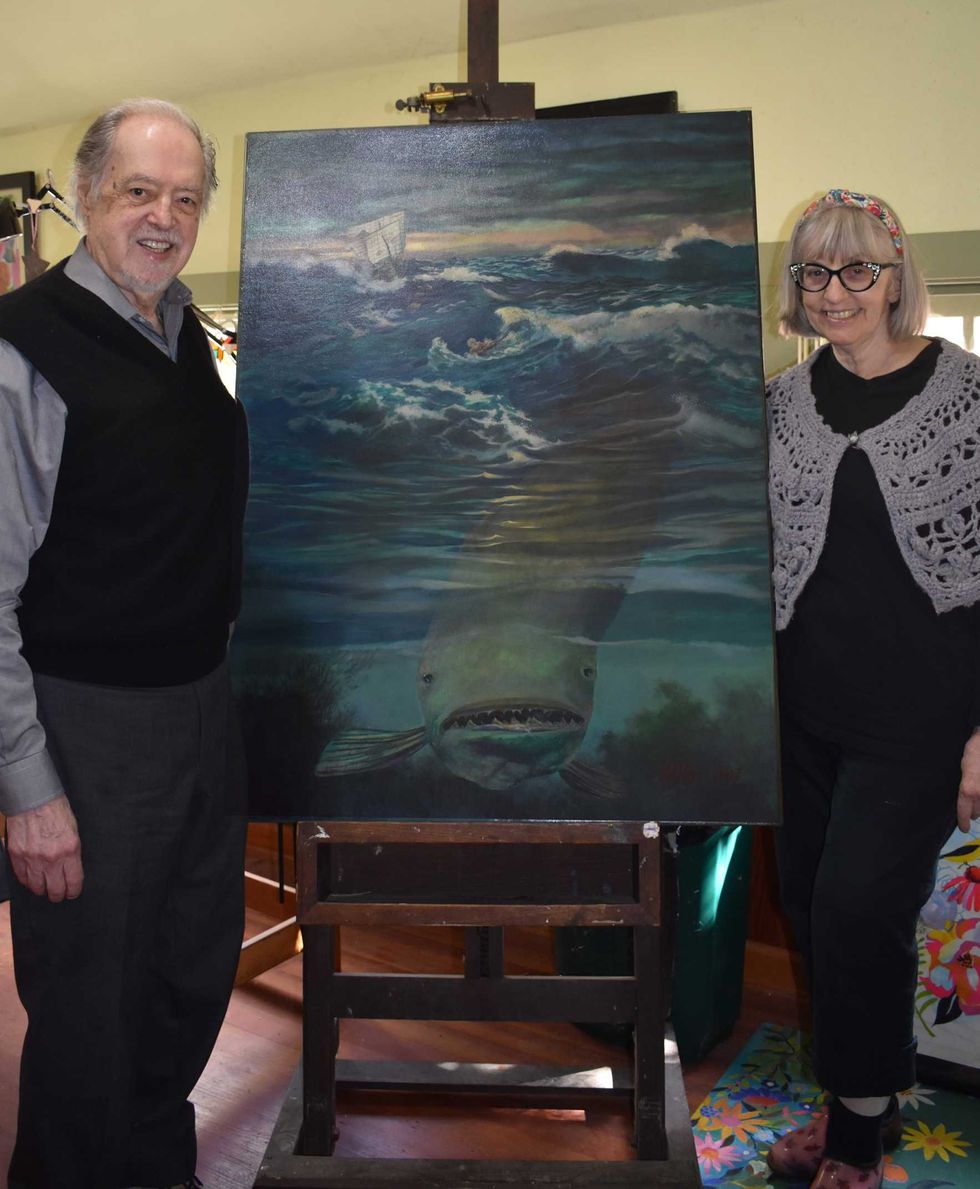 Justine and Victor Valla in their studio with a painting of Victor’s,”Jonah and the Whale.” Robin Roraback