LAKEVILLE, Conn. — Attorney General William Tong knows firsthand about the plight of immigrants.
He spoke to a standing-room-only crowd at Trinity Lime Rock Church March 6, which together with those on Zoom totaled 225. The event was hosted by Vecinos Seguros 2, a grassroots organization that works to make sure those without legal status know their rights.
Tong has been an outspoken critic of President Donald Trump’s immigration policies and is part of a group of attorneys general around the country who are banding together to take legal action against his actions.
He stirred the audience with his personal story. Growing up in West Hartford, where he remembered kids showing up at his school from Cambodia, Laos and Vietnam after he was the first Asian student enrolled, he thought “they were refugees and I was the son of immigrants. I thought I was better than them. In fullness of time, I realized what we were all doing here. My parents and grandparents ran for their lives in China. I am nothing but the son of refugees. There was no daylight between those kids and the immigrants showing up today.”
Tong related how his parents met while both were working in a restaurant in Hartford. One day, in the 1970s, a representative from the Immigration and Naturalization Service showed up and because his father was undocumented, was threatened with deportation. After much thought, the senior Tong was resigned to the fact he would have to leave. But shortly before the deadline, while driving along the Berlin Turnpike, he decided to make a last-ditch effort. He went home and wrote a six-page handwritten letter to then-President Richard Nixon explaining his case. The INS agent returned later and said the president had read the letter and sent the message that the country welcomed him and urged him to stay.
Tong said he’s often asked what brings him hope during these times. “In one generation, I went from that Chinese restaurant to attorney general of this state. There are kids out there now; families living with that dream. We need to help them keep it.”
The attorney general said that when Trump talks about denaturalizing citizens and then about anchor babies, he is talking about him. “Banning birthright citizens is utterly and brazenly unconstitutional.” Audience members, as they did several times during the presentation, applauded loudly.
Speaking on the importance of immigration for moral and economic structural reasons, Tong noted, “America runs on Dunkin’ and immigrant workers. There would be no economy without immigrants.” Half of all farm workers are undocumented, as are half of those working in the meat packing industry he said.
Touching on Connecticut’s Trust Act that was passed in 2013, Tong explained that it limits how local law enforcement can cooperate with federal immigration officials to protect the rights of undocumented immigrants. He called efforts to repeal the act “ridiculous,” saying “the federal government does its job and we here do ours.” He said if anyone tries to get rid of the act, he will fight it and believes he’ll win, emphasizing several times that Connecticut is a sovereign state. The federal government has a lot of power, but can’t come to Connecticut to tell its citizens what to do.
When asked what people can do to help those without legal status, Tong advised not to put anyone at risk and make sure they have a plan if ICE shows up. Agents must have a judicial warrant to come on private property. He also recommended they seek people who will provide pro-bono legal advice. He said those holding green cards have legal status and should be respected by ICE. He also recommended not using the word “sanctuary” since it has no legal meaning and can be inflammatory. He was also forthright in saying not everyone can be protected from deportation.
He added there is no evidence to support the claims that immigrants create crime more than American citizens and stressed the Trust Act does not protect violent criminals.
At the outset, Tong said he and his colleagues had sued the federal government when Trump and the Office of Policy and Management tried to freeze all federal funding for a variety of grants, especially those dealing with medical research. “We now have an injunction to stop him from breaking the law. Remembering we have checks and balances, we’re serving as the only check since there is so much disinformation out there.”
Coming to the end of his message, Tong’s tone was foreboding. “We’re not on the precipice of a constitutional crisis, we’re in one. Trump is already not in compliance with federal court orders. If he doesn’t follow Supreme Court rulings, we’re in a dark place. We all have the responsibility to take to the streets and speak out.”







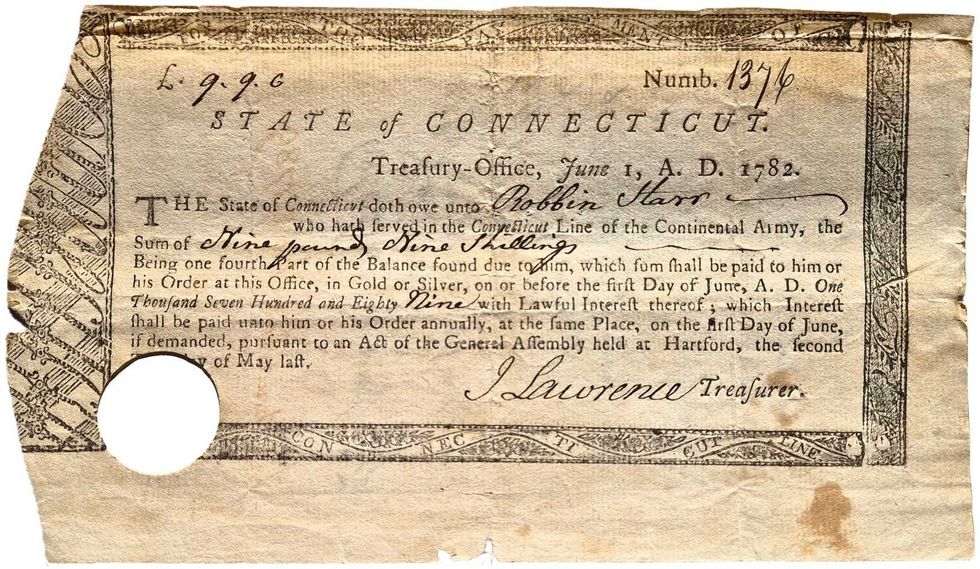 Pay Bill for Robin Starr’s service in the Continental Army.Courtesy the Alex Breanne Corporation
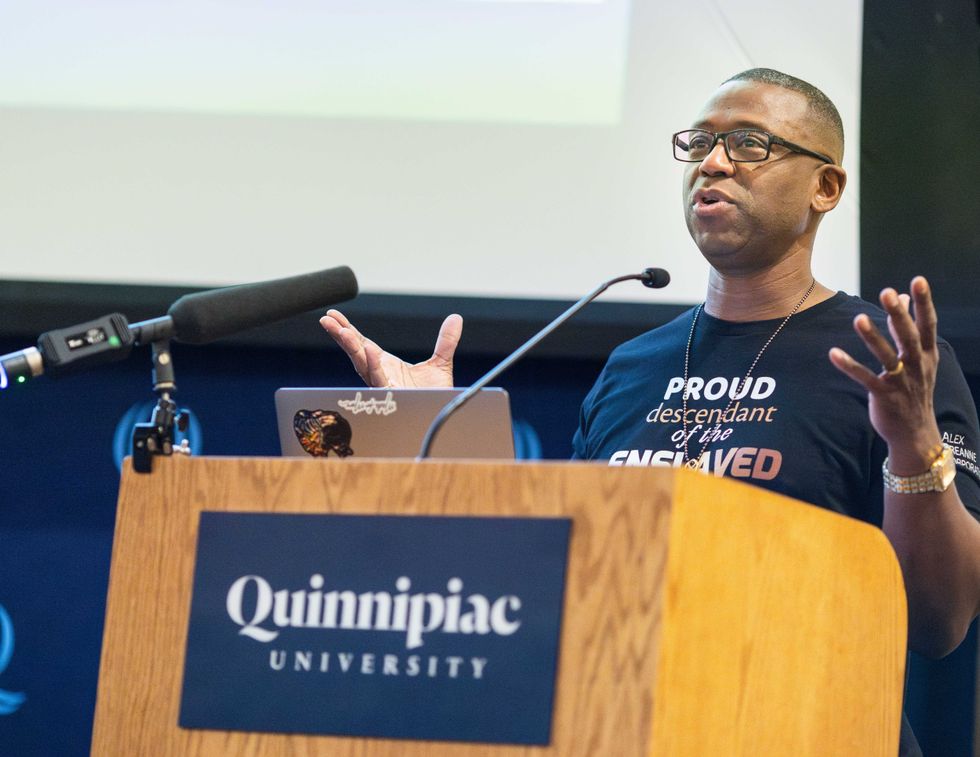 John Mills speaking at Quinnipiac University.Courtesy the Alex Breanne Corporation

 Stephanie Saetta,with her rescue dog George and Blue (left), a shepherd mix awaiting his forever home.Madi Long