Tribute to a Survivor

Tribute to a Survivor
Photo HarperCollins

She’d hide behind

a new identity — that was it.

She wouldn’t be Zhanna.

She’d use an alias.

She’d drop the Zh from her name

become Anna —

smaller, plainer,

more able to blend in.

She’d begin again.

A for Anna.

A for alive.


In 1941, Nazi Germany launched a surprise invasion of the U.S.S.R., bombing buildings, executing political prisoners, and causing a mass exodus of Ukrainian evacuees who fled for refugee camps for the remainder of Germany’s occupation and the duration of World War II. Among the survivors was American journalist Greg Dawson’s mother, Zhanna Arshanskaya Dawson, who as a child was able to hide her Jewish identity and wound up as a piano performer in a German variety act. She and her sister were eventually rescued by a U.S. Army Lieutenant and she was enrolled in the Juilliard School of Music in New York City. This stranger-than-fiction story was turned into a lyrical nonfiction story-in-verse for children by Greg Dawson and author Susan Hood with “Alias Anna: A True Story About Outwitting the Nazis” published last year by HarperCollins.

On Sunday, July 16, Greg and his wife Candy Dawson will appear at Music Mountain in a pre-performance talk before The Chamber Music Sunday concert to discuss the life of Zhanna Dawson, who often played at Music Mountain in the 1950s and 60s. This will be followed by a concert Penderecki String Quartet with pianist Anya Alexeyev performing selections by Johann Sebastian Bach, Béla Bartók, who protested against the Nazis in Hungary, and Erwin Schulhoff, a Jewish composer who was blacklisted during World War II.


Latest News

‘Elie Wiesel: Soul on Fire’ at The Moviehouse
Filmmaker Oren Rudavsky
Provided

“I’m not a great activist,” said filmmaker Oren Rudavsky, humbly. “I do my work in my own quiet way, and I hope that it speaks to people.”

Rudavsky’s film “Elie Wiesel: Soul on Fire,” screens at The Moviehouse in Millerton on Saturday, Jan. 18, followed by a post-film conversation with Rudavsky and moderator Ileene Smith.

Keep ReadingShow less
Marietta Whittlesey on writing, psychology and reinvention

Marietta Whittlesey

Elena Spellman

When writer and therapist Marietta Whittlesey moved to Salisbury in 1979, she had already published two nonfiction books and assumed she would eventually become a fiction writer like her mother, whose screenplays and short stories were widely published in the 1940s.

“But one day, after struggling to freelance magazine articles and propose new books, it occurred to me that I might not be the next Edith Wharton who could support myself as a fiction writer, and there were a lot of things I wanted to do in life, all of which cost money.” Those things included resuming competitive horseback riding.

Keep ReadingShow less
From the tide pool to the stars:  Peter Gerakaris’ ‘Oculus Serenade’

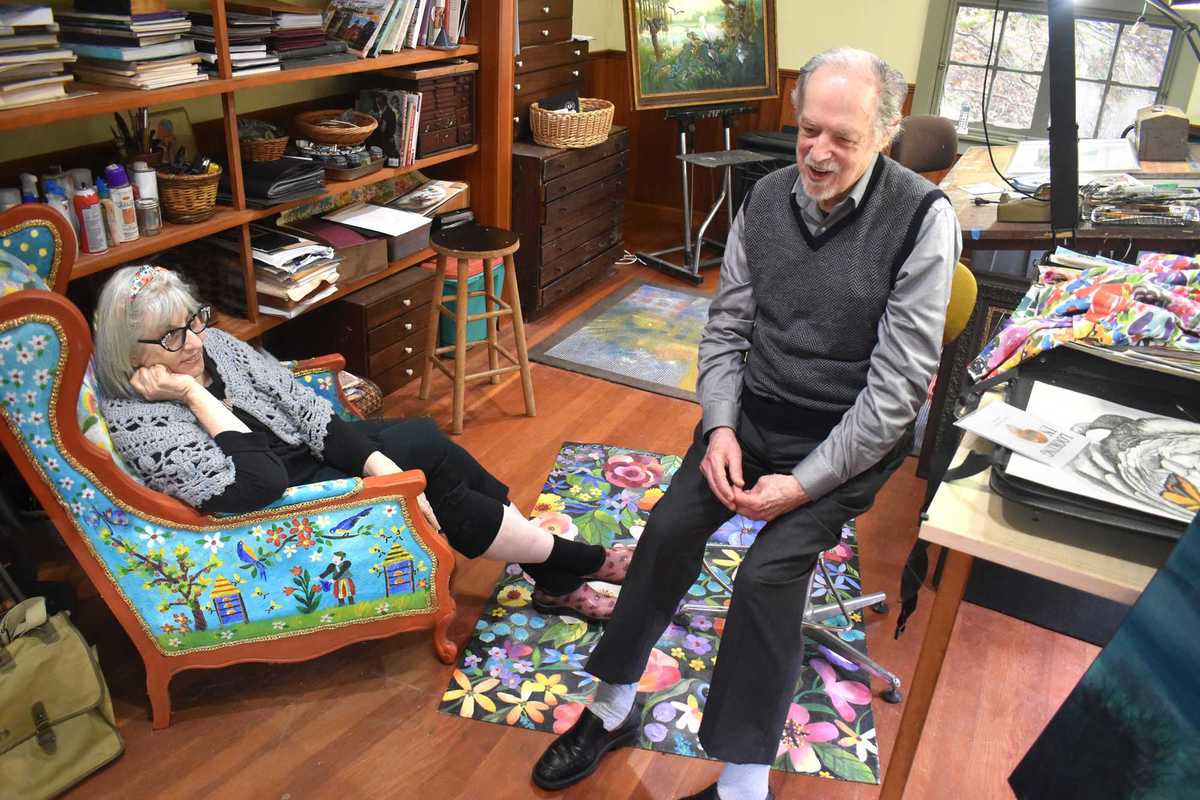
Artist Peter Gerakaris in his studio in Cornwall.

Provided

Opening Jan. 17 at the Cornwall Library, Peter Gerakaris’ show “Oculus Serenade” takes its cue from a favorite John Steinbeck line of the artist’s: “It is advisable to look from the tide pool to the stars and then back to the tide pool again.” That oscillation between the intimate and the infinite animates Gerakaris’ vivid tondo (round) paintings, works on paper and mosaic forms, each a kind of luminous portal into the interconnectedness of life.

Gerakaris describes his compositions as “merging microscopic and macroscopic perspectives” by layering endangered botanicals, exotic birds, aquatic life and topographical forms into kaleidoscopic, reverberating worlds. Drawing on his firsthand experiences trekking through semitropical jungles, diving coral reefs and hiking along the Housatonic, Gerakaris composes images that feel both transportive and deeply rooted in observation. A musician as well as a visual artist, he describes his use of color as vibrational — each work humming with what curator Simon Watson has likened to “visual jazz.”

Keep ReadingShow less