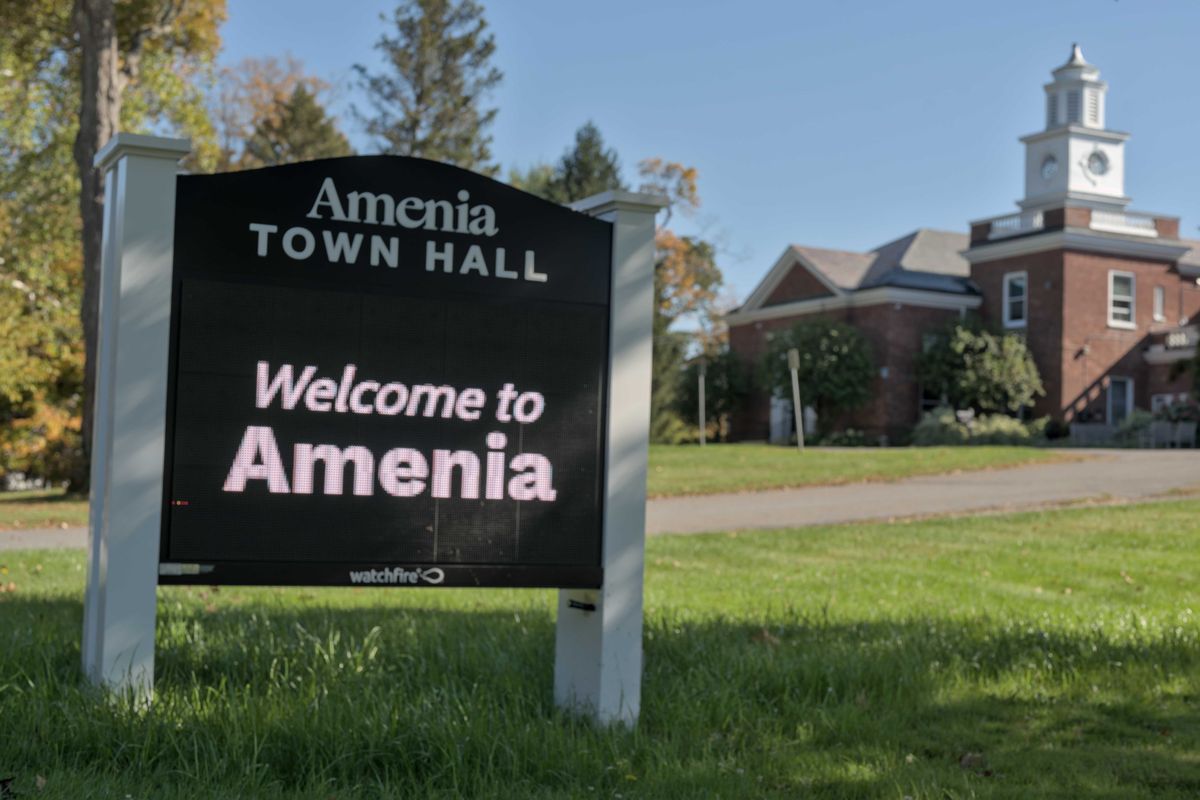
Amenia decides against pursuing grant, avoiding park-land forever status

Amenia Town Hall
John Coston

Amenia Town Hall
AMENIA — Nine resolutions were considered at the regular meeting of the Town Board on Thursday, June 6, with eight winning unanimous approval, but one failing to pass by a vote of 3 – 2.
The failed resolution would have permitted the Parks and Recreation Department to apply for a grant from the Environmental Protection Fund within the Parks, Preservation and Heritage program, a state-administered fund.
Early in the meeting, Town Supervisor Leo Blackman indicated his intention to oppose making that application that, if awarded and accepted by the town, could provide funding for the Amenia Green project described in a Master Plan to enhance the property surrounding the Town Hall for recreational use.
As explained by Blackman, the grant program administered by the state parks system, would require that that parcel of town land would need to remain park land forever. He believes that the edges of the Town Hall parcel might one day be built upon as the commercial center might grow.
Blackman also indicated that residents should have more opportunity to consider the Amenia Green project design. Although public information sessions have been held in recent years with the landscape architect, he was concerned that attendance at those sessions was light.
When the resolution came to a vote later in the meeting, in addition to Blackman’s negative vote, Councilmembers Rosanna Hamm and Nicole Ahearn also voted against it.
Hamm expressed her concern for the major projects coming before the town that would need bonding to complete, including the new Town Garage, the water district and the wastewater project, and the potential for expense to upgrade Beekman Park’s concession stand and septic system.
The cost for a grant writer to complete the application was also a concern.
“I feel that the town is jumping the gun on an application without a firm grasp on the details,” said councilmember Ahearn, explaining her reluctance to favor the resolution.
The other eight resolutions earned unanimous approval to move ahead on several initiatives.
The North East Community Center (NECC) will expand its services and have an office at the Town Hall, offering local residents a more convenient way to access those services.
Town Attorney Ian Lindars explained that the NECC will provide social services, including possible after-school or senior programs, and the NECC will reinstitute the Friday night Farmers’ Market program.
Also approved unanimously was an expense of $5,000 to fund an evaluation of the Beekman Park septic system, to be done by Crawford and Associates Engineering and Land Surveying.
Councilmember Paul Winters said that the study will create a drawing of the septic system, noting that in the 1970s the Amenia Lions Club had built the concession stand but no drawings exist. He reported that for many years, recreation programs were all volunteer driven.
Zoning text to regulate cannabis distribution will be drafted by AKRF Environmental Planning and Engineering Consultants at a cost of $12,500. The zoning regulation amendment being drafted would regulate the sale of cannabis in the town.
Design and engineering services for a new Town Garage and salt storage facility took a step ahead as the Town Board voted unanimously to seek proposals for those services. Those proposals will be due by July 25.
The Amenia Green project to enhance the property adjacent to the Town Hall also moved ahead with a resolution to accept the Master Plan prepared by Didona Associates.
Councilmember Paul Winters explained that the Amenia Green project planning began two years ago and that the Recreation Department has spent $20,000 to create the Master Plan at no expense to the town. He recalled that three public information sessions were held to collect input from residents.
To Councilmember Hamm’s question about whether the Master Plan can be altered, Winters replied that the plan as written presents multiple options. Hamm was concerned about the drainage plans in relation to the wetland areas.
“When you displace water, it has to go somewhere. What kind of soil would be brought in,” Hamm asked.
“I’m impressed with the document generally,” Blackman said, but he felt that it does not indicate that there will be a public presentation.
Other resolutions allowed for funding for the Amenia Green design and construction documents, the next step in the project. $15,000 will be transferred from the Cell Tower revenue fund to pay architects’ fees. Added to that amount will be the town’s acceptance of a gift from the Amenia Wassaic Community Organization in the amount of $75,000, earmarked for the Amenia Green project’s design and construction document preparation.
With the funding resolutions approved, the Town Board voted unanimously to hire Didona Associates to complete the design and construction plans for the Amenia Green project at a cost of $89,500.
Councilmember Hamm asked whether any additional fees would be likely.
“Recreation has gotten this far without asking for funds. Recreation will pay for anything additional,” councilmember Winters replied.
Nathan Miller

Caroline Farr-Killmer has been leading the effort to rebuild Millerton’s fire-ravaged Water Department building since last February.
MILLERTON — Village officials expect a rebuild of the fire-ravaged Water Department building to begin soon, with the aim of completing it before the end of summer.
Fire project manager Caroline Farr-Killmer has been managing the effort to demolish and rebuild the village’s Public Works Department building since a fire destroyed it and all the equipment inside last winter. She said that Dutchess County Department of Health approval is the last hurdle for a new Water Department building before construction can start.
Millerton Mayor Jenn Najdek said she expects construction to start as soon as the designs get approval from the health department.
Officials described the new Water Department building as an urgent need. Farr-Killmer explained the village’s water system has been operating with just one operational well, causing concerns about potential water shortages at that wellhead and its longevity. The village cannot operate the second well until it is enclosed in a structure, Farr-Killmer said.
Najdek doesn’t expect Millerton’s upcoming 175th anniversary celebration to impact the construction. She said health department approval should be arriving within the week, and the 400-square-foot building likely wouldn’t take long to construct. She clarified that there is no clear timeline at this moment, but expects to get work started as soon as approvals come in.
Millerton’s Water and Highway building caught fire last February, destroying the structure and all of the village’s road maintenance and police equipment. Since then, property restoration firm BELFOR has been working to clear and prep the site for a brand new set of buildings.
Farr-Killmer explained the Water Department building, which will house one of Millerton’s municipal wells, must now be a separate structure from the Highway Department building due to environmental and health regulations. Municipal wells require up to a 200-foot buffer from other structures to prevent drinking water contamination.
Millerton News
CANAAN — Anita L. (King) Gochey, 85, of 77 South Canaan Rd. died June 5, 2026, at Geer Village. She was the wife of the late Lester Gochey. Anita was born July 16, 1940,in Winsted, daughter of the late Ivan and Irene (Dulude) King.
Anita was well known throughout the Northwest Corner. She worked for many local businesses and organizations. Anita worked at the Rexall Drug Store, C.A. Lindell and Sons, Bob’s Clothing, Brooks Pharmacy, and the Housatonic Valley Regional High School in the cafeteria.She used her skills in calligraphy to complete the record books for the North Canaan Congregational Church.Anita’s daughter remembers her as being very creative with cardboard, and a loving mom.
Anita is survived by her son Raymond Gochey and his fiancee’ Chris Filkins of Hinsdale, Massachusetts; and her daughter Michele O’Brien of Sharon. She is also survived by her sister Denise Warner of Torrington and her brother Arthur King of Danbury. Her three grandchildren, Kyle Gochey of Pittsfield, Massachusetts, Cody O’Brien of Georgia, and Sabrina O’Brien of Falls Village. Anita was predeceased by her brother, Martin King.
A Celebration of Anita’s life will be held on Saturday June 20, 2026, at 2:00 p.m. in the Newkirk-Palmer Funeral Home 118 Main St. Canaan, CT 06018.
Nathan Miller
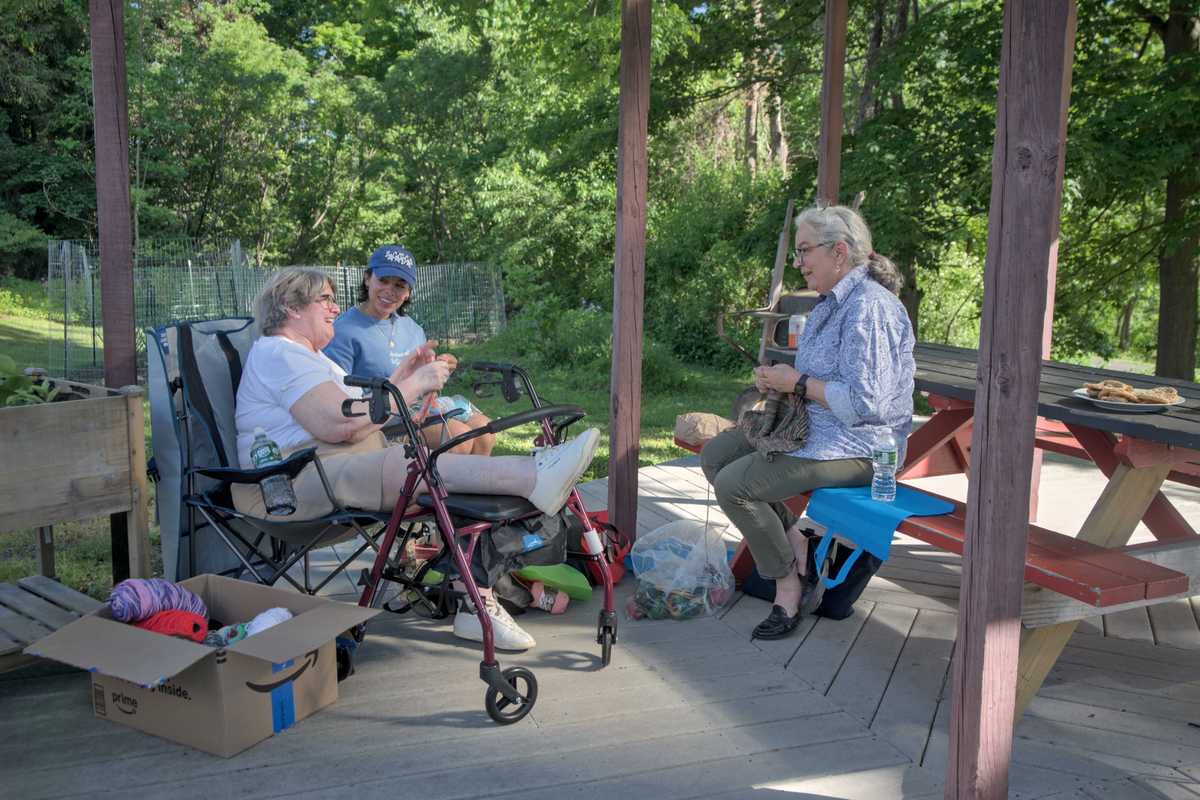
Carol Kneeland, left, Cyndhia Valle, center, and Irene Banning knit together on North East Community Center’s back porch during the first “Community Porch Party” on Wednesday, June 3.
MILLERTON — A new pilot program at the North East Community Center aims to bring in community members for chill hangs at the nonprofit’s office on South Center Street this summer.
The weekly “Community Porch Party” is an evolution of senior administrative assistant Ash Baldwin’s “Craft Collective,” which invited community members to enjoy a group crafting session where participants were encouraged to bring individual projects, swap tips and be together. The gathering on Wednesday, June 3, and the preceding “Craft Collective” meetings are part of a broader effort to provide accessible, community-building programming.
The pilot program is set to run every Wednesday through the end of July.
NECC board chair and interim Executive Director Irene Banning joined Baldwin along with Millerton resident Carol Kneeland and Pine Plains resident Cyndhia Valle at the program’s opening night. Kneeland brought enough knitting needles and yarn to go around, and taught Valle how to get started making a knitted square.
“She’s a total pro of 40 minutes,” Kneeland said, knitting needles in hand.
Banning said the community center is working to return to a former status as a community hub. She remembered the COVID-19 pandemic as a turning point for the organization, when it shifted to providing crisis management programs such as its food pantry and housing assistance.
While those programs are still important to NECC’s mission, Banning said, community building is equally so.
She recalled needing an outlet for social interaction when her son moved away from her home, prompting her to find a knitting group based out of Pine Plains.
“One day I just picked up my knitting and I decided to go,” Banning said. “It’s been a fabulous thing.”
The “Community Porch Party” is less focused on the crafting, and instead on just providing an opportunity for people to enjoy a nice yard and a chat with fellow community members. Baldwin and Banning assembled sweet treats and snacks for people to eat, and crafters are encouraged to bring a project but it’s not required.
The effort stems from a recognition that social interaction can be difficult to come by in northeast Dutchess County.
“It’s so hostile out there, and you always have to be careful about what you say or what you don’t say,” Banning said. “Just to have a place where that doesn’t matter is really nice.”
NECC’s “Community Porch Party” is set for Wednesdays from 3 p.m. to 5:30 through July 29.

Want more of our stories on Google? Click here to make us a Preferred Source.
Graham Corrigan
PINE PLAINS — Community Day returns to Pine Plains on June 13, reviving a tradition last celebrated in 2023 during the town’s bicentennial celebration.
The event’s return has been spearheaded by an ad hoc group of residents led by Lenora Champagne, Jeanne Valentine-Chase, Lisa Agnelli, Joan Taylor, Helene Marsh and others.
Champagne and Valentine-Chase, who are on the town’s Beautification Committee, said they recruited volunteers to help organize it, realizing that Community Day is a big undertaking. “It was clearly a bigger project than what that committee could take on,” said Champagne. “So we turned to people who’d been involved in previous Community Days.”
The community was up to the task. Some of the entertainment will be familiar: live music will fill the air, local businesses and nonprofits will set up booths along Main Street, and the Graham-Brush House will host fiddlers and reenactments.
New additions to Community Day abound, too: a 31-vendor market will set up shop by the Catholic church on Poplar and Church Street. The market will host makers offering sourdough bread, artisanal jewelry, and everything in between. The Pines, a historic Victorian inn on Maple Street, will open its doors for tours as well.
This year’s Community Day is also offering an eye-popping amount of complimentary experiences, for kids and adults alike. First there’s a free breakfast hosted by Pine Plains Fire Company. Free raffle tickets are on offer, with the chance to win prizes like gift certificates to local businesses like Chaseholm Farm and Factory Lane Automotive — or fruit trees donated by Full Circus Farm. There’s a free scavenger hunt to work up an appetite, and free lunch from local restaurants to sate it — all chased down with a postprandial stroll through the free corn maze.
“There ought to be something of interest for everyone,” Champagne said. “We’re really curious to see what people enjoy.”
Town Councilwoman Jeanine Sisco is the group’s liaison to the town. She’ll also be the one “collecting garbage and schlepping benches.”
“We did Community Day for years,” Sisco said. “But sometimes people just didn’t step up. We’re hoping this will be the start of doing it every year.”
The goal, Sisco says, is to bring people in to town. All the people: generational locals and weekenders alike. “We want to bring all those folks into a united venue to get to know what’s going on in town, and revitalize the spirit of community.”
Leila Hawken
AMENIA — The Water Committee is exploring options to allow municipal water customers to pay their bills online and by credit card.
Responding to customer interest in additional payment options, the committee discussed potential billing software upgrades during its regular meeting Wednesday, June 3.
Town Billing Clerk Nancy Nowak presented information from Muni-Link of Bellwood, Pennsylvania, a cloud-based billing company that serves municipal utilities.
“This software is so much better,” Nowak said. “It is similar to what we have now, but it’s easier.”She added that the company works with four credit card processors.
Initial set-up cost for the system is estimated at $12,000, Nowak said, with an additional monthly charge of $650. Current administration costs for billing stands at $138 monthly for the town.
“But you would be getting twice as much service,” said Water Committee chairman Bill Flood, comparing the proposed streamlined billing system to the present one.
Nowak had explained that the current system provides limited account management capability, leaving much input to be done by hand. She reported also that over the years, customers have asked for the convenience of emailed billing and on-line payment.
For those water district customers who lack computer capability or who prefer to pay in person, there would still be the option for mailed billing.
The committee agreed to continue to explore the option, gathering additional information, before presenting a proposal to the Town Board.
In other discussion, Flood announced that the prefabricated pump house building is expected to be installed at the Lavelle Road site in the fall. The foundation is ready to accept the new structure.
A program to replace non-working water meters is progressing with VRI Environmental Services, the town’s water operator, having sent out 20 postcard notices. In response so far, 13 meters have been replaced.
In final action, the Water Committee agreed to meet quarterly, rather than the current monthly schedule. Special meetings will be scheduled as needed.
Millerton News

SHARON — Susanne Cecilia Berberoglu, beloved wife, mother, grandmother, and friend, passed away peacefully on May 14 surrounded by the love of her family.
Born on Fe 13, 1951, in New Milford, Susanne lived a life filled with warmth, adventure, compassion, and dedication to those she loved.
A graduate of Brookfield High School, Susanne went on to work as a travel agent, a career perfectly suited to her adventurous spirit and love of discovering the world. She especially cherished her travels to Australia, London, and Hawaii, creating memories that she carried throughout her life.
Susanne had a lifelong passion for antiques and found joy in collecting and appreciating beautiful pieces filled with history and character. She was also deeply devoted to her beloved Boston Terriers, whom she lovingly raised and cared for over many years. Her home was always filled with warmth, laughter, and the companionship of the dogs she adored.
Above all else, Susanne treasured her family. She is survived by her devoted husband of 54 years, Tayfun Berberoglu Sr.; her loving daughter, Jennifer; her son, Tayfun Berberoglu Jr.; and her cherished granddaughters, Faora and Sybella. Her love, kindness, strength, and gentle spirit will forever remain in the hearts of all who knew her.
Susanne will be remembered for her caring nature, adventurous soul, and unwavering love for her family, friends, and animals. Her memory will continue to inspire all whose lives she touched.
The Kenny Funeral Home has care of arrangements.
Want more of our stories on Google? Click here to make us a Preferred Source.
Want more of our stories on Google? Click here to make us a Preferred Source.