Thank you!
Your support is sustaining the future of local news in our communities.

The many voices of “A Jericho’s Cobble”

The many voices of “A Jericho’s Cobble”

Author Tom Schachtman

Patrick L. Sullivan

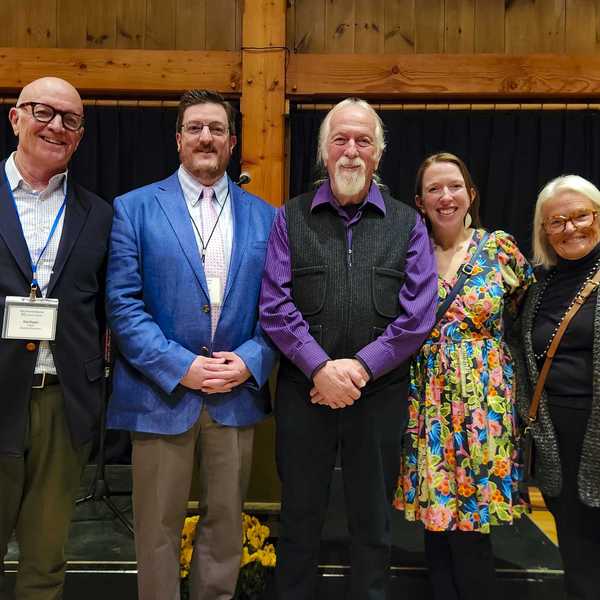
Tom Shachtman read from his new book, “A Jericho’s Cobble Miscellany,” at the Scoville Memorial Library on Sunday, May 17.

Shachtman and Harriet Shelane read excerpts from the points of view of an 18th-century settler in the wilds of New England, a contemporary high school senior who cannot wait to get herself out of town, a Native American sachem and an upright piano.

The book tells the story of a fictional New England village that Shachtman said he imagines as being about 20 miles east of Great Barrington.

It is a tale told through several genres: fiction, newspaper stories, oral histories, poetry, plays and emails.

Shachtman said he was inspired by Edgar Lee Masters’ “Spoon River Anthology,” in which small-town Americans’ stories are told in free-verse form by the deceased.

“I thought it was a wonderful idea, but I didn’t want everybody to be dead.”

Shachtman said there are more than 100 distinct voices in the book and that he began with 50 to 100 pages of notes on all sorts of topics.

“It’s not one story. It’s many stories. That’s why it took five years.”

Shachtman was asked how closely Salisbury resembles Jericho’s Cobble.

“Of course there are similarities. I’ve lived here for 30 years.”

He said certain stories in the book, such as an arson attack at the Town Hall and the transformation of the local weekly newspaper from a for-profit to a nonprofit, have obvious local precedents.

“But these are not unique to us,” he added.

About that upright piano: Shachtman paused before reading that particular excerpt and looked at the audience.

“Not all the speakers are living or dead. Some are inanimate objects.”

He then read “An Upright’s Lament.”

“I haven’t been seriously caressed in a long time,” the passage begins.

The piano, a 1903 Hamilton, goes on to say it has been relegated to “the seldom-used back dining room of the Grey Griffon Inn with its fading wallpaper.”

“In my heyday, when many people still knew how to play a piano, I was the focus of attention in the pub, where late of an evening, after enough alcohol had been downed, there would always be someone opening me up and striking my keys, to general enjoyment.”

But times have changed, and the piano is not optimistic.

“I fear the coming winter’s continuously roaring fires in the inn’s many fireplaces: Their dry heat will wick away the last bit of moisture from my woods, leaving me fit only for the garbage heap and the lumber pile.”

Latest News

Libraries, Town Halls open as cooling centers during heat wave

North East Town Hall will be open on Thursday, July 2, for people who need a cool place to sit and sip water. The Town Hall is located at 19 N. Maple Ave. in Millerton.

Photo by Aly Morrissey

Community cooling centers are opening across Dutchess County as extreme heat brings temperatures into the high 90s.

Many libraries, town halls and community facilities are serving as cooling centers, offering air-conditioned spaces, drinking water and restrooms. Temperatures are expected to reach triple digits in some areas of the county this week.

Keep ReadingShow less

The nature of Upstate Art Weekend

The nature of Upstate Art Weekend

On Thursday, June 25, a collection of eager art enthusiasts gathered at Olana State Historic Estate in Hudson to kick off the seventh annual Upstate Art Weekend (UAW).

Helen Toomer, founder, was joined by sculptors Ellen Harvey, Jean Shin and Gabriela Salazar to discuss their work and the legacy of painter Frederic Church. Church, whose 200th birthday is being celebrated this year, is widely credited as one of the founding members of the Hudson River School of painting. The discussion took place at Olana, Church’s grand estate, where the three artists’ installations are on view.

Keep ReadingShow less
google preferred source

Want more of our stories on Google? Click here to make us a Preferred Source.

Benjamin Reynaert and the art of layered living

Benjamin Reynaert

Jennifer Almquist
Creating a home is, at its core, an act of love.
— Benjamin Reynaert

Benjamin Reynaert is focused on creative direction and interior styling. He is market director at Elle Décor, a design consultant, and author of “The Layered Home: Inspiration for Crafting Cozy, Collected Rooms,” published this year by Clarkson Potter. He co-founded Ticking Tent, a market featuring antiques, luxury items and vintage treasures. The biannual event is held in New Preston, Connecticut, and Bedford, New York.

Adopted from South Korea at 3 months old, Reynaert grew up in Bloomfield Hills, Michigan. He always knew he wanted to be an artist. “I just loved drawing. I loved making things with clay,” he said. “Remembering what it felt like to be creative as kids and applying that to our creativity as adults is essential.” A graduate of the Rhode Island School of Design (RISD), where he earned a BFA and a degree in architecture, Reynaert also studied bookbinding in Rome. His attention to detail and aesthetic sense reflect years of training and a finely tuned eye for objects. “Attending RISD nurtured my creativity and taught me how to problem-solve,” he said.

Keep ReadingShow less
Beneath the surface: Delano Dunn and Mickalene Thomas explore history, memory and art

Mickalene Thomas and Delano Dunn at Wassaic Project.

Lucia Landolo

Before “Echoes in the Margin,” Delano Dunn’s new solo exhibition at Troutbeck in Amenia opened, the artist sat down with curator and artist Mickalene Thomas for a conversation at the Wassaic Project on Wednesday, June 24. Their wide-ranging discussion offered an intimate look into Dunn’s practice while situating the work within broader questions of history, memory and representation.

Presented by the Wassaic Project, the exhibition brings Dunn’s richly layered paintings into conversation with Troutbeck itself, the historic estate long associated with artists, writers and civil rights leaders, including W.E.B. Du Bois, Langston Hughes and many more.

Keep ReadingShow less
After a Hollywood career, Scott Siegler turns failure into fiction

Scott Siegler at his home in Sharon.

D.H. Callahan

Scott Siegler is bored of success stories. But Scott Siegler has had the kind of successful Hollywood career that people write books about.

Before he was 30, he’d earned three degrees. Before he moved to Hollywood, he’d already won an Emmy for one of the nine documentaries he directed and produced. Before he helped launch Netscape, bringing the Internet to the public, he’d already started his own Hollywood studio.

Keep ReadingShow less
google preferred source

Want more of our stories on Google? Click here to make us a Preferred Source.

google preferred source

Want more of our stories on Google? Click here to make us a Preferred Source.