AMENIA — A proposed 26-home affordable housing subdivision has drawn opposition from nearby residents, who have rallied others from across town against the plan.
Hudson River Housing’s Cascade Creek proposal calls for 26 single-family homes on lots ranging from 0.28 to 0.41 acres. The site is across Route 22 from Old North Road, near Freshtown Plaza. The homes would be sold to qualifying moderate-income buyers.
Over more than four years, Hudson River Housing has pursued plans to build homes in Amenia. Supporters say Cascade Creek would expand access to homeownership in a town where the median home sale price has risen about 90% since 2018, outpacing inflation and wage growth in Dutchess County. Opponents have questioned how the subdivision would fit into the surrounding neighborhood where the standard residential lot is significantly larger, and raised concerns about its environmental impact, including potential effects on nearby wells.
Amenia’s workforce housing provisions allow developers to build more homes if they meet federal and state affordability standards. The Cascade Creek proposal also qualifies for additional homes because more than half of the 24.13-acre site would be protected by conservation easements.
Some supporters say the opposition reflects stereotypes about affordable housing and the people who rely on it. Leo Blackman, a former Amenia town supervisor and longtime affordable housing advocate, said he was disappointed by the neighbors’ opposition.
“It’s crazy that that’s still so deeply embedded in people’s heads,” Blackman said. “It makes me very, very angry because I have been working on affordable housing in this area as part of the Tri-Town Coalition for a long time.”
Several opponents said they recognize the need for affordable housing but questioned whether the project needed 26 homes to be financially viable. Ashley Merritt, who lives near the site with her husband, Kenny, said they would support a smaller development.
“We do need affordable housing, we know that’s an issue,” Merritt said. “It’s the amount of houses that are in that property. If they came back and said 15 to 20 houses, we would be OK with that.”
Under Amenia’s zoning code, the Planning Board must approve both a preliminary and a final plan for a major subdivision such as Cascade Creek. Hudson River Housing has been working toward preliminary approval since December 2024. The board opened a public hearing Oct. 29, 2026, and voted to keep it open after hearing from neighbors Nov. 12, citing significant public interest.
Hudson River Housing and project engineer Peter Sander of Rennia Engineering say the public record addresses most of the concerns raised. They say some questions, particularly those about neighboring wells, require testing that would follow preliminary approval. Opponents say the developer has yet to do enough to address their concerns.
Density concerns
Chief among neighbors’ criticisms is the total number of units — Hudson River Housing is currently pursuing approval for 26 homes, down from 28 after the developer reduced the number of units in June following comments from the public and Planning Board members.
Critical neighbors have balked at that reduction, saying just two fewer houses still isn’t reasonable for the neighborhood. The Merritts drew comparisons to the homes along Cascade Road, which borders the development site’s western side. Single-family homes along that road sit on parcels ranging from 0.34 to 2 acres. They said the Cascade Creek lots, which are mostly 0.28 acres, would be too small.
Ashley also called attention to the bucolic views of the hay field that currently occupies the site. The loss of agricultural land has been a chief concern among many critics, among them Mygatt Road resident Bobby Powell. He said he moved to Amenia in the ‘80s from Brewster to escape suburban sprawl and enjoy a life in the countryside. The Cascade Creek development reminded him too much of communities he said he moved here to get away from.
“I would like to keep the community the same way I moved in. It’s a nice place,” Powell said. “It’s happening all over the country where they’re trying to force low-income housing in places where people don’t want it.”
Still, Powell and the Merritts said they aren’t wholly opposed to homes. They, along with other neighbors, said the site did make sense for houses, but the developer should bring the number of homes down and the lot sizes up to fit in more with the surrounding neighborhoods.
Sander and Hudson River Housing President of Real Estate Development Mary Linge have spoken about the number of homes in the project at multiple Planning Board meetings, saying repeatedly that reducing the number of houses would break the economics of the project.
Sander directly addressed concerns over the number of proposed lots at a Nov. 12, 2025, Planning Board meeting. He said that a reduced number of lots would be infeasible because of cost and environmental impacts.
Sander said a smaller number of houses would reduce the pool of homeowners paying into the shared maintenance costs for the common well and septic system, driving up each individual homeowner’s HOA fees. Reduce the number of lots too much, Sander said, and the developer would have to install individual wells and septic systems for each lot. A change like that would dramatically increase the environmental impact of the development, costs to build and individual homeowners’ costs.
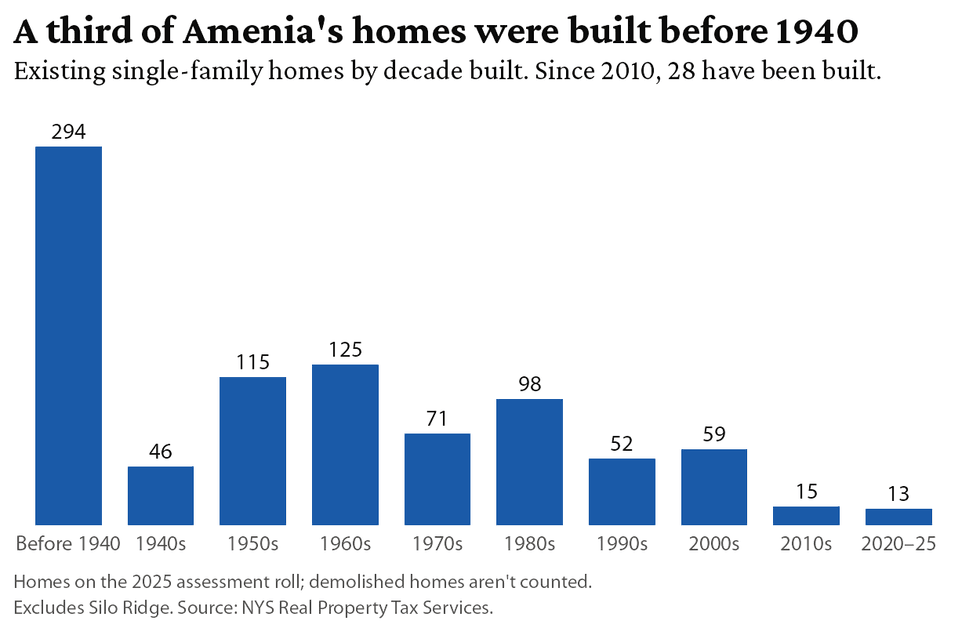 Illustration by Nathan Miller
Affordable housing in Amenia
Those claims have drawn further scrutiny from critics. They questioned how the homes could be sold for affordable prices at all after the cost of construction, calling attention to significant price jumps in building materials over the past two years the plans have been in the discussion phase.
Ashley Merritt said she was discouraged by a lack of financial transparency surrounding the project. She didn’t believe the homes would be capable of benefiting cost-burdened buyers, and questioned whether there was a demand for new single family homes in the real estate market.
She used her coworkers in the medical field as an example. She said many healthcare professionals she knows are looking for rentals rather than to purchase a home, and that salaries in the area don’t pay enough to attract people, let alone afford homeownership.
“We can’t get providers to come to this area because they can work somewhere else and make more money,” Ashley, who works to recruit doctors and nurses as part of her job at a healthcare facility, said. “Or it’s those that are stuck making $17.25 an hour and they can’t afford it so they’re not looking to purchase. They’re looking for a decent rental.”
Blackman pushed back on that assertion. He said home construction in Amenia has slowed, and many employers told him during his tenure leading town government that they struggled to hire people because of a small hiring pool exacerbated by high housing costs.
Blackman worked over the course of years to bring affordable housing development to Amenia, helping lead the Housing Board during its revival in 2019. Blackman and other Housing Board members helped form with Hudson River Housing the Tri-Town Coalition in 2019 — a collaborative effort between the nonprofit and Pine Plains, Amenia and Millerton housing advocates to bring more affordable housing to northeast Dutchess County.
“Working class people cannot afford to buy a house,” Blackman said, continuing on to say that rising prices have displaced many people he knows who grew up in the area but couldn’t afford to stay. “My neighbors who grew up here have gone into great depth about how their grandchildren, their children had to leave because there was no place for them to live.”
Hudson River Housing’s Mary Linge has said that the subdivision will target homebuyers earning up to 80% of Dutchess County’s area median income, a figure set by the U.S. Department of Housing and Urban Development. HUD’s 2026 fiscal year 80% AMI figure for Dutchess County is $100,700 for a four-person household.
The proposal’s project narrative, available with application documents on the town’s website, details a mix of New York State subsidies, grants and borrowed funds that will pay for the development. The housing project is being developed as part of the New York State Department of Homes and Community Renewal’s Affordable Homeownership Opportunity Program.
That program provides state funding and backs mortgages for home buyers in housing developments that meet state and federal affordability standards. Under those standards, a home must be priced such that annual costs — including mortgage payments, insurance, Homeowners’ Association fees and maintenance among other costs — don’t exceed 30% of a household’s gross income.
To meet those standards, Sander said, the builders have to be mindful of the shared costs of infrastructure maintenance. Too few homes and it becomes impossible to build the subdivision at a reasonable cost and even the homes themselves fail to meet affordability standards.
“We believe that consolidating utilities in one spot and also dispersing those maintenance costs really do benefit the community as a whole,” Sander said at the November 2025 meeting.
At more recent meetings Sander clarified that position, saying that ultimately the number of homes in the project is dependent on water availability. At a June 10, 2026, Planning Board meeting, he said county Board of Health testing could determine that the available water on site won’t support 26 houses. If that were to happen, he said, Hudson River Housing would have to rethink the scale of the project before seeking further approval.
Impacts on water
Alan Peck, who lives on Cascade Road in a property that’s adjacent to the subdivision site, has been most vocal about the proposal’s potential impact on his private well. He said Sander’s assurances that water impacts will be thoroughly studied aren’t satisfactory.
He doubted the planned test wells’ ability to accurately determine the impacts on groundwater in potential drought conditions, saying the proposed 72-hour test period wouldn’t produce enough data to draw appropriate conclusions. Peck said he doesn’t think he should be responsible for the cost to redrill his well if the subdivision reduces his water availability.
“If they put those wells in and mine goes dry, the town is not going to do anything to help me and HRH is not going to do anything to help me,” Peck said. “If HRH gets approval on this project the minimum they could do is guarantee the surrounding wells for 10 years.”
Sander said he won’t have clear answers about the proposal’s water impact until after the Planning Board grants preliminary approval, and that the plans for the subdivision won’t be set in stone even after the Board of Health approves water and septic plans. The proposal will have to go back to the Planning Board following that testing, according to Amenia’s subdivision code, which will have the authority to either grant final approval or reopen environmental review depending on how the plans had changed.
During the June 10 meeting, prior to the reduction from 28 units to 26, Planning Board members pressed Sander and Linge on potential water test results and assertions that the project’s economics break with reduced numbers of houses. Board member Jamie Vitiello asked what would happen to the project as a whole if Board of Health testing determined the site’s water capacity wouldn’t support the number of homes that Linge and Sander say are necessary to make the economics work.
“If the wells don’t support 28 houses, is this binary?” Vitiello asked. “Is this truly binary, 28 homes or it’s nothing?”
Sander and Richard Rennia, the principal engineer and founder of Dover-based engineering firm Rennia Engineering Design, said the project wouldn’t necessarily be abandoned if the water capacity required a reduction in the number of homes.
“Say if the water comes back that it supports 23 houses, then Hudson River Housing would have some big decisions to make,” Rennia said. “It could be 23 lots, it could be something completely different.”
Sander responded to those concerns again at the most recent public hearing on Nov. 12. “We are also eager to make sure that there is an adequate water supply on the site for our subdivision and the community,” Sander said. “At this point, there are no other insurances that we can provide to the board or the public regarding water. We cannot drill test wells or monitor effects on neighboring wells until we receive sign-off from the Health Department — and that can only happen if the Planning Board grants preliminary subdivision approval.”




 White plates for the win! The food will be the star while seasonal herbs make for fragrant decor.Kerri-Lee Mayland
 Shop the house! A favorite bowl or pitcher from your travels, a ceramic bowl your child made, use a wooden vessel for fruit that can become part of the centerpiece.Kerri-Lee Mayland
 Thrifted mismatch! Gather unique unexpected things and cluster them for a fun centerpiece.Kerri-Lee Mayland

 Paul Chaleff in his studio with some recent ceramic sculptures.Annette Stover


 Provided