NORTH EAST — New York joined 19 other states across the U.S. this March when it legalized adult-use recreational marijuana through the Marijuana Regulation and Taxation Act (MRTA), making it permissible for New Yorkers to roll up a joint for pleasure and not just use cannabis for medical necessity, as had previously been the case. Now it’s up to local municipalities to decide if they will also allow the psychoactive drug to be sold within their borders and if they will likewise allow lounges, similar to bars that sell liquor.
On Thursday, July 29, North East town Supervisor Chris Kennan talked about the issue with this newspaper.
“The thing that is coming up, which will be public, is the town has to make a decision as to how it’s going to approach the recently enacted state law regarding cannabis,” he said. “It is going to happen not just here, but in other towns. Because of the way it’s structured, I think we’re going to hear a lot about it now.”
Kennan continued to say that “the town has a decision to make whether it wants to permit cannabis dispensaries in town and whether it wants to permit on-site cannabis consumption, otherwise known as lounges, which are two separate things.”
He clarified that one can happen without the other.
“My hope is to find a way to engage the public in a discussion of what we would like to have in the town,” added the town supervisor. “That may be some kind of a forum. Other towns have asked people to write in or fill out online polls, those maybe possibilities as well.”
According to the MRTA, municipalities have the ability to opt in or opt out of having dispensaries and/or lounges in their communities. They will need to pass local laws by the governor’s Dec. 31 deadline to do so. Municipalities that opt out of allowing either dispensaries or lounges (and they can opt out of one or both), can opt back in down the line.
Governor Andrew Cuomo’s end-of-year deadline is putting the pressure on municipalities, which is why many towns and villages are placing the issue on their agendas for their August board meetings.
If municipalities miss that Dec. 31 date and take no action before then, noted Kennan, they cannot decide to opt out after that point.
In his Aug. 4 community-wide newsletter email, Kennan noted, “Since this end-of-year deadline is closer than we all might think, this is something the town needs to consider and decide in the near future.”
Kennan further noted that “cannabis sales will be subject to a 4% local sales tax, of which municipalities will retain 75%.”
To get local input, and to share what the North East Town Board knows about the new law and how it might apply in the village as well as in the town, Kennan is planning to co-sponsor a town forum with Millerton Mayor Jenn Najdek. More details will be published as soon as they become available; details can also be found at www.townofnortheastny.gov and at www.villageofmillerton.net.
Meanwhile, Pine Plains town Supervisor Darrah Cloud and her Town Board are dealing with exactly the same issue this month as well. She also updated her community via her weekly newsletter email, Dear Pine Plains, on Friday, July 30.
“It’s time to talk about the new Marijuana Law,” she wrote. “We are being pressured by the governor to make a decision quickly on what we want to allow to happen in town as regards sales and use… In a nutshell, the town has to make a decision as to whether or not to allow marijuana to be a.) consumed in specifically licensed places [the way bars do alcohol]; and b.) sold in a dispensary, which would be regulated exactly like our liquor store. Our zoning would regulate where and what hours these entities would be open.”
Cloud noted sales tax collected on marijuana will be regulated at about 9%, with 4% given back to the town.
“The Town Board would like your input on this subject,” she added, along with referencing a PowerPoint presentation prepared by the Association of Towns attached at the bottom of the July 30 newsletter. “At the very least, for now please write to me at supervisor@pineplains-ny.gov and give me your 2 cents. I will collect the emails and pass them along. Please stay tuned for further news on this.”
The issue promises to be on the board’s August agenda.
The Amenia Town Board plans to discuss the MRTA at its Aug. 19 meeting, according to town Supervisor Victoria Perotti, who shared with this paper that the topic will be on that night’s agenda, although she gave no further insight on any details about how the town plans to handle the matter. For more information, go to www.ameniany.gov.
Residents, though, are encouraged to attend the August Town Board meeting to learn all they can about the whether recreational marijuana could one day be legally sold and smoked on the streets of Amenia.
In nearby Millbrook, Village Clerk Sarah Witt confirmed the Village Board “plans to discuss the marijuana law at our August meeting; the agenda will be out on Monday, Aug. 9. There has been no real discussion about it, so I don’t know their position on it yet. If they decide to go the Local Law route, they will automatically hold a public hearing.”
The Millbrook Village Board meets next on Wednesday, Aug. 11, from 6 to 8 p.m. at the Millbrook firehouse at 20 Front St. If necessary, a second monthly meeting will be scheduled. All village meetings are now being held in person at the firehouse to allow for social distancing. More information about meetings can be found at www.villageofmillbrookny.com.
The Town of Washington is also planning to address the MRTA at its August meeting, on Thursday, Aug. 12, at 6 p.m., according to Town Clerk Mary Alex. All town meetings are now taking place in person at Town Hall, at 10 Reservoir Drive, Millbrook. For more information, go to www.washingtonny.org.




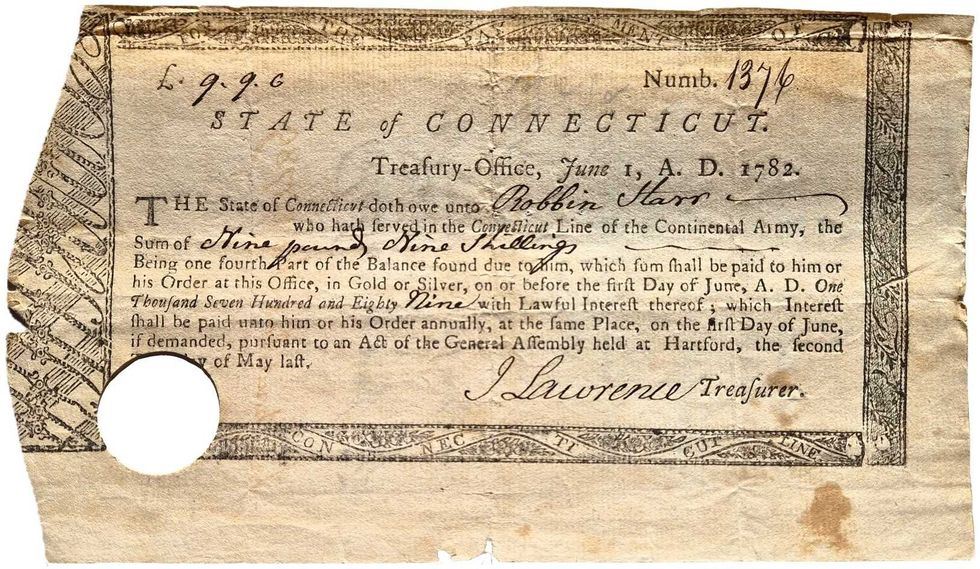 Pay Bill for Robin Starr’s service in the Continental Army.Courtesy the Alex Breanne Corporation
 John Mills speaking at Quinnipiac University.Courtesy the Alex Breanne Corporation

 Stephanie Saetta,with her rescue dog George and Blue (left), a shepherd mix awaiting his forever home.Madi Long