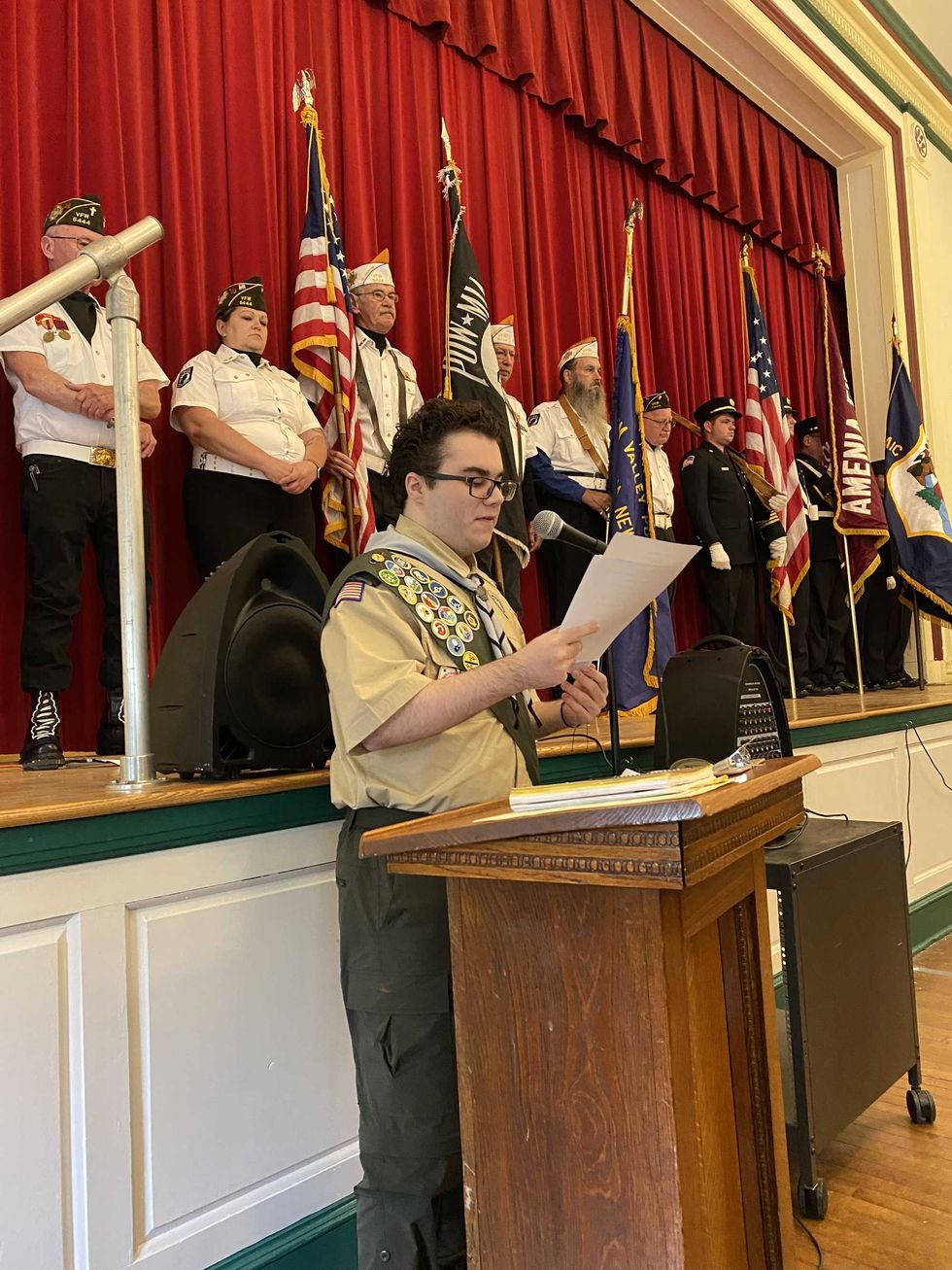
Stissing Mountain High School wins state title in cross-country

Nicholas McPherson and Jared Heggenstaller firing on all cylinders on the course in Verona.
Photo by Maureen Carney courtesy of The New Pine Plains Herald


PINE PLAINS — On Friday, Nov. 11, the Stissing Mountain High School boys’ varsity cross-country team won the New York State Public High School Athletic Association cross-country championship for schools of comparable size.
The Pine Plains team placed three runners in the top 20 in a 5-kilometer (3.1 mile) race packed with 115 contestants.
Winning the state title was “like a weight being lifted off my shoulders,” said senior Jared Heggenstaller. “We had set a goal of winning the states last winter and then… ‘Wait! We really did this!’”
The championship meet is scored by comparing the performance of each team’s top five runners. The team with the lowest overall total is the winner. For Pine Plains, junior Maxwell Decker placed eighth; sophomore Daniel McPherson, 11th; Jared Heggenstaller, 20th; senior Nicholas McPherson, 25th; and senior Maxwell Heggenstaller, 28th. This resulted in a team score of 38 points. The second-place team, from South Lewis Central School, southwest of Adirondack Park, finished with a 58-point total.
The boys’ team was not the only Pine Plains entry to do well at the meet, held at the Vernon Verona Sherrill High School in the village of Verona. Sophomore Violet Bliss, competing as an individual runner, placed 11th in a field of 111 runners.
A cross-country race begins with all runners massing at the start line. “The start of a race like this is a stampede as one huge group gets funneled onto the course,” said Heggenstaller.
The Pine Plains team had run the course the day before, scouting out the terrain and planning a race strategy. “The course was really brutal with hills, twists, branches and some areas of poor footing,” he said. His twin brother, Maxwell, added: “It’s the kind of course where, if you went out too fast, you’d burn out; and there were definitely some runners who did that.”
Owing to the stampede at the race’s start, the Pine Plains team was unable to stay together as a group. Their plan was to lay back at the beginning of the race. “At the two-minute mark, we were all pretty far back in the pack,” Jared said. By the mid-point of the race, eight minutes in, the Bombers’ top runners — Decker, Daniel McPherson and Jared Heggenstaller — had begun their move to the front and held their relative positions through the end of the race.
Coach Ryan Carney said, “This is a huge accomplishment for this group and for our school district.” Carney is very proud of his team. As he told the Herald earlier this month: “These kids are incredible. They’re great students, they are so good to each other.”
Team captain and senior Gabriel Hieter, and junior Nicolas Montoya finished further back, but each has contributed to the spirit evident among this team. Hieter said his role “is to let the fast runners run, work to make sure we stick with our training program, and recruit students to join the (cross-country) program.” Two days after the winning race, the squad gathered after school for a 50-minute run to keep their legs loose.
The victory at Verona as well as Bliss’ strong showing capped a thoroughly satisfying season for the Bombers. In only its second year, the cross-country program, led by Carney, has enjoyed startling success. They will try to extend their good year on Saturday, Nov. 25, when the boys team will compete again against runners from throughout New York in the Nike Cross Regionals Northeast meet at Bowdoin Park in Wappingers Falls.
The event will feature two separate competitions, one for New York teams and another for teams from New England, New Jersey and Pennsylvania. “New York is traditionally a cross-country powerhouse,” said Carney, and thus fields as many teams in regional competitions as the whole group of other northeastern states. The top two teams from both the New York group and the other states running on Nov. 25 will participate in the Nike Cross Nationals in Portland, Oregon, on Saturday, Dec. 2.
This article is courtesy of The New Pine Plains Herald.
The following excerpts from The Millerton News were compiled by Kathleen Spahn and Rhiannon Leo-Jameson of the North East-Millerton Library.
January 24, 1935
About Millerton
Mayor and Mrs. William J. Brewer and Mr. and Mrs. Miles Jenks left on Monday for a month’s vacation in Florida.
Mr. Roy Ganung and daughter, Jane, spent Tuesday afternoon In Poughkeepsie.
Jean Silvernale is confined to home by illness.
Miss Blanche Bates is spending several weeks at the home of her brother, Edward Bates, at Pittsfield, Mass.
George Wooding of Thornewood spent Sunday at the home of his sister, Mrs. Harry Card.
Mr. and Mrs. Lewis Decker and family moved to Lakeville on Sunday.
January 22, 1976
Snowmobiles Tresspassing[sic], Officer Says
Trespassing and riding on public roads are the major offenses committed by area snowmobilers this winter, New York State Conservation Officer Harry Wheeler stated this week.
He asserted that a number of snowmobile riders have been sighted traveling on public roads and soaring across private property without permission, both illegal acts.
January 18, 2001
Local Homes Added to Historic Register
COLEMAN STATION — Three houses in the town of North East were recently added to the National Register of Historic Places.
The Oliver Barrett House, the Dakin-Coleman Farm and the Thomas Wheeler Farm, all located in the Coleman Station area, were selected by the New York state Office of Parks, Recreation and Historic Preservation to be listed individually on the register, though the entire Coleman Station Valley was considered for the recognition in 1993.
Millerton Sees Some Business Changes; Shops Move, Expand
MILLERTON- Two stores on Main Street in Millerton have interior changes in the works.
Leslie Hoss Flood has recently relocated her Amenia-based store to the basement of the Millerton Antiques Center. Ms. Flood’s shop had been in Amenia for about 15 years, where, in addition to selling used and antique furniture, Ms. Flood also ran an upholstery shop.
After removing several partitions and installing new lights, the basement store looks entirely new. Ms. Flood is pleased with the space, which offers more room in which to showcase her wares. She is also taking advantage of the additional area by creating a separate reupholstery room and a section to display in-stock fabrics.
Pasta-At-Large Expands
After acquiring the empty space, owner Sofia Okołowicz has expanded her business to provide “a little more elbow room inside.”
The front portion has been open since late November and, in recent days, Ms. Okolowicz has removed a wall and had electricity installed in the new area.
The college-age generation is grappling with inflation, increasing housing prices, climate change, and now mass corporate layoffs. In a world where geopolitical turmoil is increasing, the ground beneath their feet is shifting. Many believe their future is bleak.
My nephew, Joey, just got married. His wife lives with her parents, and he lives with his. While he makes good money as a pharmacy manager at a national chain drugstore, neither he nor his wife can afford even a down payment on a house in Long Island. They are moving in with the wife’s parents. Joey’s sister is also married with two children. They also live with their parents. Welcome to the American dream turned nightmare for almost 70 million young Americans.
The typical age range of Gen Z is 1997 to 2012. They are the demographic cohort succeeding Millennials and preceding Generation Alpha. They are the most racially and ethnically diverse generation in America, with 48% being non-white.
Almost all of this generation is highly active on social media. Almost 60% are planning to pursue a college education. They are just as likely to identify as Republicans, Democrats, or Independents. As such, the present populist upheaval the U.S. is undergoing takes an inordinate toll on them. It may be why 91% of Gen Zers report experiencing symptoms of stress and anxiety.
While Wall Street opened the year celebrating the promise of a bright future, thanks to AI. Opinion leaders predict that artificial intelligence, robots, and space, among other technological breakthroughs, will dramatically reshape the way the world works. For college grads, all they see is a no-fire, no-hire labor market where unemployment among workers ages 20 to 24 continues to rise. It is now to 5.3% and even worse for those younger than that.
The National Association of Colleges and Employers predict the entry-level hiring crisis will worsen this year, rating job prospects as poor or at best fair. At a recent gathering of employers at the Yale School of Management, 66% admitted they planned to cut jobs or freeze hiring.
With an economy that is expected to grow by 3% in 2026, one would have expected the opposite reaction, but then you would not be reckoning with the impact of artificial intelligence on the job market. Potential employers are concerned and uncertain about how AI might reshape the workforce over the next few years, and rightfully so.
Most analysts believe that many white-collar positions, especially at the entry level, will be replaced by technological advancement. Underscoring that concern, many corporate giants, including Amazon, UPS, Target, and Google, announced layoffs affecting more than 60,000 jobs. And to many, that is just the tip of the iceberg.
Faced with taking fast-food jobs at minimum wage and lacking work experience in their hoped-for professions, 3 in 5 Gen Z workers are looking elsewhere for a job with some kind of reasonable future. Almost half of these young workers believe the blue-collar jobs may offer better long-term security than corporate work in the technology fields. The top sectors pursued by Gen Z include plumbing, automotive repair, construction, and electrical work.
I happen to agree with that belief, but unfortunately, Gen Z applicants face the same barrier to entry in their white-collar arena—lack of experience. Many job applicants, regardless of industry, are now required to have at least 3 years of experience and up to 5 years before being considered.
The lure of six-figure salaries in the blue-collar area is attracting more Gen Zs to vocational schools. However, what many conveniently forget is that earning that kind of take-home pay requires years of experience, a substantial investment in personal tools and equipment, and serious wear and tear on the body.
As I write this, in the next room, a 65-year-old builder I’ll call Scott, who is going in for his second knee replacement next month, is building another room in our condo. Assisting him is a young GenZer. There is a constant stream of chatter as Scott talks through his drywalling process. His helper listens intently. They seem eager to learn and ask questions as they work. He did the same when he placed the struts and erected the wall.
For several years, Scott has been involved in a local high school program that teaches vocational school grads his business, while they gain on-the-job experience and a paycheck. Scott and others like him are providing a solution one day at a time. He is one answer to the dilemma facing this struggling generation. This country needs more Scotts to hire and teach a young workforce in need.
Next week, I will highlight one area where many Gen Xers have found an alternative to home ownership. It holds risks but doesn’t cost an arm and a leg to get involved.
Bill Schmick is a founding partner of Onota Partners, Inc., in the Berkshires.Bill’s forecasts and opinions are purely his own and do not necessarily represent the views of Onota Partners, Inc. (OPI).
John Satre, one of the original Satre brothers, is credited with pioneering the sport of ski jumping in the United States.
SALISBURY, Conn. — Salisbury’s longstanding tradition of ski jumping is reaching new heights this year with the 100th annual Jumpfest, scheduled for Feb. 6–8 at Satre Hill.
The weekend-long celebration opens with a community night on Friday, Feb. 6, followed by youth ski jumping competitions and the Salisbury Invitational on Saturday. The event concludes Sunday with the Eastern U.S. Ski Jumping Championships.
While spectators look skyward to watch the high-flying athletes, Jumpfest will also invite the community to look back on Salisbury’s deep-rooted ski jumping history.
Ski jumping originated in Norway in the 19th century and is a tradition familiar to most Nordic children. That was the case for the five Satre brothers — John, Magnus, Ottar, Sverre and Olaf — who grew up competing in ski jumping and cross-country skiing.
When John Satre moved to Salisbury in 1923 to work as a chauffeur, he brought the tradition with him. The rolling hills and heavy winters of the Northwest Corner resembled those of Norway, allowing John to seamlessly integrate his passion into his new community.

Within a year, his brothers followed him to Salisbury.
In 1926, John Satre captivated roughly 200 spectators by skiing off a snow-covered barn roof.
The brothers soon formed the Salisbury Outing Club — now known as the Salisbury Winter Sports Association (SWSA) — and began construction of a permanent ski jump in the same location it sits today: Satre Hill.
By 1933, the Satre brothers had won numerous championships and helped popularize the sport across the United States. Salisbury hosted the U.S. Olympic Trials in 1932, and the following year hosted the National Championships.
Tragically in 1934, at the age of 40, John Satre was killed in a car accident. The New York Times hailed him as a pioneer in U.S. skiing and his legacy is carried on in the winter sports culture that is nurtured in Salisbury today.
During this time, local children were introduced to the sport, creating makeshift jumps in their backyards out of crates and hay bales. One of these children was Richard Parsons, who became the first Salisbury resident to earn recognition for cross country skills. He earned a spot for the 1932 Lake Placid Winter Olympic Games and in 1936 competed in the Winter Olympics in Garmisch, Germany, where he was the leading American-born cross-country skier.
During World War II, young athletes who would have normally been jumping were enlisted in the service, causing a lull in the sport and deterioration of the jump itself. After the war, however, community members eagerly worked to rebuild the jump, and another Salisbury athlete emerged.

Roy Sherwood was first introduced to ski jumping when his father built him and his brother their own ski jump in their backyard. Sherwood quickly gained ground, earning himself the title of “hometown hero.” By 1954, Sherwood was offered a spot on the U.S. Olympic Team for the 1956 games in Cortina, Italy.
Sherwood’s path to the Olympics was far from easy. A year before the Games, he was diagnosed with polio, threatening his ability to compete. He recovered enough to travel to Italy, only to hit an icy patch during a practice run.
Sherwood rebounded and competed the next day, placing 36th out of 51 — the second-highest finish by an American — and was later inducted into the U.S. Ski & Snowboard Hall of Fame.
Today, four jumps line Satre Hill — K10, K20, K30, and K65. The 65-meter jump is used for competitions, and the smaller jumps are used to teach local youth during winter camps.
Islay Sheil, a Housatonic Valley Regional High School student and Lakeville resident, is the current SWSA athlete on the rise in ski jumping today. Her passion for the sport emerged during one of the SWSA winter camps, and last March earned gold in the Junior National Championships. The next Junior National Championships will be hosted in Salisbury in 2027.
While Salisbury celebrates the 100th anniversary of its own ski jump this year, the Olympic Games will be held in Milan and Cortina, Italy, the same place that Sherwood gained global recognition.
To honor the town’s remarkable history and tradition of ski jumping, Jumpfest will begin early with a Winter Warmer on Jan. 31 between 5:30 to 8 p.m. It will be at the home of Salisbury First Selectman Curtis Rand. Small plates and drinks will be served. Limited tickets are available for $50 and more details can be found at Jumpfest.org/100years/

On Feb. 1, a double feature screening of On the Hill and Downhill Racer will be held at The Moviehouse in Millerton, followed by a panel discussion on winter sports and SWSA’s role in Salisbury’s history. There will also be a raffle and SWSA merchandise for sale.
Tickets for the showing are $16 and details can be found at Jumpfest.org/100years/.
On Friday, Feb. 6, Jumpfest will host community night at Satre Hill. SWSA will offer free admission for the night. Gates open at 6 p.m. and “Target Jumping Under the Lights” will begin at 7 p.m. There will be fireworks sponsored by NBT Bank, bonfires, and food and drinks available for purchase. The Human Dogsled Race is set for 8:30 p.m. Teams of five can register at Jumpfest.org
On Saturday, Feb. 7, the Junior Competition on K20 jump will begin at 9 a.m. The Salisbury Invitational Ski Jumping Competition will practice from 11 a.m. to noon and compete at 1 p.m. Community members are invited to the Snow Ball at the Lakeville Town Grove at 8 p.m. Dancers will be accompanied by live music from the Steve Dunn Band. Entrance to the Ball is $20 with children 12 and under free of charge.
On Sunday, Feb. 8, Satre Hill will hold the Eastern U.S. Ski Jumping Championships. Athletes will practice between 11 a.m. to noon and compete at 1 p.m.
Willie Hallihan of SWSA explained that the length of time and number of people involved on an emotional level has made the sport “iconic to Salisbury.”
Hallihan recounted in the PBS documentary “The Jump” that the ski jumps are “like a family member to a lot of people”.
Amenia residents comment on Cascade Creek subdivision plan