Millions were left in the dark for days following Tropical Storm Isaias, which hit our shores on Tuesday, Aug. 4, after it battered the Eastern Seaboard. It left nearly as many people in the Northeast without power as Superstorm Sandy did in 2012, according to utility giant Con Edison. By press time, on Tuesday, Aug. 11, the majority of residents in the Tri-state region reported that their power had been restored, but it took almost a full week for some after Isaias caused blackouts that left many Northeasterners sweltering in what was sometimes 90-plus degree summertime heat, sans air-conditioning, many without fresh water, plumbing, refrigeration, phone, cable, internet, and all of the other day-to-day necessities we have come to rely on — especially as we grapple with living and working in quasi-quarantine during the COVID-19 pandemic.
If living without power is tough during normal times, during a global health crisis it’s harder still: It’s harder to drive on the roadways, with dangerous power lines down, tree limbs blocking streets and without traffic signals fully operational; it’s harder to access fresh drinking water, purchase groceries and buy other supplies and necessities; it’s harder to get to doctor’s offices and pharmacies; it’s harder to fill one’s vehicle with gasoline or get fuel for one’s generator; it’s harder to conduct business, to work remotely and to be professional in general.
Since the storm hit, utility companies like Central Hudson and New York State Energy & Gas (NYSEG) have been at work trying to restore power to our region, working with Dutchess and Columbia Counties, among others, to get us back online as swiftly as possible. For some that took longer than others. As of Sunday evening, Aug. 9, NYSEG had announced there were still roughly 1,500 of its customers in Dutchess, Putnam and Westchester Counties without power; hours later that number had dwindled to around 250 and was expected to be down to zero by the next day. Other utilities’ customers farther south, in Westchester County and New York City, fared worse and tens of thousands were still waiting for their power to be restored by Monday night. Long Island PSEG also reported at least 35,000 of its customers had no power as of Sunday night.
Connecticut suffered just as badly as New York — if not worse. Eversource Connecticut reported it had restored power to 741,000 of its customers — 90% of whom it anticipated would be back online by Sunday night. However, its online map of community service showed most of its service area would not be fully restored until Monday or Tuesday. As of Sunday night, Eversource reported that about 120,000 of its 1.3 million customers were still without power.
Admittedly, this was no small storm. There were even unconfirmed reports of a tornado or microburst hitting Millbrook. According to Communications Director of the Dutchess County Executive Office Colleen T. Pillus however, “Emergency Response did not have any reports of a tornado in Millbrook and there is nothing confirmed.”
Tornadoes were confirmed in North Carolina, where two people died, 12 were hospitalized and three were unaccounted for, according to The New York Times. Tornadoes were also reported in Virginia and New Jersey, and another likely in Delaware. And a person was killed in Queens after a tree fell on a vehicle there.
According to Central Hudson, “The storm caused widespread damage throughout the Northeast, impacting 3.7 million homes and businesses and more than 770,000 in New York State alone.”
The day after Isaias hit, on Wednesday, Aug. 5, Governor Andrew Cuomo declared a State of Emergency in a number of New York counties, including Dutchess. Also on the 5th, Dutchess County Executive Marc Molinaro held a Municipal Conference Call with the Department of Emergency Response for all mayors, town supervisors and chief elected officials in the county to talk about the storm and how to best respond to it. Molinaro brought in representatives from Central Hudson and NYSEG to participate in the call.
According to North East town Supervisor Chris Kennan, the collaborative approach worked well, and communication among all entities helped keep everyone in the loop. Amenia town Supervisor Victoria Perotti spoke about efforts to provide dry ice and water to local residents, which the utilities also did at points throughout the region. Pine Plains town Supervisor Darrah Cloud said her town experienced a hiccup when Central Hudson’s server went down just as the storm began, making communication tough for those trying to place emergency calls.
Dutchess County worked hard to collaborate, yet the New York State Legislature announced on Monday it will hold a joint legislative hearing to look into “the response failures of various utility companies during the aftermath of Tropical Storm Isaias,” charging that hundreds of thousands of ratepayers suffered outages and untenable restoration times. Lawmakers plan to evaluate the utilities’ preparation and response to the storm outages, calling their response to Isaias a “complete failure” that needs to be improved going forward.
We hope their investigation will shed light on the issue, and improve utilities’ responses in the future — because with all that science has shown us, storms like Isaias promise to keep coming.




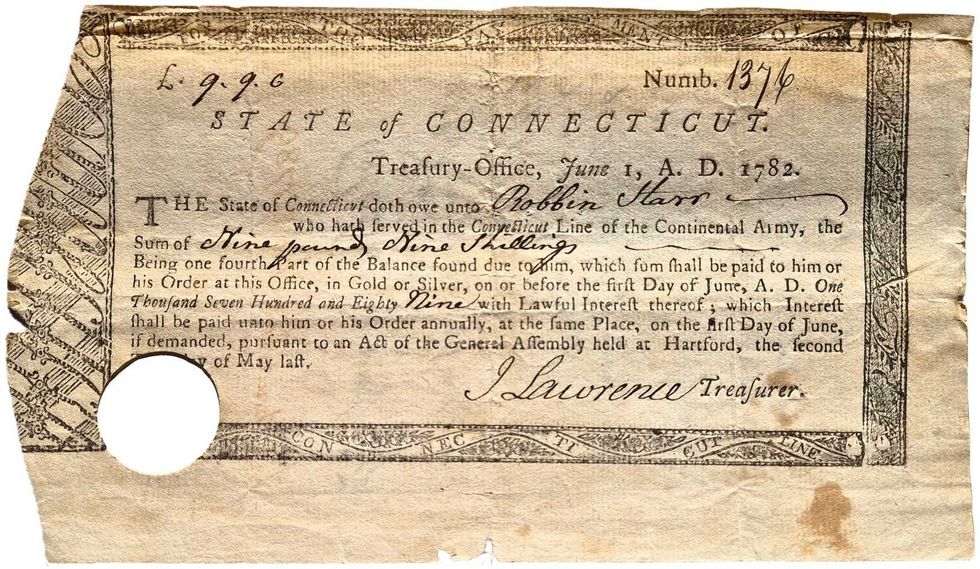 Pay Bill for Robin Starr’s service in the Continental Army.Courtesy the Alex Breanne Corporation
 John Mills speaking at Quinnipiac University.Courtesy the Alex Breanne Corporation

 Stephanie Saetta,with her rescue dog George and Blue (left), a shepherd mix awaiting his forever home.Madi Long