Horton House Scone Company, the perfect complement to St. Patty’s Day

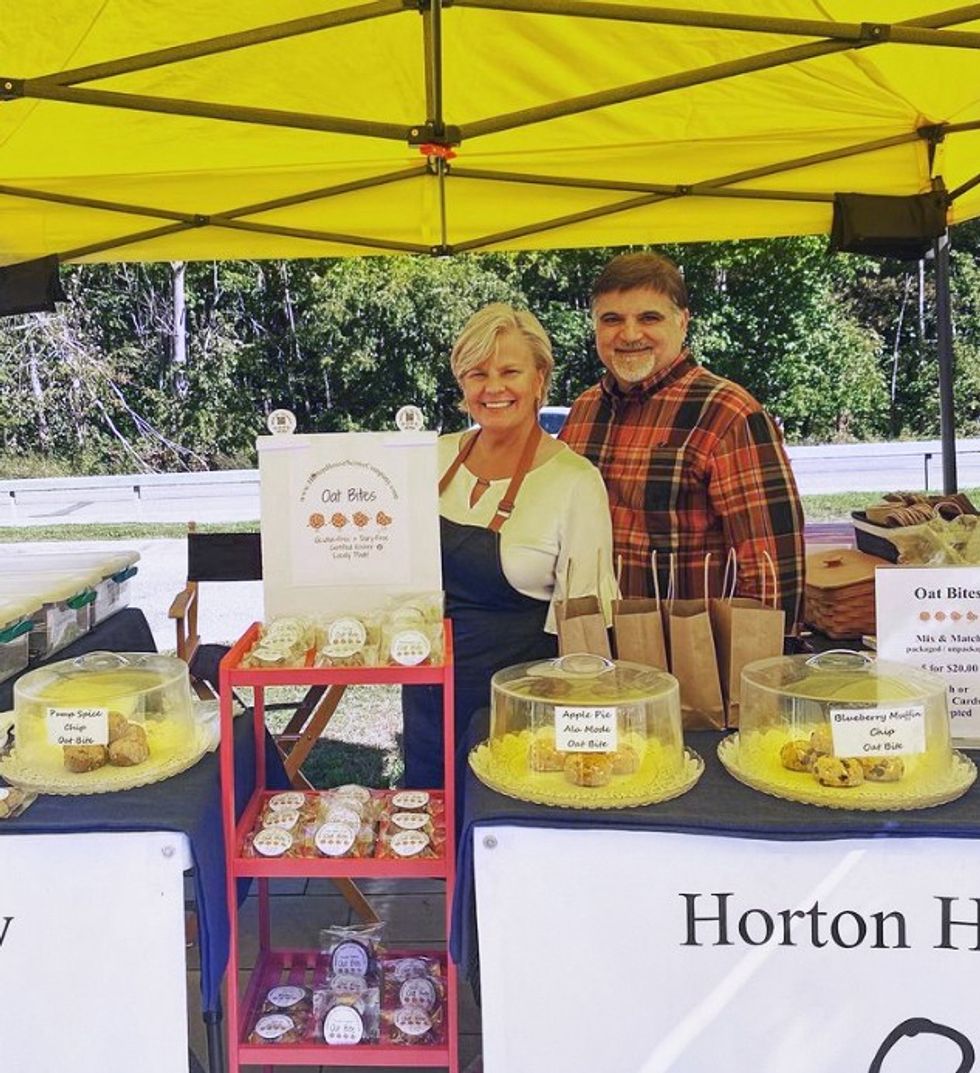
Married for 20 years, Cynthia and John Vergilii of Amenia’s Horton House Scone Company are indeed a perfect pairing in both life and business. Photo submitted

AMENIA — Residents yearning for something a trifle sweet, relatively healthy and incredibly satisfying — whether on this St. Patrick’s Day, Thursday, March 17, or any other day of the year — will realize they’ve struck gold when they taste what Horton House Scone Company has been baking in Amenia since it opened last May.
Although scones may be traditionally Scottish, rather than Irish, they are nonetheless delicious come St. Patty’s Day or any other time. Especially the ones made by bakers Cynthia and John Vergilii of the Horton House Scone Company.
Before relocating to their new digs in Amenia (from where they ship their scones; they do not have a physical bakery), the Vergiliis previously owned the historic Joseph Horton House in Wappingers Falls. When in the southern end of the county, the duo dressed in costume and held high tea lunches and Colonial dinners.
Over the years, the house became a destination on the local bus tour circuit, welcoming 10,000 people a year.
Well-known for their scones and inventory of Harney & Sons tea, both of which were featured at high tea. They also sold their scones commercially.
Years after selling their house in Wappingers, when considering their next move, their daughter suggested they stay with her in Fishkill. She urged them to return to their tea and scone business.
At John’s suggestion, the couple started selling their baked scones at the Dutchess Flea Market in Fishkill. Between that time, the Vergiliis gave up eating meat and animal products, meaning they were no longer baking with cream, eggs or dairy products.
Asked about the pros and cons of switching to a plant-based diet, Cynthia explained it’s all about making substitutions and finding items that taste just as good. While it can be tricky, the health benefits are highly rewarding.
“If you have the right recipe, you can do just about everything,” Cynthia said, adding that she and John love fooling people with their healthier ingredients that taste just as indulgent.
While at the flea market, the Vergiliis were asked by customers if they had dairy-free, nut-free or gluten-free scones. That inspired them to bake with even healthier ingredients.
After some fine-tuning, Horton House Scone Company had the Vergiliis’ scones circulating through local farmers markets, retail stores and other venues. Just recently, their scones started selling at LaBonne’s Market in Salisbury, Conn.
Cynthia said, “Moving up here was amazing and we didn’t even realize, truly, when we moved here how the people in this area value locally-made and locally-sourced products, so we are thrilled to be able to offer as many local products as we can.”
Asked how their recipes have changed, John said they’ve fine-tuned their baking to use Hudson Valley cold-pressed sunflower oil or grapeseed oil in place of butter, as well as syrup sourced right in Amenia. All of their goodies are sweetened with either maple syrup or ground coconut.
As for her recipe for running a successful business with her husband, Cynthia said, “I would say we love working together; 20 years we’ve been married and we’re best friends.”
Between John’s computer and marketing skills and Cynthia’s creativity and ability to keep their inventory organized, the pair is perfectly paired as both life partners and business partners.
Baking from the comfort of their apartment, they recently added low-sugar cookies to their offerings in addition to their scones.
Cynthia also achieved her dream of pairing their scones with Harney & Sons tea and Irving Farm coffee; both popular manufacturers and retailers from Millerton.
Horton House has gift boxes of “perfect pairings” that put the Vergiliis on the map for presents; John said their merchandise places an emphasis on the beautiful Hudson Valley and its products.
The husband-and-wife duo recommend trying all the teas to find which ones pairs best with their flavorful scones; they’ve created some delicious combinations during the last few months to get scone enthusiasts started.
One suggestion is their blueberry muffin scone with Harney’s “Blueberry Green” tea; or their cinnamon scone with “Hot Cinnamon Spice” tea; their low-sugar chocolate chip cookie with “Chocolate Mint” tea is another winner.
These pairings and others may be found online at www.hortonhousesconecompany.com. To place an order, go to the website or call 207-317-6950; orders are shipped Mondays through Thursdays.
Along with accommodating special requests, the Vergiliis offer custom-made labels for special occasions and are happy to work with people interested in selling their scones at their stores or at special events.

Millerton News
PART-TIME CARE-GIVER NEEDED: possibly LIVE-IN. Bright private STUDIO on 10 acres. Queen Bed, En-Suite Bathroom, Kitchenette & Garage. SHARON 407-620-7777.
The Salisbury Association’s Land Trust seeks part-time Land Steward: Responsibilities include monitoring easements and preserves, filing monitoring reports, documenting and reporting violations or encroachments, and recruiting and supervising volunteer monitors. The Steward will also execute preserve and trail stewardship according to Management Plans and manage contractor activity. Up to 10 hours per week, compensation commensurate with experience. Further details and requirements are available on request. To apply: Send cover letter, resume, and references to info@salisburyassociation.org. The Salisbury Association is an equal opportunity employer.
Gardeners needed for native plant design business: March 15- December 1st. Must be physically fit and dependable. Call for interview 347-496-5168. Resume and references needed.
Weatogue Stables in Salisbury, CT: has an opening for experienced barn help for Mondays and Tuesdays. More hours available if desired. Reliable and experienced please! All daily aspects of farm care- feeding, grooming, turnout/in, stall/barn/pasture cleaning. Possible housing available for a full-time applicant. Lovely facility, great staff and horses! Contact Bobbi at 860-307-8531. Text best for prompt reply.
Hector Pacay Landscaping and Construction LLC: Fully insured. Renovation, decking, painting; interior exterior, mowing lawn, garden, stone wall, patio, tree work, clean gutters, mowing fields. 845-636-3212.
PROFESSIONAL HOUSEKEEPING & HOUSE SITTING: Experienced, dependable, and respectful of your home. Excellent references. Reasonable prices. Flexible scheduling available. Residential/ commercial. Call/Text: 860-318-5385. Ana Mazo.

12 week old black and tan/blue tick coonhound: mix for sale. First set of puppy shots done at 8 weeks. Call 860-248-9947 for more info. and price.
PUBLISHER’S NOTICE: Equal Housing Opportunity. All real estate advertised in this newspaper is subject to the Federal Fair Housing Act of 1966 revised March 12, 1989 which makes it illegal to advertise any preference, limitation, or discrimination based on race, color religion, sex, handicap or familial status or national origin or intention to make any such preference, limitation or discrimination. All residential property advertised in the State of Connecticut General Statutes 46a-64c which prohibit the making, printing or publishing or causing to be made, printed or published any notice, statement or advertisement with respect to the sale or:rental of a dwelling that indicates any preference, limitation or discrimination based on race, creed, color, national origin, ancestry, sex, marital status, age, lawful source of income, familial status, physical or mental disability or an intention to make any such preference, limitation or discrimination.

FOR SALE: 39 Hospital Hill Road, Sharon. 1680 sq.ft. Two family, rare side-by-side units. 4 bed; 2 full bath, 2 half. Great investment, or live in one and rent other side. $485,000. Call/text Sava, 914 -227-4127.
FOR RENT COMMERCIAL KITCHEN IN FALLS VILLAGE: Located in the heart of Falls Village. 425 sf space fully equipped for catering business, wholesale food prep or bakery. Several successful local businesses got their start here! Event space in building could be available. Contact anita@100mainst.com.
Millerton News

Want more of our stories on Google? Click here to make us a Preferred Source.
Dee Salomon
Fireweed attracts the fabulous hummingbird sphinx moth.
You must figure that, as rough as the cold weather has been for us, it’s worse for wildlife. Here, by the banks of the Housatonic, flocks of dark-eyed juncos, song sparrows, tufted titmice and black-capped chickadees have taken up residence in the boxwood — presumably because of its proximity to the breakfast bar. I no longer have a bird feeder after bears destroyed two versions and simply throw chili-flavored birdseed onto the snow twice a day. The tiny creatures from the boxwood are joined by blue jays, cardinals and a solitary flicker.
These birds will soon enough be nesting, and their babies will require a nonstop diet of caterpillars. This source of soft-bodied protein makes up more than 90 percent of native bird chicks’ diets, with each clutch consuming between 6,000 and 9,000 caterpillars before they fledge. That means we need a lot of caterpillars if we want our bird population to survive.
So how do we ensure that there are sufficient caterpillars for them? That is the question, as caterpillars are very particular. Their butterfly or moth mothers cleverly attach their eggs to the very specific plants their tiny babies require. Once they hatch, the caterpillars eat the leaves of these plants until they are either picked off by birds to feed their young or create a chrysalis and turn into a moth or butterfly to repeat the cycle of life.
Some caterpillars are generalists and can survive on a variety of plants, but most — 90 percent, according to scientists — are specialists, relying on only one or two types of plants for survival. In their winged form, dietary restrictions ease as they source pollen more widely, but when it comes time to lay eggs, they use a keen sense of smell to find the specific plants that will help their young survive.
Research by Doug Tallamy shows that 90 percent of butterfly and moth species rely on just 14 percent of native plant species for food, which makes the planting of these “keystone” plants critical. Let’s review a few.
Goldenrod: Not all goldenrod is created equal. Old field goldenrod, (Solidago nemoralis), is a shorter and less aggressive alternative to the tall, aggressive goldenrod we are familiar with, as is wrinkleleaf goldenrod, (Solidago rugosa), a compact species that has arching sprays of bright yellow flowers supporting more than 100 species of insects. This species is deer-resistant with no serious pests or diseases. Last year, Mt. Cuba Center, a conservation center out of Delaware, focused its trials on goldenrod, and its research report, available online, is sortable not just by aesthetic attributes but also by the number of insects seen on each species.
Scarlet strawberry: (Fragaria virginiana), is one of the plants I have had great luck growing in the woodland. When there is a new sunny spot, which happens when a tree or large branch falls, I plant a few strawberries, which I dig out of a spot where they are thriving. These plants make a great groundcover and are especially nice used under trees for caterpillar “soft landings.”
Spotted Joe-Pye weed: We see this plant, (Eutrochium maculatum), on roadsides in late summer, but it looks as sharp as an ornamental in the hands of Michael Trapp, who, in the garden behind his shop in West Cornwall, encloses a bed of Joe-Pye weed with a short boxwood hedge, dignifying this plant that supports between 35 to 40 caterpillar species, including those that become the three-lined flower moth, Clymene moth, ruby tiger moth, Eupatorium borer moth and great spangled fritillary moth.
I am less familiar with fireweed, (Chamaenerion angustifolium), but will be adding it this year, as it may be the prettiest of the keystone plants in our region and attracts the fabulous hummingbird sphinx moth. I will let you know when I find a local nursery that stocks it and, when planted, how it fares here.
Also keep in mind this spring: smooth aster, (Symphyotrichum laeve); white yarrow, (Achillea millefolium); and the beautiful Canadian columbine, (Aquilegia canadensis), which is the first food for hummingbirds’ arrival in the Northwest Corner.
Dee Salomon ‘ungardens’ in Litchfield County.
Robin Roraback
Stephanie Haboush Plunkett
"The field of illustration is very close to my heart"
— Stephanie Plunkett
For more than three decades, Stephanie Haboush Plunkett has worked to elevate illustration as a serious art form. As chief curator and Rockwell Center director at the Norman Rockwell Museum in Stockbridge, Massachusetts, she has helped bring national and international attention to an art form long dismissed as merely commercial.
Her commitment to illustration is deeply personal. Plunkett grew up watching her father, Joseph Haboush, an illustrator and graphic designer, work late into the night in his home studio creating art and hand-lettered logos for package designs, toys and licensed-character products for the Walt Disney Co. and other clients.
“The field of illustration is very close to my heart,” she said. Inspired by that example, she studied illustration at Pratt Institute and began her career as an illustrator before shifting toward museum work. An internship at the Brooklyn Museum proved pivotal. “It was inspiring to see the children come alive in front of art,” she recalled.
In addition to her curatorial work, Plunkett is the author of two children’s books, “Kongi and Potgi: A Cinderella Story from China” and “Sir Whong and the Golden Pig,” and has written or co-authored numerous books on illustration, including “Drawing Lessons from the Famous Artists School” and “Leo Lionni: Storyteller, Illustrator, Designer.” She earned an MFA from the School of Visual Arts and built a museum career that included positions at the Brooklyn Museum, the Brooklyn Children’s Museum and the Heckscher Museum of Art before joining the Norman Rockwell Museum, where she has worked for 31 years.
But elevating illustration has meant challenging decades of critical skepticism.
“The goal has been to shine a light on this important American art form and to elevate public awareness of its artistic and cultural importance,”Plunkett said.
As a popular and widely circulated art, illustration is sometimes thought of as inferior to fine art, such as painting and sculpture. Plunkett considered why. She theorized that the 1913 New York Armory Show, the International Exhibition of Modern Art, with works by artists such as Picasso, Matisse and Duchamp, initially contributed to this evaluation. In the 1930s and ’40s, abstract expressionism became the art of the nation, and the rift widened further.
“Norman Rockwell became the antihero for many art critics of the time,” said Plunkett. “Illustration was viewed as too commercial and sentimental because of its emphasis on visual storytelling.”
Plunkett calls illustration “art with a job to do.” She explained, “Illustrators are adept at solving visual problems for their clients while expressing their own aesthetic and artistic vision.”

She noted that the line between the fine and applied arts “is much more porous now, with many artists working across platforms and styles.” She cited late-20th-century illustrators like Marshall Arisman, Barbara Nessim, Robert Cunningham, Bernie Fuchs and Mark English as illustrators who forged unique approaches to working and seeing.
Plunkett commented that people want to see the original illustrations. “Generally, Rockwell exhibitions bring high attendance. Currently, our traveling exhibition, ‘Norman Rockwell: From Camera to Canvas,’ is at the New Britain Museum of American Art, but we’ve traveled Rockwell and illustration to 45 states and several countries, including Japan, France, Italy and Germany.”
Nowadays, illustrators take on subjects that are important to them. “The children’s book industry is committed to sharing the richness and diversity of people and cultures with young readers.” Plunkett cited the late illustrator Jerry Pinkney’s commitment to this goal. As a boy, Pinkney found no books portraying children like him, and “his life’s mission as an artist was to present inspiring, positive images of children of color.”
The Norman Rockwell Museum and Rockwell Center seeds were sown when “Rockwell placed the first 199 artworks in the care and collection of the Norman Rockwell Museum upon its founding in 1969, some of which he personally acquired for the fledgling collection,” said Plunkett. “The museum’s current Rockwell holdings include 865 original artworks, the artist’s Stockbridge studio and an archive of 400,000 photographs, letters, props and first uses of the artist’s work. We also hold about 25,000 illustrations by other artists, from the historical to the contemporary.”
“We call ourselves the home for American illustration. We have a real commitment to illustrators and what they’ve accomplished,” said Plunkett.
The Norman Rockwell Museum is located at 9 Glendale Road, Stockbridge. For more information and to purchase tickets, visit
nrm.org
Brian Gersten
Craig Davis, co-founder and board chair of East Mountain House, an end-of-life care facility in Lakeville, will sponsor a March 5 screening of the documentary “Come See Me in the Good Light” at The Moviehouse in Millerton, followed by a discussion with attendees.
The film, which is nominated for best documentary at this year’s Academy Awards, follows the poet Andrea Gibson and their partner Megan Falley as they are suddenly and unimaginably forced to navigate a terminal illness. The free screening invites audiences to gather not just for a film but for reflection on mortality, healing, connection and the ways communities support one another through difficult life transitions.
East Mountain House grew out of a realization that “there are so many issues with how we are taking care of our dying in our community,” said David. “We wanted to provide a solution for some people where they can die in a serene and calming home-like setting.” This compassionate approach at East Mountain House is carried out with the support of seven staff members and 42 volunteers who do everything from reading to residents, gardening, cooking, communicating with family members and assisting with therapeutic treatments. East Mountain House houses just two residents at a time, and staff and volunteers work around the clock to accommodate their needs.
In a culture where we are trained to panic when a loved one is dying, and where a clinical space like a hospital is the norm for many individuals at the end of their lives, Davis feels that East Mountain House is an alternative with a natural and organic approach to death. It’s a place where death can be celebrated and viewed as something that is simply a part of life. Davis’ vision for East Mountain House is more than a decade in the making, and he is eager to introduce his work and his perspective to locals at the upcoming community screening.
One of the reasons Davis was interested in sponsoring a screening of “Come See Me In The Good Light” was because the film gracefully explores themes of vulnerability, resilience and the search for meaning in the face of death. Through its deeply personal storytelling, the film highlights how people navigate loss, transformation and the desire to be seen for who they truly are. The documentary’s emphasis on compassion and human connection aligns closely with the mission of East Mountain House, making the post-film discussion a natural extension of the evening.
Davis hopes the event will serve as both a cultural offering and a community touchstone — an opportunity for neighbors to gather in a welcoming space, share ideas and reflect on the importance of end-of-life support systems. The screening is free and open to the public, though advance registration is recommended due to limited seating.
For registration, go to themoviehouse.net.

Want more of our stories on Google? Click here to make us a Preferred Source.

Want more of our stories on Google? Click here to make us a Preferred Source.