






Latest News
Stanfordville local uses 3D printers to block Flock cameras
Nathan Miller
Sep 29, 2026
STANFORDVILLE — Jim Griffin was among dozens of Dutchess County residents who stood up in opposition to local law enforcement’s adoption of license plate reading cameras at a community forum in Pleasant Valley on Wednesday, Sept. 23.
But rather than simply voicing his disapproval of the technology, Griffin had something to offer to county residents in the room — a chance to take matters into their own hands. Griffin, using his collection of 3D printers and a penchant for hacking, which he said dates back to the early ‘90s, is manufacturing plastic covers that he said disables the cameras without damaging them.
Griffin was inspired by the increased use of license plate readers manufactured by Flock Safety, an Austin, Texas, based company that produces the cameras and provides software that police use to identify and track persons of interest. Opponents of the cameras nationwide have taken to cutting down the cameras — an act that has been met with criminal charges.
Griffin acknowledged using the plastic covers would still likely lead to criminal charges, but hoped they would be lesser than if opponents damaged the cameras.
“Doing civil disobedience — which is an American tradition — always comes with a consequence,” Griffin said. “I think if we can make those consequences as small as possible for people, the better off we are.”
Griffin’s concern over the technology grew in February when Pine Plains residents and the Town Board members discovered police department officials had entered into an agreement with Flock Safety without involving the Town Board. He initially set out to design his own cover for the cameras, but eventually discovered the “Flock Sock” design online on a site where makers share designs with others.
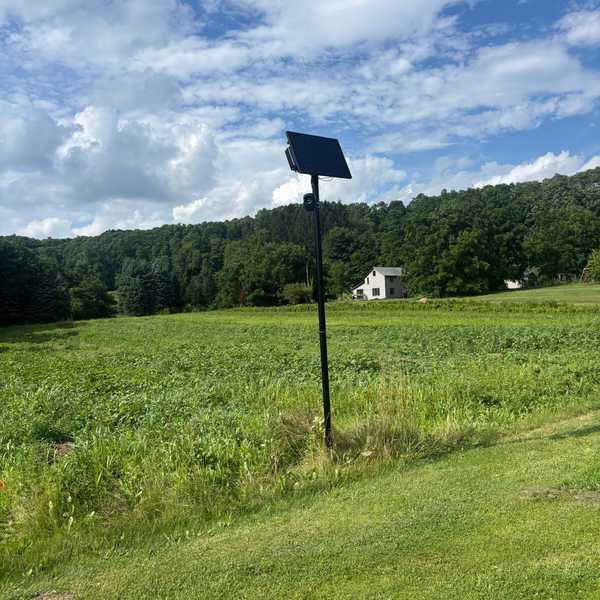
The Flock Sock is a plastic sleeve that slides over top of Flock cameras. The devices block the camera’s view but cause no damage to the device or the pole it’s installed on. Griffin said he thought the coverings were a perfect solution, allowing concerned citizens a physical manifestation of their opposition to the cameras that doesn’t carry the same risk of criminal prosecution.
“My intent was protection of the government investment from vandalism,” Griffin said wryly. “We want to protect this investment so that when it’s returned, it’s returned at full value.”
Griffin, a 50-year-old network architect, said his opposition to license plate reading cameras is rooted in values he’s had since he was a high schooler. He framed the technology, which has become widespread across the United States in recent years, as a mass surveillance network that grants police unprecedented access to information about citizens’ movements without a warrant.
He said he has been voicing his concerns about the technology to local leaders for months, and he was glad to see the swell of opposition in Dutchess County. When Dutchess County District Attorney Anthony Parisi and Sheriff Kirk Imperati announced just two days later that the cameras were coming down, Griffin was pleasantly surprised.
Griffin urged county residents to remain vigilant in opposition to the cameras, acknowledging that county officials’ decision to terminate Dutchess’s Flock camera program does not restrict local municipalities from forming independent agreements with the company. He said he will still make Flock Socks for concerned citizens who would like some.
Keep ReadingShow less
Habitat for Humanity plans first build in Amenia
Graham Corrigan
Sep 29, 2026
Habitat Dutchess CEO Eelco Kessels, left, COO Jen Radicone, center, and Construction Director Todd Bowen III visit the site of a planned affordable home in Amenia on Tuesday, Sept. 22. Prospective homebuyers will soon be allowed to apply to purchase and live in the planned home.
Photo by Graham Corrigan
AMENIA — Habitat for Humanity plans to begin construction of a home on Depot Hill Road in October and open applications for prospective buyers in December.
The structure, which will be located near the Harlem Valley Rail Trail parking lot in Amenia, is part of a $1.2 million round of federal housing and community development grants announced earlier this year by Dutchess County Executive Sue Serino.
At a site visit last week, Habitat for Humanity of Dutchess County CEO Eelco Kessels was joined by COO Jen Radicone and Construction Director Todd Bowen III. The land has been cleared of trees, and groundbreaking is set to begin in October.
“The plan was always to build a home that fits in with the other homes here,” said Kessels. “We want to make sure that this becomes a place where a family is going to thrive, affordably, for the next 30-plus years.”
The 3-bedroom, 2-bath home will be a modular home.
“It exceeds New York State energy codes,” added Bowen, the construction director. “And we’ll be looking for volunteers when springtime comes around.”
In December, the home will be delivered in 4 boxes. Applications for ownership will open that same month, and remain open until February. Porches, landscaping, and the driveway will be added in March, and the owners will — tentatively — be able to close in May.
Kessels said the home’s price will fall in line with Amenia’s workforce housing regulations. Applicants must have an income between 60% and 80% of the area’s median and housing costs will not exceed 30% of the chosen family’s annual income, he said.
Habitat will host information sessions about this particular property in October and November. Additionally, prospective homeowners have the ability to participate in Habitat for Humanity’s Homebuying University, which runs from September to December. A Spanish language version of the course is available in January and February.
“Affordability isn’t just helping folks acquire a home, it’s helping them stay in a home,” said Kessels. “We have one of the older housing stocks in New York state, so we’re not just dealing with a shortage of new construction, but also a lot of homes in need of critical maintenance and repairs.”
While this Habitat branch has largely focused on Poughkeepsie in the past, there are plans to expand into Dutchess County’s eastern edge. Kessels says the organization is in talks to purchase properties that could accommodate as many as six houses in Millerton. It’s still early days, but one thing is certain: the area’s need for affordable housing has reached critical levels.
“We’ve really found a community here that is seeing their nurses, teachers, and shop workers get priced out,” said Kessels. “But we’re investing in home ownership, and in individual families that are going to be in the community for a long time.”
The Depot Hill home is one of 14 projects funded through the county’s 2026 Community Development Block Grant (CDBG) and HOME programs. Both are funded by the U.S. Department of Housing and Urban Development. County Executive Sue Serino said the awards “help people right here in Dutchess County, supporting our neighbors who need extra help,” and cited expanded affordable housing for families as one goal.
Habitat for Humanity of Dutchess County, founded in 1986, focuses on first-time homeownership. The organization builds for families earning 60-80% of the area median income for low-interest mortgages.
Elsewhere in the county, the funding will pay for sidewalk replacement near a Beacon elementary school, ADA improvements at Pawling Village Hall, and infrastructure for a five-lot housing subdivision in Poughkeepsie.
Keep ReadingShow less
New briefs filed as Copake solar farm awaits ruling
John Coston
Sep 29, 2026
Residents packed the Copake Town Hall meeting room on Monday, Sept. 14 for the New York State hearing on the proposed 42-megawatt solar farm.
Photo by John Coston
COPAKE — The parties involved in the mid-September New York State hearing on Copake’s proposed Shepherd’s Run solar project filed briefs on Monday, Sept. 21, further supporting their ‘for’ and ‘against’ stances on the project.
On Monday, Sept. 14, the state held an adjudicatory hearing in a packed Copake Town Hall for the purpose of establishing facts related to flood plain compliance and second, meeting the requirements of the town’s wetlands laws.
The four parties in the hearing that filed briefs are Chicago-based Hecate Energy LLC, which has sought to build a multi-megawatt solar farm in Craryville for nearly a decade; the state Office of Renewable Energy Siting and Electric Transmission, known as ORES; the state Department of Environmental Conservation; and the Town of Copake.
Maureen F. Leary and Dawn MacKillop-Soller, administrative law judges at the New York State Department of Public Service’s ORES office, who conducted the hearing, will now issue a hearing report and a recommended decision on Shepherd’s Run draft permit. The ultimate decision to grant or deny a final permit will be made by ORES’s executive director.
Because of a time clock on the project, ORES has until Oct. 19 to make a decision whether to grant a site permit or deny Hecate. If the application moves ahead, Hecate will then have to come to the town to get a permit before construction can begin.
In its response to the adjudicatory hearing testimony, ORES staff recommends that the current draft permit for the project be made final, but with the addition of “further analysis of wetlands on the site based on the test imony presented at the adjudicatory hearing in order to ensure that potential impacts to wetlands and water resources are avoided, minimized and mitigated to the maximum extent practicable.
“No further modifications or conditions are necessary in order to address the Applicant’s compliance with the substantive portions of the Town of Copake’s Chapter 135 Floodplain Development Law,” the ORES filing stated.
In its filing, New York’s DEC affirmed that “it is DEC’s position that ORES does not have authority to waive local laws that administer … local floodplain management permitting … This authority is federally delegated to the local community only.”
Hecate noted that: “The record demonstrates that the application … would comply with all applicable laws and regulations unless waived, including applicable wetlands laws and the applicable provisions of Chapter 135. The record therefore supports the issuance of a final siting permit.”
The Town of Copake filed a brief that focused on several alleged shortcomings in Hecate’s application. “The Sept. 12, 2026 system component inventory places panels, arrays, collection lines, access roads, fencing, limits of disturbance, and a second inverter in mapped Zone A,” the town’s attorney, Benjamin Wisniewski, wrote in one example.
“The Applicant has not met its burden … to demonstrate, by a preponderance of the evidence, compliance with the state wetlands laws or with the substantive provisions of Chapter 135,” the brief continued.
“The Application should therefore be dismissed or denied,” he concluded.
Keep ReadingShow less

Want more of our stories on Google? Click here to make us a Preferred Source.

Friends of Irondale Schoolhouse awards $4,000 in total scholarships
Millerton News
Sep 29, 2026
Friends of Irondale Schoolhouse have awarded two scholarships of $2,000 each to:
— Jeiny Tun Xo - attending Hartwick College, Oneonta to study Accounting
— Kylei McWhirt – attending University of Albany to study Business
These scholarships are made possible by donations to Irondale Schoolhouse from:
— Associated Lightning Rod
— Designer Finds
— Dutchess Trading
— Gilded Moon Framing Shop
— Harney Tea
— Moore & More Printing
— Motor Works
— N.B.T. Bank
— Northeast Muffler
— Precision Auto Storage
— Willa’s Restaurant
John Brunese
Trustee/Friends of Irondale Schoolhouse
Keep ReadingShow less
Amenia residents voice concerns over rural character
Leila Hawken
Sep 29, 2026
Wassaic resident Leo Blackman addresses the Amenia Planning Board at a Sept. 23 public hearing on the environmental impacts of the proposed 27-lot Keane Stud subdivision. More than 70 people attended the hearing at Town Hall, where speakers raised concerns about the loss of farmland and the town’s rural character.
Photo by Leila Hawken
AMENIA — More than 70 people gathered in the Town Hall auditorium Wednesday, Sept. 23, for a public hearing on the environmental impacts of a proposed 27-lot subdivision at the Keane Stud horse farm on Depot Hill Road.
The hearing was part of the Planning Board’s environmental review of the proposed subdivision, which would divide 605 acres into 27 lots. Speakers raised concerns about the loss of farmland, scenic views and Amenia’s rural character, while one supporter said the project would increase the town’s tax base.
About a third of those attending spoke. The hearing has now closed, but the board will accept written comments through Monday, Oct. 5, Chairman Robert Boyles said.
The Keane Stud application was filed in 2023. During the environmental review, the developers have met with the town’s visual consultant, George Janes, to discuss the project’s potential effect on the landscape.
Aaron Werner, vice president for planning and development at AKRF, outlined the review process at the hearing on behalf of the developers. He said residents had several opportunities to comment on the proposal and that their feedback had been considered as the plans developed.
Each proposed lot would be at least 10 acres, with 90% of its land restricted to agricultural use and off-limits to development. The developers say they envision small-scale farming on them.
Residents had three minutes each to address the Planning Board. Several said dividing the property could make it harder to farm and diminish the area’s rural character.
“We need to get serious about protecting and preserving our large farms,” said resident George Bistransin, who predicted the lots would be bought by wealthy people.
Bistransin said dividing the property could prevent farmers from using large equipment to harvest hay there, making it harder for him to obtain hay for his small farm.
Wassaic resident Leo Blackman, who has lived in Amenia for 24 years, said the subdivision would change the town’s character, creating a suburban setting in an area designated for its scenic value.
Resident Nancy MacKenzie raised concerns about additional traffic.
“I care deeply. I’m not opposed to development, but I am to this one,” said Wassaic resident Ken Monteiro. He questioned whether buyers of the lots would establish small working farms and warned that the subdivision could erode the town’s character.
Local organic farmer Erich McEnroe described the difficulties young farmers face in getting started.
Speaking on behalf of the Amenia Conservation Advisory Committee, member Mark Doyle raised concerns about the view east from DeLavergne Hill.
He referred to residents’ requests, most recently in 2025, that the town protect the view and described past efforts to establish a conservation easement.
Wassaic General Store owner Sharon Kroeger also urged the town to protect the viewshed.
“The town should take the initiative in preservation,” Kroeger said.
Brigham Ferrand, vice president of the Hudson Valley Economic Development Corporation, spoke in support of the subdivision. Ferrand said the developers had listened to residents and scaled back their plans. He said the project would increase the town’s tax base.
“I don’t want to see the character disappear,” said resident Judy Moran, echoing the concerns of other speakers.
Town Supervisor Rosanna Hamm spoke about the residential development she has seen during her lifetime in Amenia.
She said agricultural tax breaks are not easy to obtain and pointed to the tax revenue contributed by Silo Ridge homeowners. Hamm also cited Keane Stud’s contributions to town programs, including decorations for the annual Harvest Festival.
Keep ReadingShow less
Millbrook library seeks $50,000 budget increase
Leila Hawken
Sep 29, 2026
In advance of the Nov. 3 election, residents attended information sessions at The Millbrook Library to learn more about a ballot resolution to increase the library’s annual operating budget by $50,000. Library Board member Albert Yoon led the session on Friday, Sept. 25.
Photo by Leila Hawken
MILLBROOK — A proposal to increase the Millbrook Library’s annual funding by $50,000 to support its daily operations was the subject of two information sessions, ahead of a vote on the resolution set for Tuesday, Nov. 3.
The information sessions were held at the library on Wednesday, Sept. 23, and Friday, Sept. 25. If approved, the annual operating budget for the library would increase from a total of $349,000 to $399,000, the total that supports daily operations.
Library Board member Albert Yoon reviewed the details of the proposed increase at the Sept. 25, information session. At the outset, he distinguished between this proposal and the capital building repairs project expected to cost $2 million for roof repairs and HVAC system replacement. The funding for that project is already secured through state grant funding and a court-approved use of the library’s private trust.
“We have been running a deficit for years,” Yoon said of the need to increase the operations budget for the library. He explained that the income stream is unpredictable, relying on inconsistent donations and other inconsistent sources.
“We need sustainable funding,” Yoon added. “You don’t want donations to need to support the library’s operating budget.”
As to why it is needed, Yoon said that demand for library services has grown over the past five years. More than 15,645 people visited the library in 2025, Yoon said.
Thinking that $50,000 would be a palatable increase in the views of residents to meet the annual deficit, Yoon noted that the deficit has been brought about by an increased demand for services. Recent local opinion polling has shown that residents are asking for expanded library hours, for example.
To place the proposed increase in perspective, Yoon reported that if a property owner’s home is assessed at $250,000, for example, that homeowners annual tax bill for 2027 would increase by $8.16. If assessed at $500,000, the bill would increase by $16.32.
“Most people know what the Millbrook Library provides. We need every Town of Washington and Millbrook voter to vote on November 3,” Yoon said.
For more information about the budget resolution, go to www.millbrooklibrary.org.
Keep ReadingShow less

Want more of our stories on Google? Click here to make us a Preferred Source.
loading