Millerton’s fire department marks 134 years of battling blazes

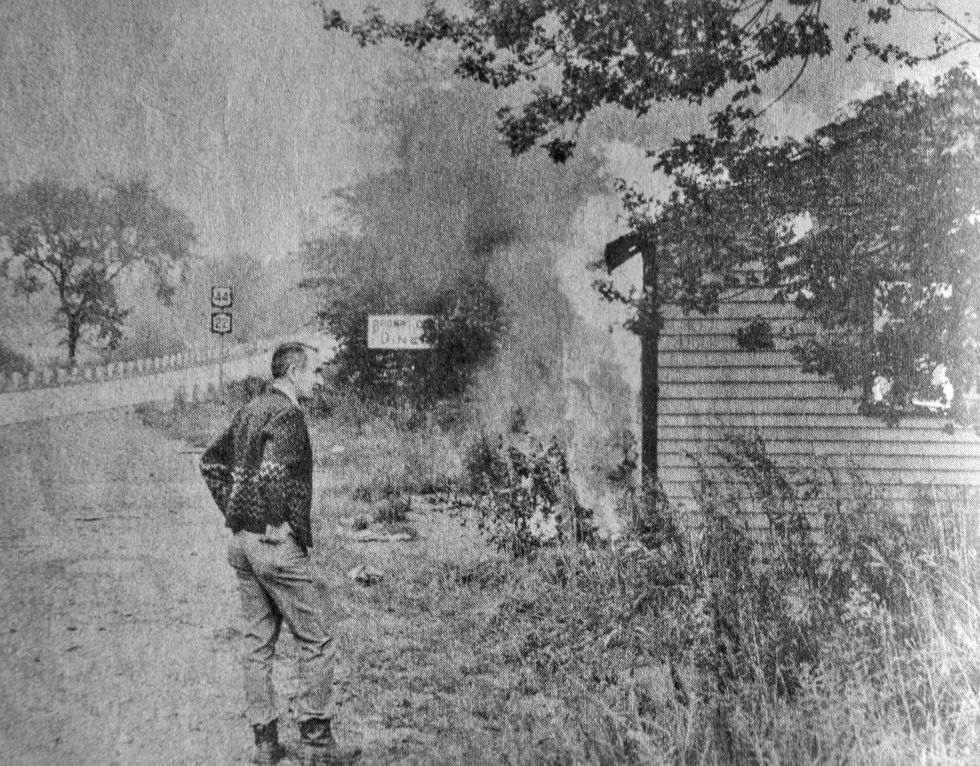
Millerton Fire Co. members monitor a fire at the Brown Cup Diner on Route 22. The diner would later be completely destroyed by the fire.
Archive photo


Millerton Fire Co. members monitor a fire at the Brown Cup Diner on Route 22. The diner would later be completely destroyed by the fire.
Millerton’s volunteer fire department has spent more than 130 years protecting the village, a legacy that began after a fire ravaged and destroyed a prominent hotel in 1891.
North East Fire District Commissioner Dave Vandebogart, who serves as the fire company’s historian, is himself a third-generation member of the Millerton Fire Company. He said Millerton’s rapid growth after the arrival of the railroad spurred the need for an organized fire department.
At the time, building codes didn’t exist and materials were much more flammable. Densely populated communities like the newly-formed Millerton could face devastation if a fire broke out and spread through the community.
That fear materialized in January 1891, Vandebogart said, when the Millerton Hotel near the intersection of John Street and Center Street caught fire. Village residents banded together with buckets to try to douse the flames, but the effort wasn’t enough to save the building. The incident highlighted a need for an organized fire company with proper firefighting equipment.
The fire company officially formed in January 1892, after village trustees met at the Millerton National Bank and voted to create a local fire company. Trustees later elected to name the company the E.H. Thompson Hose Company in honor of the bank’s president, who provided the venue for the trustees’ early meetings.
The newly-formed hose company soon purchased a horse-drawn hose cart, complete with a 500-foot hose, wrenches and 28 pails for carrying water. An additional horse-driven cart carried nine ladders.
The fire company’s first official home was a building that still stands at the corner of Dutchess Avenue and Century Boulevard in Millerton, neighboring the building that houses EcoBuilders and Moore & Moore Printing. That building was constructed in 1902 and named the E.H. Thompson Fire House to further honor the Millerton National Bank’s president.
Millerton’s fire department slowly grew, expanding its equipment collection until a new firehouse was necessary and constructed in 1962. That building on Century Boulevard still serves as the company’s main firehouse today and is currently undergoing renovations to its exterior.
Firefighters have had to staff the firehouse 24/7 on multiple occasions during the village’s history — including in 1969 when a massive snowstorm shut down Route 22 for two days and two nights.
People crowded the firehouse for a warm place to stay as the snowstorm stranded travelers and forced some locals out of their homes. Everyone was stuck until large snow blowers arrived from Poughkeepsie to clear Route 22.
But Vandebogart said the fire company faces more profound challenges than just fighting fires. Changing demographics in the area and increased training standards have created challenges for the volunteer organization.
“Everything is modeled for career,” Vandebogart said, highlighting a shift over recent decades toward professional emergency medical services and firefighters nationwide. As that shift has occurred, safety standards and training requirements have risen across the board, placing a larger burden on volunteers.
Another challenge is attracting new members. In 2017, the Millerton Fire Company ran a program known as “Explorers,” which allowed teenagers from 14 and up to participate in volunteer work at the firehouse.
But that program folded due to staffing issues, and the North East Fire District Board of Commissioners has proposed a policy limiting volunteer participation to those no younger than 16 at its regular meeting on Tuesday, April 21.
Vandebogart said the rising cost of living in the region further exacerbates recruitment challenges. As costs increase, younger generations of Millertonians have become less likely to stay in the community to build a life.
“Membership kind of ebbs and flows,” Vandebogart said. “It is hard to keep young people around here.”
Looking toward the future, Vandebogart said the fire company hopes to avoid having to transition to professional firefighting for as long as possible.
“We’re just trying to keep it volunteer,” Vandebogart said.
Nathan Miller
Police drone operators take flight from the parking lot of J.H. Ketcham Hose Co.'s Wingdale station, near the search area for 49-year-old Ryan Courtien on Wednesday, July 15. Courtien has been missing since Sunday morning when we left his house to work in his front yard.
DOVER PLAINS — The search for former Dover Town Supervisor Ryan Courtien entered its third full day Wednesday, July 15, drawing emergency responders from across northeast Dutchess County and western Connecticut after the longtime public official disappeared from his property Sunday morning.
Courtien — a 49-year-old Wingdale resident, former Dover Town Supervisor, current Planning Board chair and volunteer firefighter — went outside at 9:30 a.m. on Sunday, July 12, to do yard work at his home on Waldo Road and never returned. New York State Police have led a search and rescue effort since Sunday afternoon, mobilizing up to 80 people per day to search the woods surrounding Courtien's home.
As of Wednesday morning, July 15, Courtien remains missing as authorities scour the area with heat-detecting drones, helicopters, scent hounds and searchers on foot.
Authorities and local officials are urging the public to keep an eye out for Courtien and check any security or trail cameras for signs of him. Authorities say Courtien was last seen wearing tan pants and a black t-shirt. His cellphone was left behind and State Police Trooper Krystal Paolicelli said Courtien's vehicle is accounted for at his home.
"We are asking residents to check their Ring cams, if anyone has any trail cams," Paolicelli said. "Anything that they see that they think could help us in this investigation, just give us a call. Even if they think it's silly, give us a shout."
Members of the public will not be allowed to take part directly in search and rescue efforts, but Dover Town Supervisor Rich Yeno said community members may assist by donating water and electrolyte drinks to rescuers. Donations may be left at the J.H. Ketcham firehouse on Route 22 in Dover Plains.
Paolicelli said safety concerns are behind the decision to limit direct public involvement in the search. Authorities are searching the heavily wooded and rugged area directly surrounding Courtien's home on Waldo Road, posing a risk that nonprofessionals could be lost or injured.
Yeno praised Dover and surrounding communities and emergency responders for the show of support during the search for Courtien. He said the sizable response is a testament to the dedication of emergency responders and the tight-knit community that exists across Dutchess County and even into Connecticut.
"Everybody's a neighbor," Yeno said. "It's been overwhelming, but I can't thank the town enough."
Searchers have had to contend with temperatures climbing into the 90s and now face air quality issues due to wildfires in Ontario, Canada, that have cast a smoky haze over much of the Hudson Valley on Wednesday, July 15.
The heat poses challenges in the use of heat-detecting drones, New York State Police drone coordinator Bryan Conti said, but the devices are still helpful in the search effort.
The troopers' drones are equipped with both infrared and typical visible-light cameras that drone operators utilize to identify whether a heat signature belongs to wildlife, natural features or a missing person.
Drone operations have also been conducted in pre-dawn hours to aid the effectiveness of the heat-seeking capabilities. Those hours are crucial, Conti said, because of the heat and how objects on the ground retain it.
"The biggest thing right now, at this time of year, is everything holds the heat," Conti said. "We've been clearing a lot of the questionable areas or heat signatures."
Nathan Miller
A rendering of the planned pool and poolhouse shows a shallow, ramped entrance allowing access for people with disabilities.
Plans for the long-awaited community pool and poolhouse at Eddie Collins Memorial Park are moving into the construction phase, with village officials aiming to open the facility by summer 2027.
The Village Board of Trustees hopes to hold a ceremonial groundbreaking in July as part of Millerton’s 175th anniversary celebration. With contracts for electrical, plumbing and mechanical work now approved, construction is expected to begin in August.
The project has been in development since March 2024, when the village first unveiled plans to renovate Eddie Collins Memorial Park. Funding accelerated later that year after the village secured a $6.4 million grant through New York’s NY SWIMS capital program to construct a community pool, poolhouse with bathhouse facilities, community room and septic system.
The project received an additional boost in December 2024, when the New York State Office of Parks, Recreation and Historic Preservation awarded the village a matching grant of up to $675,000. In March 2025, the Foundation for Community Health contributed a $23,557 grant to help cover administrative costs associated with the project.
Then in February of this year, the Village revealed final designs for the pool. The structure is intended to withstand heavy seasonal use and support year-round community programming.
The pool design includes several features aimed to appeal to a wide range of ages, including a waterslide, diving board and water-play elements for children.
The proposed layout includes a sloped, shallow entry area with young children and accessibility in mind, a mid-depth section and a deep end designed to accommodate a diving board, officials said.
The plans also include a kitchen area that can support concessions and special events with outside vendors – a revenue stream village officials hope will offset operational costs.
The park’s first swimming pool was installed in 1966 in the rear southwestern corner of the park. Over time, the high water table lifted and cracked the pool. Groundwater infiltration prevented the pool’s water from heating up even on hot summer days.
The renovations to Eddie Collins Memorial Park have been a hit with residents so far. Construction on Phase 1 — regrading of the park, a new entrance and paved parking areas, a soccer field, accessible playground upgrades, new basketball courts and pavilion improvements — was completed in 2022.
Additional reporting provided by Aly Morrissey.
Aly Morrissey
Filmmaker Philip Milano of Dover Plains holds the Scotch U-matic cassette containing his original 1970s documentary about the Harlem Valley Transportation Association.
Long before the bustling Harlem Valley Rail Trail hosted runners, walkers and cyclists, a historic railroad ran through Millerton, connecting rural towns to New York City. The eventual dismantling of the railroad was met with criticism and pushback from residents.
That chapter of local history comes alive in a resurfaced documentary film that had been tucked away in an attic in Dover Plains for more than 40 years.
Philip Milano, the filmmaker and longtime Dover Plains resident, made the film as a student project during his time at New York University.
“It took me about a month to make,” Milano said. “I played all the music myself, lined up the interviews and edited it.”
The 28-minute film chronicles the efforts to retain passenger and freight rail service between New York City and Chatham, New York in the 1960s and 1970s.
Milano was contacted last year by a former Copake Falls resident who wanted to view the film for research. Skeptical that the old Scotch U-matic cassette – a bulky, professional-grade videotape used in the 1970s – would still play, Milano agreed to ship the only existing copy of his movie out west. To his surprise, it was successfully digitized.

The video is slightly grainy with crisp audio. Footage shows the former Saperstein’s building – now Westerlind – and its famed railroad mural, along with shots of the old Sharon and Millerton stations.
In an early scene, a young Holly Nelson – co-founder of Oblong Books – stands in her store and speaks passionately about the loss of rail service and its impact on rural businesses, farms and residents.
“It brings in the whole question of rural powerlessness,” Nelson said, warning that locals would soon become “highway hostages,” forced to drive gas-guzzling cars.
The late Frank Perotti, who served as the supervisor of North East for more than a decade, also appears, speaking about the loss of freight service affecting his dairy farm. “We see the loss in the economy since we’ve lost the service to the railroad,” he said.
The video aired on cable television, which was only available in Manhattan at the time. He watched the premiere from his aunt’s city apartment, surrounded by friends and bottles of wine.
“This must be what the Beatles felt like the first time they heard one of their songs on the radio,” he remembers thinking.
The film was also screened at The Moviehouse in Millerton for a one-night showing.
Though Milano didn’t pursue filmmaking after NYU, he stayed rooted in the area, opening Milano’s Restaurant in Pine Plains, which operated for 14 years. The location is now home to Back Bar Beer Garden.
Nearly 50 years later, Milano says he is content with how history unfolded. “If the trains had stayed, this whole area would look completely different,” he said. “In a way, I’m glad it didn’t happen because I still like bouncing along these scenic back roads. It’s one of the prettiest parts of New York.”

Want more of our stories on Google? Click here to make us a Preferred Source.
Aly Morrissey
The Village of Millerton was founded a decade before the Civil War during a time when railroads were transforming rural economies, the nation was expanding westward and tensions over slavery were mounting.
The first 25 years of Millerton reflected that era of rapid change, characterized by an almost overnight transformation from farmland to being a railroad hub.
According to “A Beckon Call to a Village,” a 2001 history compiled by former North East Historical Society president Diane Thompson, leaders in the already-established Town of North East understood the opportunity a rail line could bring.
A meeting was held at the Wakeman House, home of local farmer Walter Wakeman, where a small group of men began laying out plans for a village that did not yet exist.
Wakeman himself played a crucial role, selling a 66-foot strip of his farm – nearly half a mile long – to the railroad. Additional acreage followed to accommodate a depot, engine house, sheds and extra track.
Civil engineer Sidney Miller is credited with bringing the railroad to what would later be known as Millerton in 1851. According to historical documents, he was so well regarded that the village was named in his honor.
On Sept. 1, 1851, the first train rolled into Millerton.

Iron production also played a key role in Millerton’s early growth. In 1854, the Millerton Iron Company established a major foundry in the area known as Irondale.
By 1882, the plant employed about 150 workers and by 1890 it was producing up to 12,000 tons of pig iron annually. The raw iron was used to manufacture cast-iron products, including railroad car wheels.
Irondale grew into a small industrial hamlet with a general store, grist mill and post office.
With the railroad established, Millerton quickly expanded. In 1852, just one year after the first train arrived, the Millerton Hotel was erected on North Center Street behind what is now the Oakhurst Diner. Built by Alexander Hawley, Alexander Trowbridge and James Winchell, the two-story building catered to rail passengers and visitors.
The hotel was later acquired by A.J. Pulver, who modernized it. For roughly 50 years, it stood as a symbol of Millerton’s growth before being dismantled in 1936. Its materials were salvaged during the Great Depression.
That early period saw the construction of a Greek Revival-style commercial building that housed E.W. Simmons & Co., Millerton’s first general store. Opened in partnership with Harvey Roe of Spencer’s Corners, the store sold groceries, lumber and building supplies.

By the mid-1860s, Millerton’s commercial district continued to expand. In 1865, prominent builder Ambrose Beers constructed an Italianate-style carpenter shop that would later become home to Dewitt “Dewey” Husted and his wife. For 18 years, it operated as a confectionery and bakery. It later served as a sporting goods and furniture store, and after a 2008 renovation is now home to Elyse Harney Real Estate.
By 1875, Millerton was formally incorporated and recognized as a municipality. Kneeland J. Munson became the village’s first mayor.
In just 24 years, Millerton had transformed from farmland to railroad outpost to incorporated village, with even greater expansion waiting in the decades to come.
D.H. Callahan
The Kingston Guards and the Bovina Dairymen
These aren’t your standard gym rats trying to relive their high school or college glory.
The Kingston Guards are playing ball the way it used to be played. To be specific, they’re playing baseball by the rules of 1864, the last full season before the Civil War. To them, it’s a purer form of the game, devoid of constant rule changes and all that pesky equipment like gloves, helmets and catchers’ masks. Sure, there are umpires, but they’re really there more to settle arguments than make actual calls.
The whole game feels less aggressive and more friendly. In fact, many of the players on the Guards and other teams in the vintage baseball scene came from softball leagues that had simply become too competitive. These aren’t your standard gym rats trying to relive their high school or college glory. More often, they’re history buffs looking for something a little more athletic than the synchronized marching of Civil War reenactments — though, to be fair, some of them are still Civil War reenactors.
While decidedly less competitive, this brand of vintage baseball isn’t necessarily less involved. The Guards practice every week. They travel the eastern seaboard playing teams like the Boniva Dairymen, the Ulster Nine and the Hunky Dory Base Ball Club of Lansdale. They even attend a two-day vintage base ball festival in Gettysburg, Pennsylvania, where teams from across the country gather to take in a side of military history with their friendly competition.
The vintage baseball movement appears to have gotten its start in the mid-1990s, perhaps as a response to the 1994 Major League Baseball strike, which resulted in a canceled postseason and World Series. As the Major League Baseball Players Association prepares to renegotiate its collective bargaining agreement after the 2026 season, rumors swirl of another such eventuality. With many baseball fans disillusioned by an increasingly capitalistic league, another strike could fuel interest in vintage baseball.
The rules are the same for all these clubs, but the uniforms certainly are not. The Guards wear thick woolen uniforms that team member Brock “The Badger” Mehan describes as not just hot, but “humid.”The Dairymen, in the Catskills, don slacks, button-down blouses, suspenders and newsboy caps. But no matter the uniform on their backs, everybody seems to be on the same team.
You can catch the Guards in all their old-time action when take the field at the Rhinebeck Aerodrome on Aug. 14 and Sept. 11.
D.H. Callahan
Hotchkiss Library’s Book Signing Weekend draws readers of all ages
For more than a quarter century, the Hotchkiss Library of Sharon has been connecting readers with some of their favorite authors at its signature Summer Book Signing Weekend, returning for its 28th year July 31 through Aug. 2.
The weekend is one of the library’s biggest fundraisers, attracting a wide range of book fans from across the region, as well as out-of-towners who make it a point to be there. Authors represent every corner of the literary world, from children’s books to nonfiction, poetry to historical fiction and even cookbooks. They also come from all over the country, though there is an emphasis on authors local to the area.
One notable local author was former Secretary of State and Secretary of Defense under Presidents Richard Nixon and Gerald Ford, Henry Kissinger. Authors from farther away have included Pulitzer Prize winner and former executive editor of The Washington Post and The Boston Globe, Marty Baron, Bard College writer-in-residence Francine Prose and National Book Award winner Susan Choi.

This year’s featured headliner was scheduled to be E. Jean Carroll, whose book “Not My Type: One Woman vs. a President” chronicles her legal battles with President Donald Trump. Unfortunately, another legal decision was issued in her favor in June, sparking outrage and violent rhetoric from some Trump supporters. Consequently, Carroll’s appearances have been canceled.
But there is still plenty to be excited about at this year’s Book Signing Weekend, and a lot of it has to do with food. For years, the weekend has featured Author Dinners, intimate gatherings hosted by library patrons in their homes in Sharon and neighboring towns. Among the authors attending these dinners are travel writer and influencer Jennifer Broome, geneticist and internationally recognized anti-racism educator Shaumita Dasgupta, and Russian-born New York Times bestselling novelist Gary Shteyngart.
The dinners, however, are just the beginning. On Saturday, the library will host its second annual Page to Plate, a literary celebration of food.
Throughout the day, attendees can enjoy talks, demonstrations and perhaps even a cocktail or two from chefs, bakers and, of course, writers.Featured guests include novelist Adam Roberts, author of “Food Person: a Novel”; Bread Alone founder Daniel Leader; and Chris Morocco, food director of Bon Appetit and Epicurious. Programming is divided into morning and afternoon sessions, with tickets available for either session or the full day.
Of course, the main event is the book signing itself, when dozens of authors will sign books available for purchase at the library.
For tickets, visit hotchkisslibraryofsharon.org

Want more of our stories on Google? Click here to make us a Preferred Source.

Want more of our stories on Google? Click here to make us a Preferred Source.