Thank you!
Your support is sustaining the future of local news in our communities.

Millerton’s early days brought huge change to the community

Millerton’s early days brought huge change to the community

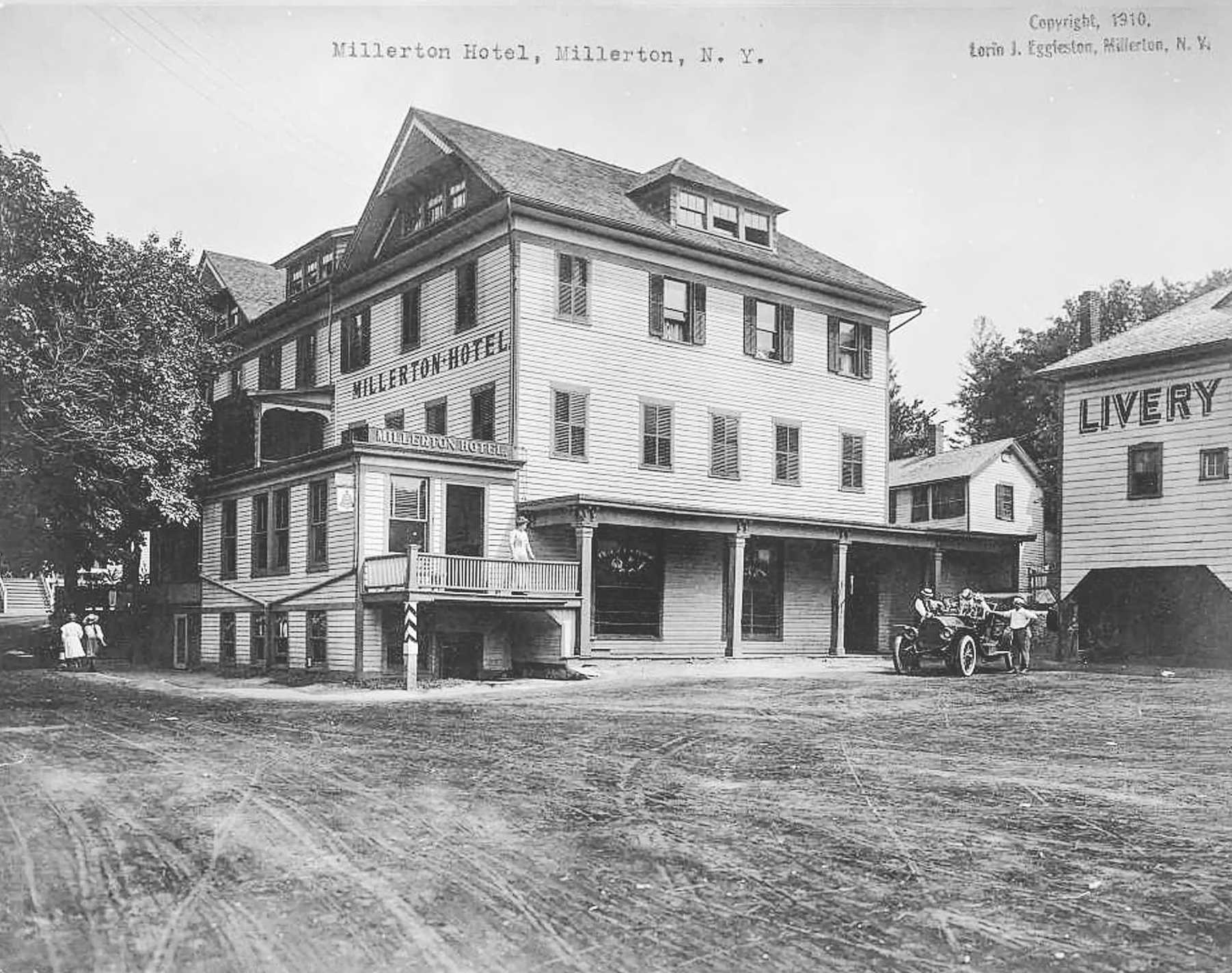
The Millerton hotel on Center Street ca. 1910.

Courtesy U.S. Library of Congress

The Village of Millerton was founded a decade before the Civil War during a time when railroads were transforming rural economies, the nation was expanding westward and tensions over slavery were mounting.

The first 25 years of Millerton reflected that era of rapid change, characterized by an almost overnight transformation from farmland to being a railroad hub.

According to “A Beckon Call to a Village,” a 2001 history compiled by former North East Historical Society president Diane Thompson, leaders in the already-established Town of North East understood the opportunity a rail line could bring.

A meeting was held at the Wakeman House, home of local farmer Walter Wakeman, where a small group of men began laying out plans for a village that did not yet exist.

Wakeman himself played a crucial role, selling a 66-foot strip of his farm – nearly half a mile long – to the railroad. Additional acreage followed to accommodate a depot, engine house, sheds and extra track.

Civil engineer Sidney Miller is credited with bringing the railroad to what would later be known as Millerton in 1851. According to historical documents, he was so well regarded that the village was named in his honor.

On Sept. 1, 1851, the first train rolled into Millerton.
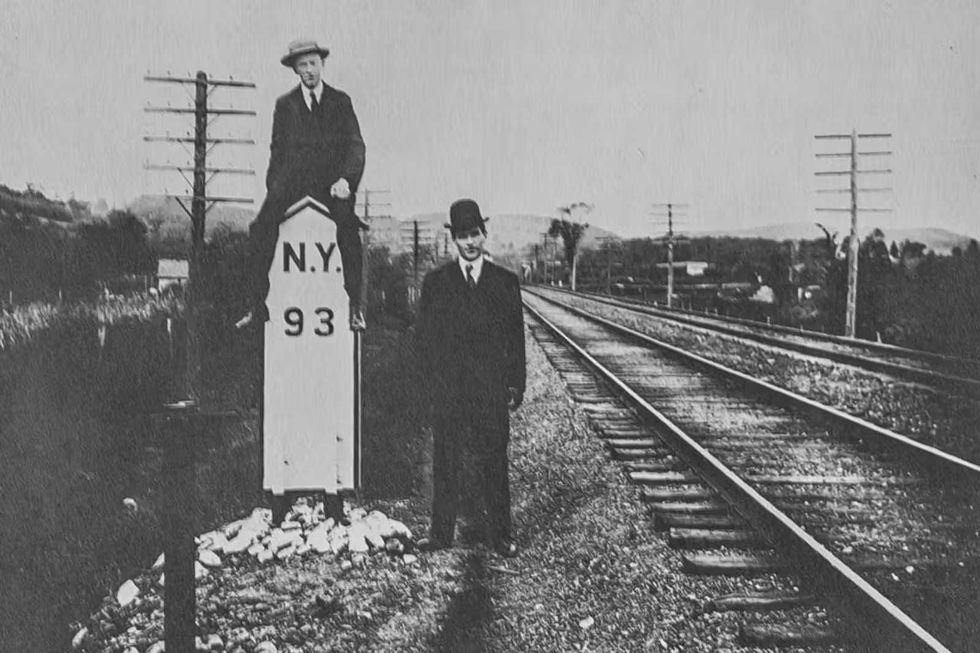
Two men pose with a mile marker noting the distance from Millerton to New York City.Courtesy U.S. Library of Congress

Iron production also played a key role in Millerton’s early growth. In 1854, the Millerton Iron Company established a major foundry in the area known as Irondale.

By 1882, the plant employed about 150 workers and by 1890 it was producing up to 12,000 tons of pig iron annually. The raw iron was used to manufacture cast-iron products, including railroad car wheels.

Irondale grew into a small industrial hamlet with a general store, grist mill and post office.

With the railroad established, Millerton quickly expanded. In 1852, just one year after the first train arrived, the Millerton Hotel was erected on North Center Street behind what is now the Oakhurst Diner. Built by Alexander Hawley, Alexander Trowbridge and James Winchell, the two-story building catered to rail passengers and visitors.

The hotel was later acquired by A.J. Pulver, who modernized it. For roughly 50 years, it stood as a symbol of Millerton’s growth before being dismantled in 1936. Its materials were salvaged during the Great Depression.

That early period saw the construction of a Greek Revival-style commercial building that housed E.W. Simmons & Co., Millerton’s first general store. Opened in partnership with Harvey Roe of Spencer’s Corners, the store sold groceries, lumber and building supplies.
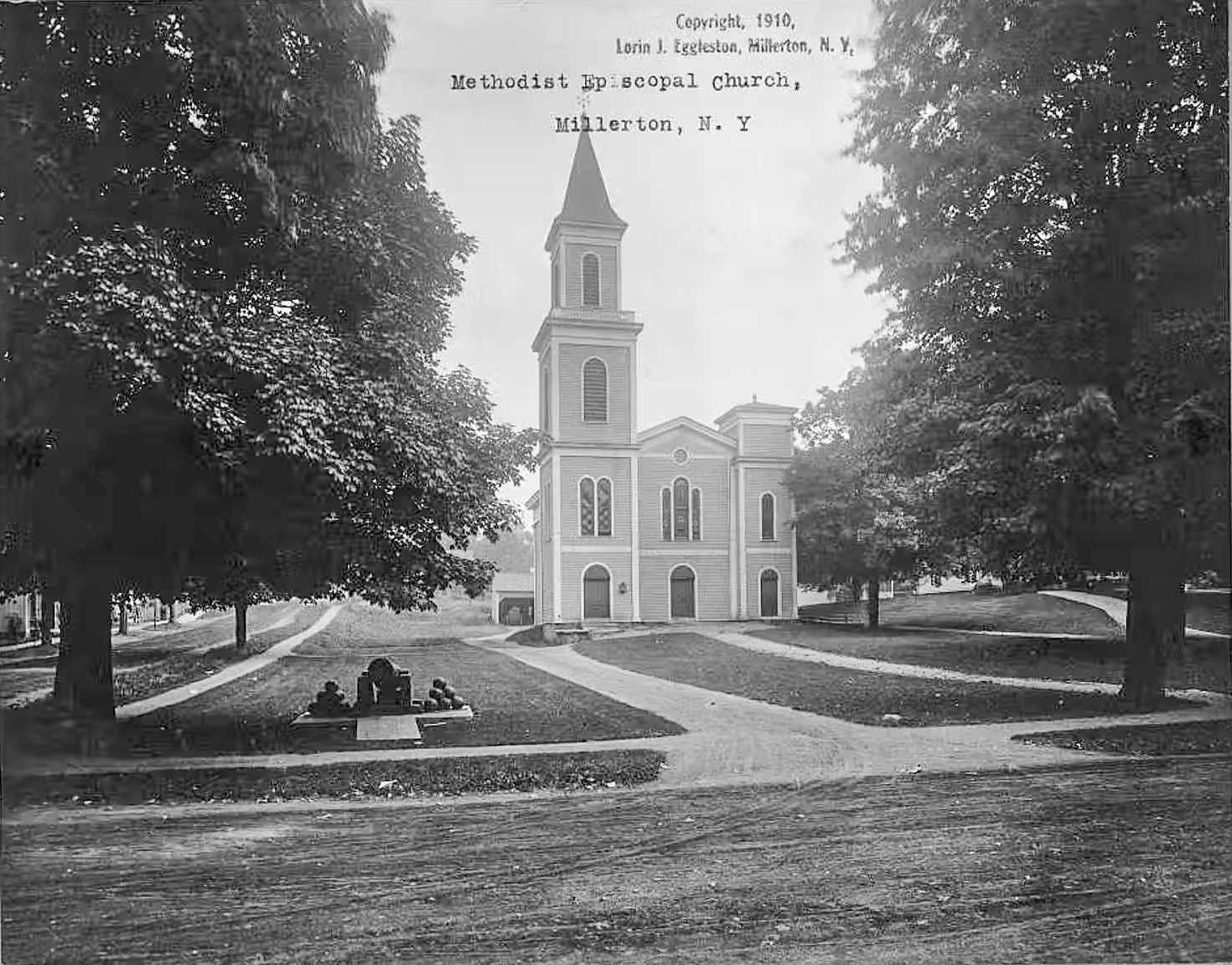
A historical photograph depicts Millerton’s Methodist church on Main Street ca. 1910.Courtesy U.S. Library of Congress

By the mid-1860s, Millerton’s commercial district continued to expand. In 1865, prominent builder Ambrose Beers constructed an Italianate-style carpenter shop that would later become home to Dewitt “Dewey” Husted and his wife. For 18 years, it operated as a confectionery and bakery. It later served as a sporting goods and furniture store, and after a 2008 renovation is now home to Elyse Harney Real Estate.

By 1875, Millerton was formally incorporated and recognized as a municipality. Kneeland J. Munson became the village’s first mayor.

In just 24 years, Millerton had transformed from farmland to railroad outpost to incorporated village, with even greater expansion waiting in the decades to come.
Latest News

Search for missing former Dover Town Supervisor continues after sudden disappearance

Police drone operators take flight from the parking lot of J.H. Ketcham Hose Co.'s Wingdale station, near the search area for 49-year-old Ryan Courtien on Wednesday, July 15. Courtien has been missing since Sunday morning when we left his house to work in his front yard.

Photo by Lucia Iandolo

DOVER PLAINS — The search for former Dover Town Supervisor Ryan Courtien entered its third full day Wednesday, July 15, drawing emergency responders from across northeast Dutchess County and western Connecticut after the longtime public official disappeared from his property Sunday morning.

Courtien — a 49-year-old Wingdale resident, former Dover Town Supervisor, current Planning Board chair and volunteer firefighter — went outside at 9:30 a.m. on Sunday, July 12, to do yard work at his home on Waldo Road and never returned. New York State Police have led a search and rescue effort since Sunday afternoon, mobilizing up to 80 people per day to search the woods surrounding Courtien's home.

Keep ReadingShow less
Millerton owes its name to a transient engineer
Photo Courtesy North East Historical SocietySidney G. Miller, the engineer that helped build the railroad through Millerton, is the village’s namesake but never lived there.

The arrival of the railroad in the Town of North East in 1851 is heralded as the moment Millerton came into being — ushering in a boom period for the area that transformed it from a sparsely populated farming community into a hub of commerce.

That moment was brought about by Sidney Greene Miller and his associate civil engineers in their work as contractors for the New York and Harlem Railroad. After his work, Millerton quickly grew from an insignificant hamlet in North East to the center of the town’s activity within just 25 years.

Keep ReadingShow less
Millerton’s fire department marks 134 years of battling blazes

Millerton Fire Co. members monitor a fire at the Brown Cup Diner on Route 22. The diner would later be completely destroyed by the fire.

Archive photo

Millerton’s volunteer fire department has spent more than 130 years protecting the village, a legacy that began after a fire ravaged and destroyed a prominent hotel in 1891.

North East Fire District Commissioner Dave Vandebogart, who serves as the fire company’s historian, is himself a third-generation member of the Millerton Fire Company. He said Millerton’s rapid growth after the arrival of the railroad spurred the need for an organized fire department.

Keep ReadingShow less
google preferred source

Want more of our stories on Google? Click here to make us a Preferred Source.

New pool and poolhouse expected to open next year

A rendering of the planned pool and poolhouse shows a shallow, ramped entrance allowing access for people with disabilities.

Illustration Provided

Plans for the long-awaited community pool and poolhouse at Eddie Collins Memorial Park are moving into the construction phase, with village officials aiming to open the facility by summer 2027.

The Village Board of Trustees hopes to hold a ceremonial groundbreaking in July as part of Millerton’s 175th anniversary celebration. With contracts for electrical, plumbing and mechanical work now approved, construction is expected to begin in August.

Keep ReadingShow less
Documentary film about railroad resurfaces after 40 years

Filmmaker Philip Milano of Dover Plains holds the Scotch U-matic cassette containing his original 1970s documentary about the Harlem Valley Transportation Association.

Aly Morrissey

Long before the bustling Harlem Valley Rail Trail hosted runners, walkers and cyclists, a historic railroad ran through Millerton, connecting rural towns to New York City. The eventual dismantling of the railroad was met with criticism and pushback from residents.

That chapter of local history comes alive in a resurfaced documentary film that had been tucked away in an attic in Dover Plains for more than 40 years.

Keep ReadingShow less
Kingston Guards bring baseball back to the basics

The Kingston Guards and the Bovina Dairymen

Schuyler Meyer
These aren’t your standard gym rats trying to relive their high school or college glory.

The Kingston Guards are playing ball the way it used to be played. To be specific, they’re playing baseball by the rules of 1864, the last full season before the Civil War. To them, it’s a purer form of the game, devoid of constant rule changes and all that pesky equipment like gloves, helmets and catchers’ masks. Sure, there are umpires, but they’re really there more to settle arguments than make actual calls.

The whole game feels less aggressive and more friendly. In fact, many of the players on the Guards and other teams in the vintage baseball scene came from softball leagues that had simply become too competitive. These aren’t your standard gym rats trying to relive their high school or college glory. More often, they’re history buffs looking for something a little more athletic than the synchronized marching of Civil War reenactments — though, to be fair, some of them are still Civil War reenactors.

Keep ReadingShow less
google preferred source

Want more of our stories on Google? Click here to make us a Preferred Source.

google preferred source

Want more of our stories on Google? Click here to make us a Preferred Source.