What, exactly, is the national debt? U.S. federal debt is basically two parts: one held by the public and the other intra-governmental debt (mostly Social Security’s money, which the government has always borrowed against and then claimed that Social Security is going broke because they borrowed all the money at near zero interest rate).
As of May, total debt held by the public was $19.8 trillion, and intra-governmental debt was another $6 trillion. In the media and politicians’ utterances, these two amounts are lumped together, but they should be treated separately. The interest paid on debt held by the public is paid by the Treasury in the form of real interest to the owners of that debt. The interest paid on intra-governmental debt money the federal government pays itself and doesn’t ever really refund Social Security.
The combination of trillions more in federal debt from higher spending and lower tax receipts this year and next (think COVID-19) and the probability that there will be future federal spending to better prepare for pandemics raise my blood pressure. Governments have, traditionally, only ever repaid debt by bringing back inflation. Basically, it goes like this: I borrow $100 from you at 5% interest. If I bring back inflation that $100 is now worth less and also with inflation everyone needs more income (pay) so salaries rise and people pay more dollars in tax — even if the dollars are worth less. I then can pay you back $100, which may now only be worth the buying power of $50. Nixon did this, Reagan+Bush did this, Clinton took the credit… and on and on.
Look, this is not complicated. A house is a house, right? A house off Park Avenue on 95th Street cost $1,200 to buy in 1935, $35,000 to buy in 1950, $1,200,000 in 1990 and $3,000,000-plus this year. A house in upper New York state cost $3,500 in 1975, $35,000 in 1989 and $650,000 in 2007. The property didn’t change; the value of the dollar did with inflation.
In the defense industry they are worried that their future money needs won’t be met. “Flat” was already the new budget “up,” but “flat” now may be a budget that does not keep pace with annual inflation. Their fears are well founded that defense spending will decline in the 2020s after a couple of good years of largess from pre-2019 Congress and the White House.
Ah, but, people say, there is a silver lining to this cloud: The interest rate on the federal debt is low. The Federal Reserve’s aggressive lowering of interest rates makes federal debt more affordable, just the same as a lower interest rate on a home mortgage can make a place to live more affordable. The Office of Management and Budget (OMB) keeps the figures on all this and projected, in February, the interest would only add about $300,000,000,000 to the debt next year. COVID has chucked all those projections out the window.
The outcome of the pandemic will be to make all OMB expectations more sensitive to interest rate expectations. With rising debt and interest rates set to increase to more “normal” levels, the unthinkable “inflation” is already appearing on long-term projections — especially in the defense world. And, remember, any one major military conflict, or huge natural disaster or another economic contraction (which Wall Street is expecting) could further add to federal debt in the 2020s.
The rate on a 90-day treasury bill is currently 0.13%. On a five-year note, it is 0.33%, and on the 10-year note, 0.69%. The 30-year note rate is 1.4%. Already the OMB and the administration are hinting that next year’s budget (March 2021) will reflect probably higher interest rates and a cap, certainly, on defense spending. Once the interest rates climb, you will see inflation return and, given six-plus years, the debt can miraculously be paid down. Of course, none of that has anything to do with real prosperity for the working woman and man — in fact, quite the opposite since there’s always a gap in real value from income when inflation returns.
Peter Riva, a former resident of Amenia Union, now resides in New Mexico.



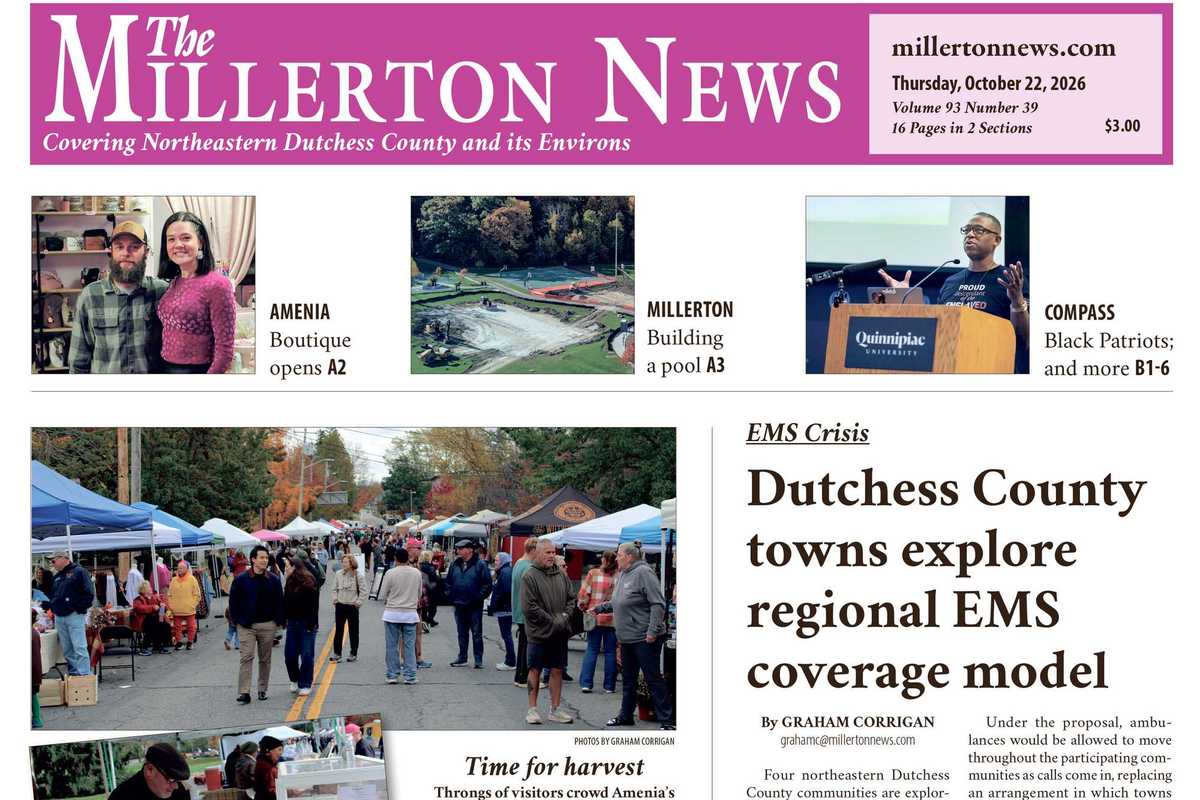


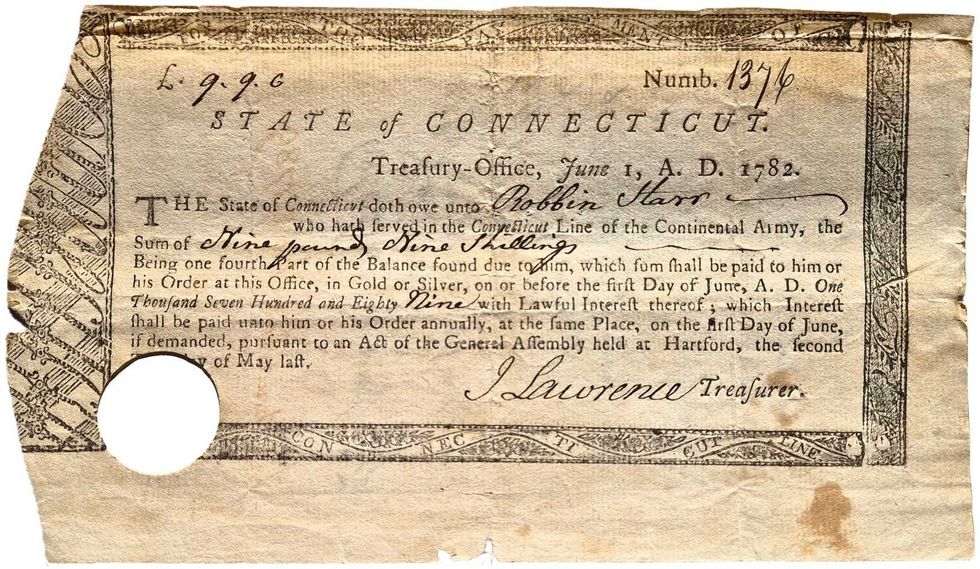 Pay Bill for Robin Starr’s service in the Continental Army.Courtesy the Alex Breanne Corporation
 John Mills speaking at Quinnipiac University.Courtesy the Alex Breanne Corporation
 Stephanie Saetta,with her rescue dog George and Blue (left), a shepherd mix awaiting his forever home.Madi Long