Largest class since 2014 graduates from Stissing Mountain High

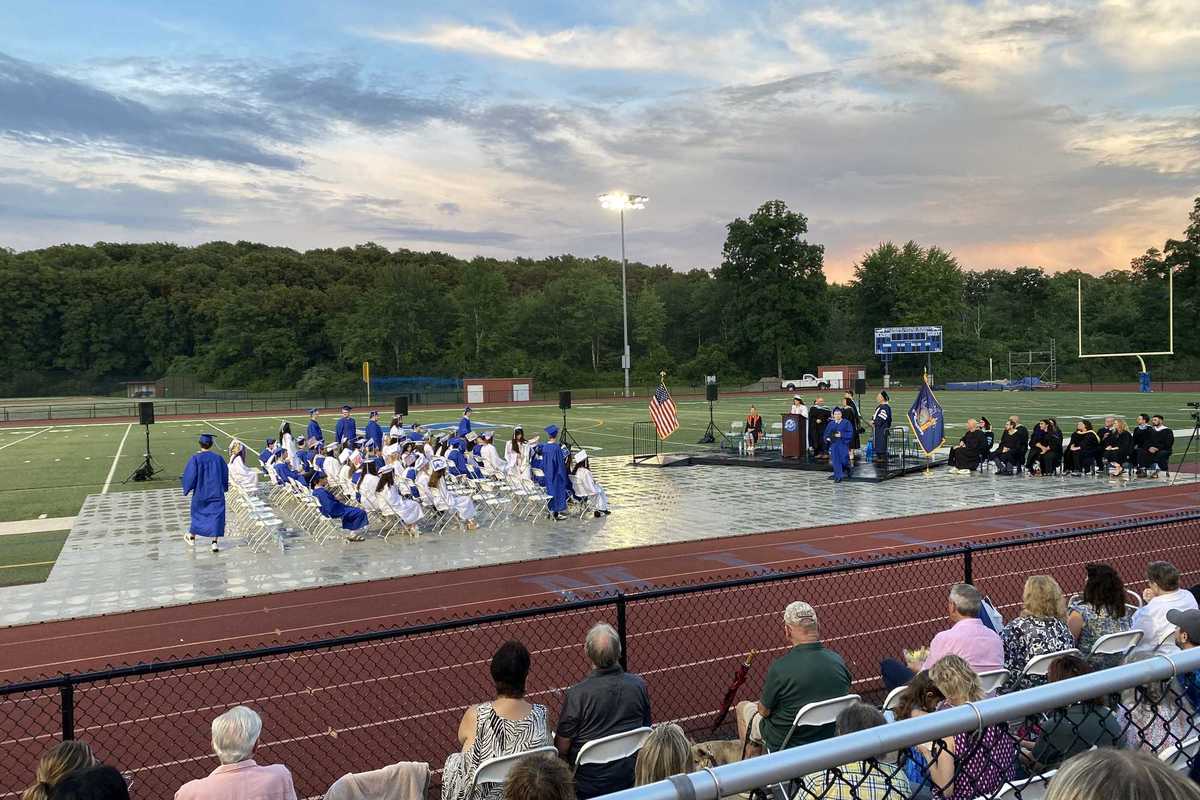
The Stissing Mountain High School Class of 2026 celebrates graduation as 82 seniors receive their diplomas.
Photo By Graham Corrigan


The Stissing Mountain High School Class of 2026 celebrates graduation as 82 seniors receive their diplomas.
PINE PLAINS — The largest graduating class since 2014 — totalling 82 seniors — celebrated the end of high school on Saturday, June 20.
Seniors from Stissing Mountain High School had their graduation at the school on Church Street in Pine Plains. Cloudy weather threatened rain but didn’t follow through as classmates, friends and family gathered to recognize the graduates’ achievements.
Principal Cristopher Boyd, School Board President Amy Fredericks, and Superintendent Dr. Brian Timm delivered opening remarks to a crowded auditorium of friends, family, and congratulatory balloons.
Dr. Timm urged the students to seek out growth through creative tension in their next chapter, and to embrace challenges as opportunities to grow. He extolled the group’s determination, and encouraged them to remember Nelson Mandela’s words: “It always seems impossible until it’s done.”
Then came the student speakers: Michelle Blackburn, Siena Millar, Salutatorian Violet Bliss, and Valedictorian Alyssa Fredericks shared messages of gratitude for the support they had received throughout their education, both from their family and community. “Pine Plains helped build the foundation we all stand on,” said Valedictorian Fredericks.
This was the last step for a class that has, in large part, been classmates since kindergarten. They were together one last time on Saturday, awash in purple robes and graduation caps for the occasion.
The class of 2026 will be spreading out next year. Popular college destinations include Dutchess Community College, the SUNY system, colleges in Boston, and the armed services. More than a quarter of graduates are starting full-time jobs after high school.
The school’s chorus performed twice during the graduation, singing the Pine Plains alma mater to introduce the student speakers, and Fleetwood Mac’s “Landslide” to play them off.
Finally, it was time: one by one the 82 seniors shuffled off the risers to shake hands with the administrators, receive their diploma, and make that long walk across the stage to the jubilant hoots of their family and friends. As they processed off the stage and into those waiting arms, one chapter ended and another began.

Nathan Miller
Cole Shapiro, left, shows a picture of the State Line Road house that he helped renovate taken during the early stages of rebuilding walls for the structure during an open house on Saturday, June 20.
MILLERTON — A unique home renovation on State Line Road is joining the ranks of thousands of buildings across the U.S. that use little to no energy for heating and cooling.
Wendy Hill’s home on State Line Road, which she rented for 10 years before buying the property and embarking on the renovation in January 2025, will be a Passive House Institute US-certified “Passive House” once renovations are completed in the coming weeks.
Passive houses are buildings that rely on thick insulation as well as heat from the sun to cut down on energy costs. The concept was developed over the past 50 years as advancements in insulating building materials allowed for more efficient construction that uses little to no energy to maintain comfortable temperatures.
Hill’s home is a standout from the typical passive house, primarily because of her decision to retrofit an existing home rather than build new.
But Cole Shapiro and his Kingston-based boutique contracting firm Building House took on the task, implementing a modern take on a two-story Cape Cod-style design with a basement garage utilizing the existing foundation.
Shapiro led a presentation on the construction of the home and discussed some specifics about passive home building at an open house at Hill’s home on Saturday, June 20.
The retrofit required the original home — built in 1992 — to be torn down to its studs and the roof removed so the entire structure could be rebuilt to passive house certification standards, Shapiro said.
“This is our first retrofit,” Shapiro said. “Good bones, a little rundown.”
From there, with nothing but the existing foundation and timber studs where the house used to stand, Shapiro’s crew began building up the walls, installing new windows and eventually building a brand new roof.
Shapiro joked with attendees, saying that the site of the nearly-demolished house was a shock in early construction.
“No matter how good you are as a builder at setting expectations with your client, nothing prepares them for this,” Shapiro said. “There was probably a lot of tears during those early days.”
The walls and windows are important aspects of a passive house build, Shapiro explained. The structures must be airtight to minimize heat loss as much as possible. Walls also have to be much thicker than typical, and are packed with high-efficiency insulation and membranes that allow moisture to escape the structure while trapping air and heat.
The windows and doors used in the build resemble vault doors, with thick frames and a flanged shape that locks in air. Passive houses are required to be essentially air-tight because leaks contribute the most to heat loss in a structure.
Passive houses seek to address this issue by sealing the building and using special air circulation systems that release stale air and ingest fresh air from the outdoors. Hill’s house uses what’s known as an “energy recovery ventilator,” or ERV, to ventilate the home without compromising heating efficiency.
ERVs transfer moisture and heat between the expelled inside air and ingested outside air, allowing fresh air to enter the home without compromising the home’s other heat-trapping measures.
The build process wasn’t entirely straightforward, Shapiro said. One hurdle was the electrical and plumbing work that Shapiro said poked holes in the house’s airtight seal and caused unacceptable air leaks. Crews had to conduct tests and patch holes to fix the leaks and bring the house into compliance with passive house certification standards.
“Our plumber-slash-electrician just could not understand what an air barrier was,” Shapiro said. “And I think at some point seemed to be making a sport of turning our air barriers into Swiss cheese.”
Airtight design requirements still allow for homeowners to open their doors and windows to let in a nice breeze, which Hill demonstrated at the open house by letting in a gentle summer breeze.
Leila Hawken
A white banner reading “workers over billionaires” has become a part of regular weekly anti-Trump administration protests led by Amenia resident Kimberley Travis.
AMENIA — A banner used during weekly political demonstrations in downtown Amenia has sparked debate over whether protesters can attach signs to town-owned lightpoles and other municipal property.
The issue came before the Town Board on Thursday, June 18, after protest organizer Kim Travis requested clarification on whether a banner reading “workers over billionaires” violates the town’s sign regulations.
Travis, who has organized regular anti-Trump demonstrations at Fountain Square since 2025, said Town Supervisor Rosanna Hamm contacted her before the meeting to say the banner was not permitted because it was secured to a town-owned light pole.
“Our temporary sign is exempt,” Travis told the board, arguing that the group removes the banner and other materials after each protest and does not damage public property. She said nylon rope is used to protect the painted surface of the lamp post.
Town Attorney Ian Lindars disagreed, saying town code prohibits attaching signs to municipal property. “I don’t agree with the interpretation of the code,” Lindars said, adding that the U.S. Supreme Court has ruled that lamp posts are not considered to be available for public use.
“You cannot tie signs to town property,” said Councilmember Nicole Ahearn.
Amenia’s Town Code regulates signs as part of the town’s zoning ordinance under chapter 121-39. Those regulations include a blanket ban on placing signs on “municipally owned property” without prior approval from the Town Board.
Hamm said her office did not receive formal complaints about the sign, but she had received phone calls and noticed complaints on FaceBook.
In response, Travis defended the sign and the weekly protest.
“We must all stand up,” Travis said, arguing that the protest is only for one hour.
Councilmember Walter Dietrich supported the usage of the banner, indicating that the protesters are not placing a permanent sign on the post.
Hamm recognized that the protesters nor the sign block the sidewalk or impede pedestrians. She indicated that she would like more time to consider the issue.
During public comment, resident Ken Topolsky spoke in support of allowing the banner, while resident Judy Moran said she was concerned about how sign regulations could be interpreted in the future if exceptions were made.
Lindars agreed that the board could delay a decision, and board members ultimately agreed to seek additional clarification on the sign regulations before taking any action.
“Nothing can be tied or attached to town property,” Ahearn reiterated.
Nathan Miller
Kanchisar Jiradhanaiphat, left, and John Schildbach hope to open Muanjai Tea on Main Street in Millerton by late July.
MILLERTON — Owners of a Thai tea shop planned for Main Street expect to get started with interior renovations this week after receiving approval for septic system plans from health officials.
John Schildbach, who plans to open Muanjai Tea at 28 Main St. in July, said on Monday, June 22, that the shop is awaiting one final approval from the Dutchess County Board of Health on the interior space itself and expects to begin installing counters and seating immediately after.
Discussions with the Board of Health over septic capacity caused earlier delays. Schildbach originally planned to have seating for 20 people inside the shop, but health officials required him to scale back that plan. The shop’s septic system was approved with the condition that only 14 seats be installed inside the shop.
He said the build out will likely take at least three weeks longer, meaning the storefront is not expected to open prior to Millerton’s 175 celebration running from July 11 to July 19. But Schildbach is planning to operate a pop-up tent offering a limited variety of tea drinks during the celebration.
Schildbach also plans to distribute 25% discount coupons to shoppers that stop by the pop-up. Customers can then use those coupons once the shop opens to get a discount at the shop once it opens later in July.
“It’s a little bit of a discount for people who want to try us out,” Schildbach said.
Schildbach announced plans to open the tea shop with his wife, Kanchisar Jiradhanaiphat, in late April. The shop will occupy the storefront formerly occupied by Candy-Os on Main Street.
“This isn’t going to be a bubble tea shop,” Schildbach said in April, describing a menu that seeks to bring authentic Thai tea culture to Millerton.
Highlights will include nom yen — a pink milk tea made with sweetened condensed milk and flavored syrup — as well as coffee cham yen, a blend of coffee and tea. The menu will also feature Thai tea ice cream floats, lattes and matcha drinks.
But the pair don’t want to limit the menu to just desserts and sweets. Schildbach said they are aiming for a sophisticated — yet affordable — menu that offers an authentic, approachable take on Thai tea shops.
That desire for authenticity will be built into the space itself, Schildbach said. Plans for the tea shop include adding a wall to create a service window typical of Bangkok tea shops, accented with tile and wood details.
The goal is to fit in with Millerton’s current lineup of Main Street businesses, while providing a unique experience for locals and visitors alike.
“It’s going to be like you’re in a tea shop in Thailand,” Schildbach said.

Want more of our stories on Google? Click here to make us a Preferred Source.
Graham Corrigan
Amid growing calls for action on emergency medical service contract costs, solutions are lagging as county officials explore options.
The county has allocated $4 million for EMS over the last two budgets, hoping to combat rising costs, a diminishing workforce, and declining numbers of volunteers. But six months into 2026, data reflecting results from the infusion has been hard to come by — and the problems persist.
At issue is the very status of emergency responders: unlike fire and police departments, there is no state mandate for a town to employ EMS responders. The cost of these services falls to the individual towns, and they’ve ballooned in recent years: North East, Amenia, and Dover split a $1.3 million contract, and Stanford pays $768,000 for its ambulance services. “This is a runaway train,” said county legislator Eric Alexander, who represents Amenia, Washington and a portion of Pleasant Valley. “So the first stop is to slow it down.”
“I was pleased when the county executive agreed that this needs to be a priority,” said Chris Drago, who represents northern Dutchess in the county legislature, “but this continues to be a Band-Aid solution.”
That’s due in part to a lack of competition. Empress EMS is the region’s primary EMS provider, and it just acquired Northern Dutchess Paramedics in late 2025. The company is the only provider of advanced life support services, commonly known as ALS, like ambulances. Basic life support, or BLS, which entails non-invasive life-saving techniques, can be administered by volunteers or first responders.
Even those BLS volunteers, however, are subject to the inherent challenges of providing timely support in rural areas such as north Dutchess. Round-the-clock coverage for an area that receives lower call volume gets expensive fast.
The high costs run parallel with Empress’ profit model. That hasn’t led to any complaints about their service, but as Rep. Drago put it, “I feel we need to take profit out of the equation of saving people’s lives.”
There are three primary ways the ambulance service makes money: billing patients and receiving reimbursements from insurance companies, taxpayer subsidies, and inter-facility transport. The latter involves moving patients to better-equipped facilities, usually in a non-emergency capacity.
In short, the more a patient uses an ambulance, the greater the profit. That’s led to northern Dutchess County to receive less attention than communities in the south — Empress ambulances tend to concentrate in the more populous southern towns, where call volume is higher. The vast majority of grants that fund fly cars, which are vehicles with basic medical equipment that allow for EMTs to provide some immediate triage care, awarded as part of the county’s EMS initiative, went to mid- and southern Dutchess towns.
But help may be on its way. Northwell Health is a healthcare provider that has been expanding north from its base in Long Island and New York City. It recently acquired Sharon Hospital in Connecticut, and has been speaking with lawmakers about providing supplemental ALS coverage to the area. At a March meeting in Milan, Northwell representatives made their pitch to town officials and emergency response leaders from northern Dutchess.
In the meantime, Northwell is implementing its own ALS program at Sharon Hospital. It involves employing hospital-based paramedics to provide a number of services. Instead of waiting for a call to come in, these paramedics will be an extra pair of hands in the emergency room and provide inter-facility transportation, in addition to their emergency response duties.
“We wanted to facilitate a dependable and effective movement of critical care patients,” said Matthew Cassavechia, Director of Emergency Services at Northwell. “We want to have a paramedic following these patients after they’ve been discharged, integrated into the larger continuum of care…it’s proven to be very effective in the general Sharon Hospital area.”
For now, Northwell hasn’t been integrated into the northern Dutchess emergency response pipeline. But that day may be fast approaching. “We’re eager for them to come online as an EMS provider in Dutchess County,” said Rep. Drago. “We could use their help.”
Joe Brennan
Phil Carroll stands near a pile of cut firewood he prepared for sale across New York. The Amenia native has been cutting trees and splitting wood for fireplaces for decades.
AMENIA — It’s been said that wood, as it burns, tells its history.
Phil Carroll has split and sold countless cords of dry highly flammable firewood over the decades and has narrated a lot of the history of his hometown, Amenia.
Carroll’s story begins more than 80 years ago on the banks of what was once Lake Amenia. Right before Carroll was born in 1942, his brother drowned at that swimming spot at the end of Lake Amenia Road, where the dam used to be. Phil’s mother was furious years later when she caught Phil skating across the frozen lake one winter day.
“She already lost one son to that lake,” Carroll said.
But they didn’t move out of their neighborhood to escape bad memories. Even after the dam broke, draining the lake into swamps nearby and forever changing Amenia’s landscape, his family bought and traded the land, moved houses, improved them, stayed close and planted huge gardens, plowed them over and made their own little community of wood cutters. Everything today is impeccably cared for.
The wood cutting machines are clean but clearly well used. It is a place of steady purposeful work.
Before making his career as a firewood supplier, Carroll worked as a tractor-trailer driver cross country but didn’t like it.
“You can’t sleep in a truck and own a house,” Carroll said. “Anybody who does that I think is crazy. You’re paying for the house and you’re out there.”
Then he got the idea of selling bundles of wood he sourced from his own property and nearby forests. His family thought he was crazy. Nobody around here would pay for kiln-dried firewood so Phil started hauling four-foot lengths of wood south to Fishkill, Clark, and Wilkins, New York, eventually leading to connections to New York City.
He had cleared trees right across the lake, where developer John Lango carved out those homes on Broadway. It was a swamp then, part of the lake. Then he worked to clear the forests behind his house — by the Squabble Hole, where the old ore mine flooded and made a perfect swimming hole. Phil couldn’t swim much, but the town boys dove off a rope halfway up Squabble Mountain.
He focused on distributing his wood Manhattan’s East Side first because storefront owners would pay and he could double park his truck at less risk of $600 tickets. In 1988, walking block to block, store to store, the small bodega owners saved him, and supermarket chain D’Agostinos took half a truckload but couldn’t put a real wood pile in the basement or else risk burning down the borough.
“I used to buy 80 to 90 thousand dollars of wood a year, just for New York,” Carroll said. “I’ve cut that down to 35 thousand now.”
While visiting New York all those decades ago, Carroll fostered an appreciation for dancing at Korean nightclubs. A full day’s worth of driving and delivering firewood would end with a high-energy fete dancing until the clubs closed at 3 a.m. Then Carroll would drive home.
Over the years, Carroll has recruited most of his family to join in on the business, including his son, Phil Carroll Jr.
Phil Jr. turned to the forest at 5 years old to work with his father. His job was marking logs with a 19 inch stick his father gave him, that had been measured and carved out for him as a template. Phil gave Phil Jr. a small hatchet, and not a Davy Crockett rubber blade, a real sharp edge and he marked off each section with a chopped notch as his father came behind him and tore through the felled tree with his chainsaw.
The assembly line begins at the simple splitter. It’s been sitting out in the split log walls around the driveway. These mostly go to the campgrounds like Copake. The air-dried local pieces take a year to cure and do not burn as good as his top-of-the-line stuff. J and J Lumber in Dover Plains bakes 19-inch lengths of various hardwood for a day and a half until its water content is bone dry.
These he splits over and over again so most of the bundle’s individual pieces are small and light enough to be picked up by anyone. The other pieces are even smaller, making for ready kindling although the whole pile will erupt in perfect flame, dry as tumbleweed.
Just look at the design of his signature product: the firewood bundle. It’s got his name on top, easy to read, so the buyer knows he’s getting the real deal from the master. The clear plastic is shrink wrapped so you can see that the wood and bark is clean and dry and free of bugs.
Phil, who still works selling firewood, takes pride in his product, he’s been known to throw a bundle across the workshop, “Who the hell made that!”
And Phil’s tireless, always figuring. As he looks out over his backyard, he’s still thinking ahead. “Next year I’m going to get a guy I know to blow up that other side of the hill,” Carroll said dryly. “I’d have twice as much flat land up here.”
Graham Corrigan
PINE PLAINS — Voters approved a school district budget on Tuesday, June 16, that cut three staff positions to save nearly $300,000 in expenses.
After the initial budget failed in May, Pine Plains Central School District administrators cut expenses to bring the tax levy within the state’s tax cap. Since the revised spending plan complied with the cap, it required only a simple majority for approval.
The second budget passed easily on June 16. The final vote count was 643 votes in favor, and 288 against.
The new budget is $290,569 less than the first budget. The reduction primarily came from eliminating three staff positions — a head bus driver, typist and nurse.
The budget’s passage now means the district will avoid much deeper cuts than what would have been required had it been voted down a second time. The mandatory contingency budget, which would have gone into effect, would have resulted in $945,789 in additional reductions and a freezing of capital projects.
The district has now moved forward with capital plans with the new budget in place. It has announced plans to replace the floor tiles at Seymour Smith Intermediate Learning Center and is continuing repair work on the roof at Stissing Mountain Jr/Sr High School.
The high school’s tennis courts and track will also be resurfaced this summer. Work is expected to begin in late June, and will last until Sept. 1. During this time, Seymour Smith and the affected athletic fields will be closed.

Want more of our stories on Google? Click here to make us a Preferred Source.

Want more of our stories on Google? Click here to make us a Preferred Source.