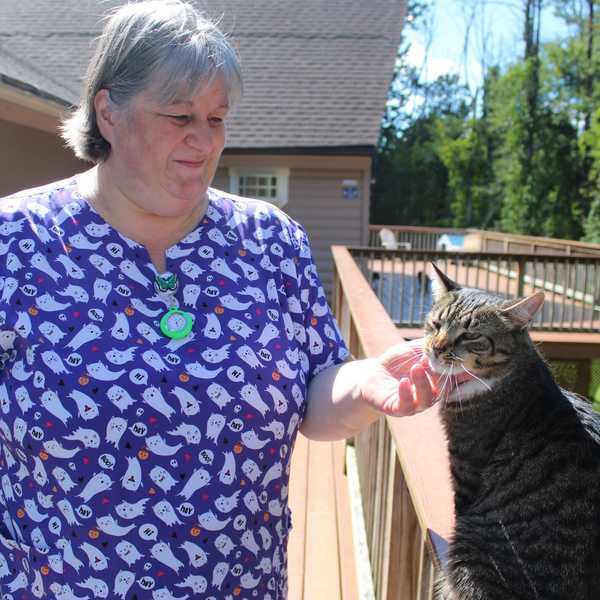



Cute class


John Coston
Friends and colleagues of the late Sam Busselle gathered at his home on Sunday, Aug. 30, to give and hear testimony about his lifelong mission to make Millerton and northern Dutchess County a better place.
MILLERTON — Sam Busselle’s half century of life and work in the Millerton community was celebrated on Sunday, Aug. 30, by friends, family members and colleagues who gathered to remember him as someone with boundless imagination and a relentless push to make the community a better place.
Busselle, who died on July 31 at the age of 86, was a Millerton resident for 50 years and cofounded with Wendy Curtis what became the North East Community Center, a nonprofit that addresses social service needs in the local community and northern Dutchess County.
“Because of him, Dutchess County’s a better place,” said Jenny Hansell, whom Busselle hired in 2001 to run NECC. “We had no staff. No programs. Busselle wanted programs for teenagers, the elderly, for transportation. My basic approach was to say ‘yes’ to everything,” she said.
“He always had another idea,” Hansell said, adding that his legacy — the NECC itself — will last beyond him.
Rebecca Busselle, Sam’s wife, said the sadness of his death is overcome by the knowledge of all the friends Sam had. “The love he spread around is coming back,” she said.
Busselle’s eldest son, Wynne Morriss, who described with some humor how his father taught him how to hitchhike, said “most importantly he told me to think about other people first.”
The gathering at Busselle’s home in North East also drew local and county politicians and civic leaders who recognized Busselle’s indomitable spirit and drive to address community problems, notably the need for affordable housing. In past years, Busselle served as a volunteer on the North East Town Board and on the Planning Board.
Former Pine Plains Town Supervisor Darrah Cloud recalled how he stopped into her office almost daily to urge her to take action on housing. “I realize now that you have to be a pain in the butt to get anything done,” she said, getting affirmative chuckles from the gathering, which was all too familiar with Busselle’s general refusal to take “no” for an answer.
Cloud pointed out that Busselle helped start the Tri-Town Coalition for affordable housing.
Chris Kennan, North East Supervisor, remarked that when he first took office Busselle demanded a meeting “to tell me what we needed to do.”
But family stories about how Busselle spent time with his children and grandchildren along with how he persisted in community improvement — including a three-year stint in the Peace Corps with Rebecca and the children in West Africa — created a broad-stroke portrait of family man with a developed public mission.
“He was game for whatever was going on,” said Don Cosentino, a UCLA professor emeritus who recalled Busselle from early Peace Corps days. “Always ready to jump in.”
Cosentino summed it up: “Architect, carpenter, devoted husband, fond father, community organizer, tireless reformer, country gentleman and city slicker. A man indeed of many ways.”
Nathan Miller
A former office building on Route 44 will soon be the first apartment complex in North East’s business district.
MILLERTON — New apartments are coming to North East’s business district along Route 44 after Planning Board members approved site plan documents.
Lilly Simons and her mother, Lauren, presented plans to convert a building that was once a restaurant and then an office building on Route 44 across from North East Ford. Simons plans to turn the building into an eight-unit apartment complex with five one-bedroom apartments, two two-bedroom apartments and a single studio.
The Planning Board granted site plan approval at its Wednesday, Aug. 26, meeting after three months of discussion on the application.
Now that the Planning Board has granted site plan approval, the developers can finalize building permits from the town’s Building Department and get started on the renovation work. Simons said plans only call for interior floorplan changes and adjustments to the parking lot to install an electric vehicle charger on the property and create more communal green space for residents.
“The basic, original footprint of the building we’re not really changing much,” Simons said. She added that some light landscaping is planned. Simons expects contractors to begin work over the fall and winter, with hopes the renovations will be complete by May 2027.
The apartments will be the first residential development in the Town of North East’s Boulevard District — a commercial zone that stretches along Route 44 from the eastern edge of the Millerton village border to the Connecticut state line. Residential development became possible in the commercial district after the town approved changes to its zoning code this year.
Simons said she was excited to provide new housing options in the community. “We’re excited about contributing to the community,” she said. “And providing something that everybody has said is really needed.”
She also expressed gratitude to town officials that helped through the approval process. Simons first appeared before the board in June. She said Planning Board members’ and town officials’ help exemplified their desire to bring more housing to Millerton.
“We really do want to give a sincere thank you to the Planning Board,” Simons said. “We appreciate the support. All of them were really great throughout the whole process.”
Graham Corrigan
Dutchess County’s top law enforcement officials will hold a public forum on their use of surveillance technology manufactured by Flock Safety on Wednesday, Sept. 23, at 5 p.m. at the Pleasant Valley Town Hall.
The forum, hosted by County Legislator Eric Alexander, will include District Attorney Anthony Parisi and Dutchess County Sheriff Kirk Imperati.
The announcement comes amid a controversial year of expansion for automated license plate readers across the county. Flock cameras have spread through small towns, gathering vehicle movement data to aid law enforcement investigations.
In a statement, Alexander said the event will give residents an opportunity to “ask questions and express concerns” about the AI-equipped cameras, while allowing the sheriff and DA to explain how the technology is deployed.
County Legislature Chair Yvette Valdés-Smith said the forum grew out of repeated constituent concerns, while Parisi said his office and the Sheriff’s Office are prepared to “answer difficult questions” and correct misinformation, even as he defended the county’s right to use lawful tools to solve crimes. Imperati added the county has taken steps to ensure the cameras are used within legal guidelines while remaining accountable to the public.
Parisi pointed to ARTCIC, the office’s online portal for Flock activity. ARTCIC highlights arrests made with the help of the Flock system, and lists the publicly available camera locations. Parisi has described it as one of the first efforts to unify multiple agencies under one crime-analysis platform.
Flock’s cameras and software are used by law-enforcement agencies across the country. It is just one company in an industry of automatic license plate readers, but Flock’s rapid growth has drawn criticism from privacy advocates. Concerns over data sharing with outside agencies—including federal immigration authorities—have prompted municipalities from Los Angeles to Windsor, Connecticut, to terminate their Flock contracts.
Earlier this year in the town of Pine Plains, a police sergeant signed an $80,000 contract with Flock without the Town Board’s knowledge or approval. The discovery came after residents spotted survey stakes marking planned camera locations around town. The sergeant has since retired, and the town ultimately canceled the agreement with Flock.
But some property owners have entered into independent agreements with the Sheriff’s department to host the cameras, leading to the presence of at least one Flock camera in every county municipality.
In August, Dutchess County Chief Deputy Steve Reverri appeared before the Amenia Town Board to discuss the utility of these cameras, and assuage concerns that the data was being misused.
September’s forum will be the county’s most direct attempt yet to address that unease head-on. Alexander frames the event as part of an ongoing effort at transparency, and Valdés-Smith said she expects a “candid and robust conversation.”

Want more of our stories on Google? Click here to make us a Preferred Source.

Graham Corrigan
AMENIA — In the midst of the ongoing affordability crisis, Amenia’s upcoming town meeting on Thursday, Sept. 17, will double as an affordability fair.
Organized by local politicians and businesses, the fair will bring residents and local businesses together to highlight discounts already available in the community.
“These are existing programs that have not found their way to Amenia in a fulsome way,” said County Legislator Eric Alexander. “It’s my job to make sure that my constituents are aware of and have easy access to these programs.”
From 5 p.m. to 7 p.m., residents can learn about property tax relief, free services for seniors, low cost veterinary services, prescription drug savings, grocery discounts, utility bill discounts, and more. Attendees are encouraged to bring their utility bills to the fair.
Alexander has organized the fair alongside State Sen. Michelle Hinchey, Assemblyman Anil Beephan, and Dutchess County Legislature Chair Yvette Valdés Smith. Participating organizations and businesses include Freshtown, Cornell Cooperative Extension, the Dutchess County Office of Veterans Affairs, and Hudson Valley Animal Rescue.
Representatives and elected officials will be on-site to answer questions and assist with applications.
The fair aims to address what Alexander sees as a lack of awareness in Amenia. On a per-capita basis, Pleasant Valley residents are five times more likely than Amenia residents to request free home-delivered meals, case management, and health insurance counseling.
Closing that gap has become more urgent as household budgets tighten.
Alexander also notes that the high prices aren’t just driven by local factors. The conflict in Iran, insurance spikes, and tariffs have driven up the cost of many household items. Wages and Social Security have not kept pace — and Alexander says relief from high prices is still a ways off.
“The purpose of this event is to help people start saving money now,” he said, “and be prepared for what lies ahead.”
Christian Murray
TORRINGTON — A judge issued a protective order Thursday, Aug. 27, in the criminal case against Maxwell Abendroth, the former Indian Mountain School athletic director and gym teacher charged with three felonies involving alleged sexual contact with a 15-year-old student.
The court identified the person protected by the order only by initials and did not disclose the individual’s relationship to Abendroth or the pending case.
The charges against Abendroth were not otherwise addressed during the brief proceeding in Torrington Superior Court.
The order prohibits Abendroth, 32, from contacting the protected person by telephone, electronically, in writing, or through a third party.
The judge told Abendroth that the order can be modified only by a Superior Court judge and remains binding even if the protected person attempts to contact him.
“No contact really means no contact,” the judge said, explaining that a violation would constitute a new felony offense.
The order also requires Abendroth to surrender or transfer any firearms and ammunition in his possession if he has not already done so.
Abendroth declined to comment when approached by a Lakeville Journal reporter outside the courthouse.
Abendroth is charged with fourth-degree sexual assault and two counts of risk of injury to a minor stemming from alleged conduct at the Lakeville school in January.
He was arrested Aug. 18 after surrendering at Connecticut State Police Troop B in North Canaan. He was released on $50,000 bond.
A 14-page arrest warrant affidavit provides further details about the allegations and Indian Mountain School’s response.
According to the affidavit, an IMS administrator making rounds Jan. 25 entered Abendroth’s office and saw him and the victim standing close together in a way the administrator considered “unsettling” and “odd.” The administrator reported that Abendroth pushed the student by the shoulder, causing her to fall over a coffee table.
The school’s director of student health and wellness interviewed the student and Abendroth the following day.
The student initially denied that anything inappropriate had occurred. She said she had been discussing exercises for back problems with Abendroth and that he had never made her uncomfortable. The school official reported that the student did not appear distressed.
Abendroth told the school that the student had come to discuss a rehabilitation protocol and that he nudged her, inadvertently causing her to fall, according to the affidavit.
Administrators continued investigating and reviewed communications between Abendroth and the student.
They found text messages dating to Nov. 20, 2025, that appeared romantic, although the initial review found nothing indicating a physical relationship, the affidavit states.
The school reported the matter to the state Department of Children and Families on Jan. 27. State police began investigating later that day. IMS placed Abendroth on administrative leave that day and fired him shortly afterward.
The school provided investigators with 40 files containing communications between Abendroth and the student. A DCF caseworker combined the files into a document totaling approximately 383 pages.
State police said Abendroth sent the student 133 emails from his school account between Nov. 20 and Jan. 22. Investigators also obtained letters and handwritten notes given to the student.
In one letter quoted in the warrant, Abendroth allegedly wrote that he felt himself being drawn toward the student and sought opportunities to see her around campus. He acknowledged that emailing her, leaving notes, and learning her schedule could get him “into a lot of trouble.”
“We do need to be careful because there are some observant people around,” he allegedly wrote.
Another email proposed using coded messages to select dates when the two could communicate.
Abendroth, according to the affidavit, would also leave handwritten notes in her cubby. “Hey, you look beautiful this morning,” one note read. Another said: “I wish it would be just you and me in my office.”
After initially denying inappropriate conduct, the student later told a DCF caseworker that she and Abendroth had kissed twice, according to the affidavit.
During a Feb. 3 forensic interview, she described several alleged encounters.
She said that during one encounter in a dark study-hall room, Abendroth grabbed her and kissed her, placed his hands on her buttocks over her clothing, and pulled her close.
During another, she alleged that he put his hands under her shirt, unclipped her bra, and touched her skin beneath the bra.
The student also provided a different account of the Jan. 25 encounter.
She alleged that she was on top of Abendroth in his office while he lifted her shirt and kissed her stomach. When the administrator entered, she said, Abendroth pushed her away, causing her to fall over the coffee table. She was not injured.
The student described an earlier incident in which Abendroth allegedly picked her up, pulled her close, and kissed her. Investigators found an email that appeared to refer to that encounter.
“I’m sorry that I scared you earlier when I picked you up,” the email stated. “I kinda just lost control and wanted to be close to you.”
Head of School Lisa Sun told families in an e-mail that IMS acted immediately after learning of the conduct, supported the student, notified authorities, and conducted an internal investigation.
Sun said that investigation found no evidence of misconduct involving other students but encouraged anyone with information to contact the school or police.
Abendroth worked at IMS from August 2016 until January 2026. He became director of the athletic department in 2019.
Patrick L. Sullivan
Rhonan Mokriski, left, and Lionel Maltby discussed the student’s film at The Moviehouse Thursday, Aug. 27.
MILLERTON – Five student films on little-known aspects of history were shown at The Moviehouse in Millerton Thursday, Aug. 27.
Rhonan Mokriski, a history teacher at Salisbury School, introduced the films, which were from the 2026 Troutbeck Symposium, held at the Troutbeck hotel complex in Amenia.
“Hamilton in Salisbury” by Rocco Famularo, a student at Salisbury School, used primary sources and some detective work to establish that Alexander Hamilton did in fact have a connection to Salisbury.
Drawing on a survey by Samuel Moore, Famularo noted that what is now Route 44 was known for years as Hamilton Street.
And working backwards from an item in The Lakeville Journal in 1941, Famularo was able to find evidence of a 1793 real estate transaction in Salisbury involving Hamilton.
Ty Moynahan, another Salisbury School student, looked at the Northeast Lime Company of North Canaan, which produced magnesium.
Magnesium was needed as part of the Manhattan Project, which produced the first atomic bombs, subsequently used on Hiroshima and Nagasaki, Japan during World War II. Moynahan interviewed Christian Allyn of North Canaan, who said that the Northeast Lime Company was known for the purity of the product and the plant’s ability to produce the volume necessary.
There was a personal connection for the filmmaker. He interviewed his grandfather Steve Moynahan, who told the story of his father, John F. Moynahan, who worked on the project.
“My name was actually on the bomb” that was detonated over Hiroshima on Aug. 6, 1945.
“It was supposed to be the bomb that ended the war,” said Steve Moynahan. “My father wrote ‘No white crosses for Stevie’ on it.”
Produced by a team at Housatonic Valley Regional High School, “MLK in Connecticut” looks at the summer a 15-year-old Martin Luther King Jr. spent at a tobacco farm in Connecticut.
The story relates how King, traveling by train in the summer of 1944, had to ride in a segregated car until Washington, D.C., where the travelers switched to a train with integrated seating.
He was headed to the Cullman Brothers tobacco farm in Simsbury. The farm produced broadleaf tobacco for cigar wrappers.
One interviewee, Lerone Martin of the Martin Luther King Jr. Research and Education Institute, said King’s future career was foreshadowed at the farm, when he was asked to lead Bible study.
The Black students working at the farm were invited to worship by a church in Simsbury, and King was asked to join the choir.
The MLK film was produced by Jordan Almeida, Sophia Camphouse, Ivy Zheng, and Sophia Fitzpatrick.
Another film was “Hotchkiss and Hampton,” made by students in Hotchkiss teacher Amanda Robiolo’s history classes, who examined the connection between The Hotchkiss School in Lakeville and what was then known as the Hampton Agricultural and Industrial Institute in Hampton, Virginia. (It is now Hampton University.)
In 1903 Hotchkiss students were making direct financial donations to Hampton and the relationship deepened over the years. The students practiced “microhistory,” making use of census records, city directories, and military records.
The final film, “Juanita Jackson: The Power of Youth” by Lionel Maltby of Salisbury School, focused on the remarkable career of Juanita Jackson Mitchell, who was the first African-American woman to practice law in Maryland and was active in the National Association for the Advancement of Colored People (NAACP) starting in the mid-1930s.
After the films, Mokriski opened the discussion by noting that the 2026 Troutbeck Symposium was the sixth year of the event, which brings high school students together to work on neglected areas of history and to tell those stories.
“We’ve found so many good ones,” he said. “You just got a taste of it.”
Mokriski said that in addition to acting as historians, the students are also filmmakers, responsible for all the technical aspects of a successful film.

Want more of our stories on Google? Click here to make us a Preferred Source.
Want more of our stories on Google? Click here to make us a Preferred Source.