Thank you!
Your support is sustaining the future of local news in our communities.

How To Survive a Pandemic, Part Two: Loving Weird Film

How To Survive a Pandemic, Part Two: Loving Weird Film
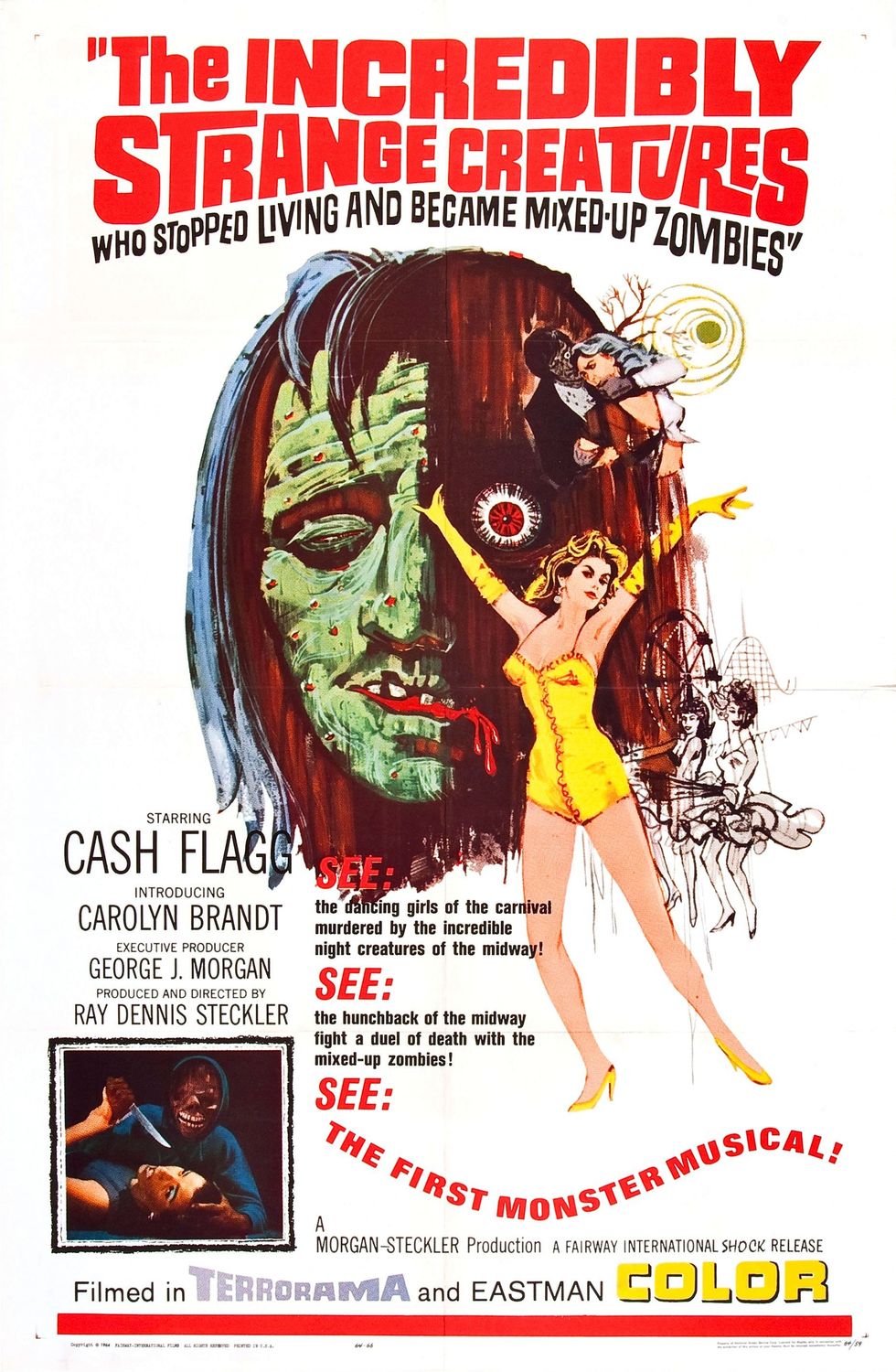
Our critic recommends“The Incredibly Strange Creatures Who Stopped Living and Became Mixed-Up Zombies”for film fans.

Back in the summer, I suggested some streaming and reading choices to combat the boredom of life during the COVID-19 pandemic. 

The other day I was chatting (by phone) with someone who suggested I use my extensive knowledge of the world’s worst and weirdest films for a similar piece.

So while you wait for Phase 37z to commence so you can get your vaccine, why not pass the time with these astonishingly bad and/or bizarre movies, all available on the usual streaming suspects:

• “The Incredibly Strange Creatures Who Stopped Living and Became Mixed-Up Zombies” (1964):

Starring the immortal Cash Flagg, this unsettling look behind the scenes of a circus is almost completely uncontaminated by a plot. It’s also a musical. (On Fandor.)

• “Dead Snow” (2009): Director Tommy Wirkola reanimated the Nazi zombie subgenre with this effort, which adds “frozen” to the description. A traditionalist at heart, Wirkola also relies on the timeless “stupid people in the woods” plot device, which provides the viewer with a comfortable perch from which to suspend disbelief. And you’ll need all the suspension you can get. Of course, it’s no “Zombie Lake,” (1981), which had nekkid volleyball, or “Shock Waves” (1977), which had Peter Cushing, but it will suffice. (On Amazon.)

• “For Y’ur Height Only” (1981):  I will argue that this is the greatest film ever made.

You can have your “Citizen Kane” and “Battleship Potemkin.” Spare me your “Rear Window” and “The Third Man.”

Why? Because none of these so-called great films has a vertically challenged secret agent who escapes the bad guys by parachuting from a high balcony. With an umbrella.

Agent 3 ½, played by the immortal Weng Weng, is a big fan of the groin kick, that being the nearest area on the personal bodies of his assailants for a man of his stature to attack. (Weng Weng was 2 feet, 9 inches tall.)

But he’s also proficient with the mini machine gun and the mini samurai sword.

The flick also features atrocious dubbing in a rich and diverse variety of accents — Long Island Lockjaw, British Dowager, Brooklyn Hood.

And the main villain clearly studied at the Moammar Qaddafi Institute of Fashion.(On Plex.)

• “The Wrestling Women vs. The Aztec Mummy” (1965): This film answers two questions that have always bothered humanity:

1) Can bad guys really run around on ancient Aztec pyramids in those pointy little shoes without tripping?

2) Can women in tight sweaters and Capri pants really save the world from an Ancient Evil?

The Wrestling Women get on the trail of some thugs in the pay of the evil Black Dragon who have swiped the sacred Aztec breastplate. 

The chase goes hither and yon, with many fine wrestling sequences, some of them between the actors’ lips and the dubbed dialogue.

The Aztec Mummy is worth the price of admission alone. He makes a heartbreaking “waaargh” sound that really makes you wonder what it’s like to be locked for centuries in an airless room guarding a princess’ remains when all of a sudden bad guys in ill-fitting suits and pointy shoes, and female wrestlers in tight sweaters and missile-silo brassieres come barging in, stirring up the dust and generally making nuisances of themselves. (On Tubi.)

• “FDR: American Badass!” (2013): Relive the glory days of World War II with this unique take on the defeat of the Axis powers. With Werewolf Hitler, FDR’s armed wheelchair, and a guest appearance by Abraham Lincoln. 

A classic from the fevered brain of Ross Patterson, the man who in 2015 reinvented the Western novel with “At Night She Cries While He Rides His Steed.” (On Amazon Prime.)

Latest News

‘So Little to Do,’ so much to discover at James Barron Art

Curator Deborah Goodman Davis reads the Emily Dickinson poem “The Grass So Little Has to Do.” Spencer Finch’s “Following Three Bees (Zinnias)” buzzes in the background.

Photo by Natalia Zukerman

“The Grass Has So Little to Do,” on view at James Barron Art in Kent, takes its title from Emily Dickinson’s poem “The Grass So Little Has to Do,” written in 1862:

“The Grass so little has to do—
A Sphere of simple Green—
With only Butterflies to brood
And Bees to entertain—”

Keep ReadingShow less
Marina Kotchoubey is taking care of business

Marina Kotchoubey at the Ian Ingersoll Cabinetmakers showroom in West Cornwall.

Photo by D.H. Callahan

After 40-something years navigating the world of custom fine furniture, Ian Ingersoll was getting ready to retire. Starting off with a little dovetail stool that he sold at a shop in West Cornwall in the 1970s, he’d grown his skill and his business into something he — and the whole town — could be proud of. Shutting down that business was not an option.

Ingersoll built Ian Ingersoll Cabinetmakers, which produced mainly classical Shaker furniture, on passion: the passion he had to make a living through creative challenges and the passion of his employees, who all seem deeply in love with their craft.

Keep ReadingShow less
A legacy of giving at Norfolk Chamber Music Festival

One hundred and twenty years ago, Carl and Ellen Stoeckel commissioned New York architect E.K. Rossiter to design The Music Shed in Norfolk, Connecticut. After nearly a decade of entertaining their friends and neighbors with the finest music of the day, they built a permanent home for their beloved Litchfield County Choral Union.

The commission and full funding of the construction was not unheard of in an era when great fortunes led to public enrichment. Railroad tycoon John D. Rockefeller was instrumental in funding institutes of higher education. Steel baron Andrew Carnegie was building libraries all over the country, and famously said that a man who dies rich is a disgrace, challenging his peers to give their fortunes back to the people.

Keep ReadingShow less
google preferred source

Want more of our stories on Google? Click here to make us a Preferred Source.

Two unique exhibitions at Geary Gallery

Henry Klimowicz with his sculpture, “Partial Pillar 1”

Photo by D.H. Callahan

On Saturday, Aug. 1, Geary Gallery opened its doors in Salisbury for two unique shows in its first- and second-floor gallery spaces. Art lovers flooded both floors over the course of the afternoon, giving the events a vibrant feeling that enhanced the importance of the art.

On the first floor is a show by Chicago-born, Colorado-based photographer Summers Moore, titled “Lobitos: Pueblo Fantasma,” or “Lobitos: Ghost Town.” The work centers around her daughter’s current hometown in Peru. Moore herself found a home away from home in Colorado in the mid-1980s and encouraged her children to seek out new places outside of their comfort zones.

Keep ReadingShow less

Writer’s retreat in the woods

Writer’s retreat in the woods

Participants in a 2024 Great Mountain Forest Woodland Academy workshop at Yale Camp.

Photo by Mike Zarfos

Great Mountain Forest (GMF) will host its first Nature Writing Retreat at the historic Yale Camp in Falls Village from Aug. 7-9, 2026. Writers of all levels are invited to draw inspiration from one of New England’s most notable forest landscapes. GMF envisions the retreat becoming an annual event celebrating writing, conservation and the relationship between people and forests.

This immersive three-day retreat reflects on the legacy of Hal Borland, the American writer and New York Times nature columnist whose work was deeply connected to this landscape. The retreat explores how wilderness shapes language, strengthens close observation and fosters environmental consciousness.

Keep ReadingShow less
From Cornwall to Rome, Adam Van Doren at Berkshire Botanical Garden

Artist Adam Van Doren and curator Donna Hassler talk to a group of visitors at the Berkshire Botanical Garden. A Stephen Proctor vessel sits to their left.

Photo by Natalia Zukerman

This summer, the Berkshire Botanical Garden in Stockbridge has hosted “Grounded in Nature: Paintings by Adam Van Doren,” an exhibition exploring the intimate relationship between architecture and the natural world.

On view for only a few more weeks in the Leonhardt Galleries, the exhibition features more than 35 watercolor and oil paintings by the New York-based artist, architect, author and Yale professor, curated by art historian Donna Hassler, director emerita of Chesterwood. The works span three distinct places that have shaped Van Doren’s artistic practice: New York City, Cornwall, Connecticut, and his travels throughout Europe.

Keep ReadingShow less
google preferred source

Want more of our stories on Google? Click here to make us a Preferred Source.

google preferred source

Want more of our stories on Google? Click here to make us a Preferred Source.