How a short story became a trilogy

Maureen McNeil
Photo by Tamara Gaskell

‘Anna Magdalena” started out as a short story that grew into a trilogy, written by Maureen McNeil, who gave a lively talk at the Roeliff Jansen Community Library on Wednesday, Dec. 13.
McNeil determined at an early age that she would become a writer. Even as a child, she had a vivid imagination, brought on by a kindergarten teacher’s story of dinosaurs. She also told of going to church often as a child, before school, and the stained glass windows and other church art encouraged her to make up stories about what was pictured.
Her sister taught her to read and write, and McNeil’s course in life was charted. Her sister, incidentally, became a teacher. A few years after telling her sister that she would be a writer, she told her mother, who found her a mentor with whom McNeil worked for over 20 years.
Being open to other cultures, becoming immersed in them, McNeil was able to learn about people, feelings, conditions and causes that her own upbringing in the Pacific Northwest, as well as her traditional schooling, wouldn’t have allowed.
“Anna Magdalena” was originally a short story that begins in the Northwest. McNeil was working on it at a workshop at New York University. When someone remarked that they’d like to know what happened when one of the characters went to New York, the story grew into a novel. After talking to a publisher about the book, McNeil ended up with a contract for a three-book deal, so Anna Magdalena, who is a performance artist, became the catalyst for a trilogy.
Introduced by library director Tamara Gaskell, McNeil proved to be natural and charming. In reading the first two chapters from the book, she invited the audience into a world that enveloped freedom, imagination and life. The prose is descriptive and, while never too much, one can “see” each item, each scene, each person or thing, clearly, never cloying or rigid. The words flow in a steady stream of sight, sound, shapes and smell, all of the senses are touched as the reader becomes enmeshed in the story of this powerful contemporary woman.
Life experiences have given birth to McNeil’s writings; she also uses historical references in a gentle fashion. A restaurant she opened with a college friend in Washington shaped some early writings. Work at the Lee Strasberg Theater and Film Institute found her reading the diary of the last seven months of Marilyn Monroe’s life. Her book “Dear Red: The Lost Diary of Marilyn Monroe” was written at that time. McNeil stated that without her intimate knowledge of Monroe, she could not have written as she did about Anna Magdalena.
After leaving the West Coast, McNeil has spent her time in Brooklyn and Woodstock, New York. The second novel of the trilogy, “Tinker Street,” is the story of Anna Magdalena as a teen coming of age in Woodstock, and the evolution of a performance artist’s life. That book is due out January 2024. The third book, “Clover Road,” is expected in 2025, and described by McNeil as utopian or dystopian, she’s not sure which.
Following the reading, questions were asked. Asked if any of her writings are autobiographical, McNeil noted that all writers write about what they know, but her stories are not autobiographical. She also said that writers create communities in their writings. As for performance artists, she thinks we are all performers, but asserts that you need to be who you are. Writing, she feels, gives you an opportunity to free yourself. She also said that, for her, writing nonfiction is harder than writing fiction.
Other works by McNeil include “Red Hook Stories,” from the beginning of her days in Brooklyn; and a collection of short stories, “Wild Blueberries.” She was a finalist for the Tiferet Fiction Prize in 2021 and won second place in the 2021 Barry Lopez Nonfiction Prize. She is a lecturer, teaches writing workshops, and is an activist who still splits her time between Woodstock and Brooklyn. She has worked with the Anne Frank Center USA, PEN America’s prison program, and the Prison Public Memory Project. In addition, she has designed and taught workshops for Yad Vashem, the Woodstock Day School, the Morgan Library and Skidmore College.
Next in the library’s author series is author and chef Julie Gale, who will discuss her new memoir “The View From My Kitchen Window,” a chronological journey of the kitchens in the author’s life, on Wednesday, Jan. 10, at 5:30 p.m.

Correction: The Amenia Planning Board does not have another meeting scheduled prior to the end of the year. It is currently unclear if the board will schedule another meeting to make up for the cancelled meeting on Dec. 10.
A snowstorm that dropped about an inch across northeast Dutchess County forced the cancellation of municipal board meetings in the Village of Millerton, Amenia and Pine Plains on Wednesday, Dec. 10.
Planning Boards for all three municipalities were meant to meet on Wednesday night.
The Village of Millerton's Planning Board was meant to discuss a site plan for Caffeine Academy — a proposed education center for children and young adults with developmental disabilities.
Caffeine Academy founder Alex That purchased Millerton's former Presbyterian church at 58 Main St. in April, with plans to convert it into the second location of his West Babylon, New York-based music and video production learning center.
The site plan hearing has been rescheduled for Tuesday, Dec. 16, at village hall, 5933 N. Elm Ave., starting at 7 p.m.
The Town of Amenia's Planning Board postponed two public hearings due to the snow.
The first on the agenda is a small subdivision proposing to split a single lot with a farm into two parcels on Kent Road.
The second public hearing on the agenda concerned a modification to site plans for two condo buildings in the Silo Ridge luxury housing development.
The board also had several discussion items on the agenda, including a special use permit to convert the former bank in the Freshtown Plaza parking lot into a drive-thru coffee shop.
Board members were also expected to discuss improvements to the septic system at Cumberland Farms on Main Street, as well as continue discussions on the proposed Cascade Creek workforce housing development and the proposed Keane Stud luxury estate subdivision.
Pine Plains Planning Board members were expected to review and approve resolutions for three applications, including the proposed Upstate Pines retail cannabis dispensary that has been the subject of months of public hearings.
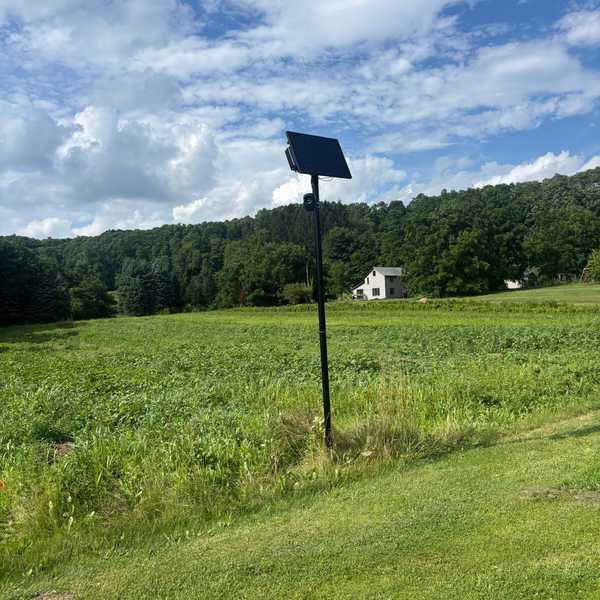
That meeting has been rescheduled for Wednesday, Dec. 17, at 7:30 p.m. The Planning Board is expected to approve a solar ground mount at a residential parcel, the proposed cannabis dispensary on Main Street and a six-month extension for site plan approval for hardwood manufacturer The Hudson Company's proposed mill and showroom.
The Stone Round Barn at Hancock Shaker Village.
My husband Tom, our friend Jim Jasper and I spent the day at Hancock Shaker Village in Pittsfield, Massachusetts. A cold, blustery wind shook the limbs of an ancient apple tree still clinging to golden fruit. Spitting sleet drove us inside for warmth, and the lusty smells of manure from the goats, sheep, pigs and chickens in the Stone Round Barn filled our senses. We traveled back in time down sparse hallways lined with endless peg racks. The winter light was slightly crooked through the panes of old glass. The quiet life of the Shakers is preserved simply.

Originally founded in England, the Shakers brought their communal religious society to the New World 250 years ago. They sought the perfection of heaven on earth through their values of equality and pacifism. They followed strict protocols of behavior and belief. They were celibate and never married, yet they loved singing and ecstatic dancing, or “shaking,” and often adopted orphans. To achieve their millennialist goal of transcendental rapture, we learned, even their bedclothes had to conform: One must sleep in a bed painted deep green with blue and white coverings.
Shakers believed in gender and racial equality and anointed their visionary founding leader, Mother Ann Lee, an illiterate yet wise woman, as the Second Coming. They embraced sustainability and created practical designs of great utility and beauty, such as the mail-order seed packet, the wood stove, the circular saw, the metal pen, the flat broom and wooden clothespins.
Burning coal smelled acrid as the blacksmith fired up his stove to heat the metal rod he was transforming into a hook. Hammer on anvil is an ancient sound. My husband has blacksmithing skills and once made the strap hinges and thumb latches for a friend’s home.
Shaker chairs and rockers are still made today in the woodworker’s shop. They are well made and functional, with woven cloth or rush seats. In the communal living space, or Brick Dwelling, chairs hang from the Shaker pegs that run the length of the hallways, which once housed more than 100 Shakers.

In 1826, the 95-foot Round Stone Barn was built of limestone quarried from the land of the 3,000-acre Hancock Shaker Village. Its unique design allowed a continuous workflow. Fifty cows could stand in a circle facing one another and be fed more easily. Manure could be shoveled into a pit below and removed by wagon and there was more light and better ventilation.
Shakers called us the “people of the world” and referred to their farm as the City of Peace. We take lessons away with us, yearning somehow for their simplicity and close relationship to nature. One Shaker said, “There’s as much reverence in pulling an onion as there is in singing hallelujah.”
A sense of calm came over me as I looked across the fields to the hills in the distance. A woman like me once stood between these long rows of herbs — summer savory, sage, sweet marjoram and thyme — leaned on her shovel brushing her hair back from her eyes, watching gray snow clouds roll down the Berkshires.
More information at hancockshakervillage.org

Exterior of Lakeville Books & Stationery in Great Barrington.
Fresh off the successful opening of Lakeville Books & Stationery in April 2025, Lakeville residents Darryl and Anne Peck have expanded their business by opening their second store in the former Bookloft space at 63 State St. (Route 7) in Great Barrington.
“We have been part of the community since 1990,” said Darryl Peck. “The addition of Great Barrington, a town I have been visiting since I was a kid, is special. And obviously we are thrilled to ensure that Great Barrington once again has a new bookstore.”
The second Lakeville Books & Stationery is slightly larger than the first store. It offers more than 10,000 books and follows the same model: a general-interest store with a curated mix of current bestsellers, children’s and young readers’ sections; and robust collections for adults ranging from arts and architecture, cooking and gardening, and home design to literature and memoirs. Anne reads more than 150 new titles every year (as many as a Booker Prize judge) and is a great resource to help customers find the perfect pick.
A real-time inventory system helps the store track what’s on hand, and staff can order items that aren’t currently available. There is also a selection of writing and paper goods, including notecards, journals, pens and notebooks, as well as art supplies, board games, jigsaw puzzles and more. The owners scour the stationery trade shows twice a year and, Darryl says, “like to tailor what we offer to suit the interest of our customers in each market.”
The Pecks know what it takes to run a successful local enterprise. Darryl has a 53-year background in retail and has launched several successful businesses. He and Anne owned and operated a bookstore on St. Simons Island, Georgia, from 2019 to 2025. They are tapping into their local roots with both stores. They raised their family in Sharon, and their daughter Alice, a native of the Northwest Corner, manages the Lakeville store.

The family values the role that a retail store plays as a supporting partner in the community, and they prioritize great management in both locations, hiring and training talent from local communities. Their 10 team members across both stores are from the area, and two of the Great Barrington employees previously worked at Bookloft.
Darryl and Anne’s attention to customer service is everywhere apparent and adds to the enjoyable and irreplaceable in-store shopping experience. The books are in pristine condition, eliminating the risk of damage that sometimes occurs during shipping. This is especially important for books that will live on people’s shelves and coffee tables for years.
Darryl says, “People love the in-store discovery — you find books you didn’t know existed, which is very difficult to do on a website. Also, many customers depend on our recommendations when visiting. There is a saying about bookstores versus online ordering: We may not have exactly what you were looking for, but we have what you want.”
Lakeville Books & Stationery’s Great Barrington store is open 7 days a week, Monday-Saturday, 10 a.m. to 6 p.m., and Sunday, 11 a.m. to 5 p.m. Parking is available in the lot behind the building and in the parking lot behind the firehouse. The entrance to the store is accessible from the store parking lot.
For more information, go to lakevillebooks.com., and sign-up for the Lakeville Books newsletter.
Richard Feiner and Annette Stover have worked and taught in the arts, communications, and philanthropy in Berlin, Paris, Tokyo and New York. Passionate supporters of the arts, they live in Salisbury and Greenwich Village.