Ancramdale makers help Kenyan girls go to school

Ancramdale woodworker John Roccanova applied final touches on one of his creations on sale at the Irondale Schoolhouse through November.
Photo Provided


Ancramdale woodworker John Roccanova applied final touches on one of his creations on sale at the Irondale Schoolhouse through November.
ANCRAMDALE — Local residents can make a difference halfway around the world by the simple act of purchasing a high quality item hand crafted by retired Webutuck shop teacher John Roccanova of Ancramdale.
Since 2010, when John and his wife Jean began their nonprofit “Grow Against Poverty,” they have been sponsoring multiple efforts to improve the lives of others, mainly in Kenya.
This year, their fund raising efforts will again be funneled partly through “Prevent Period Poverty” which is focused on bringing much needed bathrooms and sanitary supplies to girls. The program has already built a $11,000 bathroom in one school with four sinks, toilets and showers, which has already helped improve attendance.
Using money from this year’s sales, he says they are aiming at adding another bathroom to a school of 1,500 students and over 60 staff members which currently has only 2 bathrooms for the whole school.
“A lot of what we do is geared to female students because they get the short end too many times,” Roccanova said.
He adds that improving education for girls “reduces teen pregnancies, increases graduation rates and helps them get themselves and their families out of poverty.”
Inspired initially by a newspaper article on African relief needs, which tapped into their desire to improve education, their efforts have contributed to expanded classroom space, paid for computers, and helped supply funds for teacher salaries.
By providing bicycles with helmets, repair kits and safety vests to twelve schools for 510 students who must navigate more than five miles of often muddy, rutted roads, they have also boosted school attendance and have plans to expand the program with another 100 bicycles each year.
Their program has also helped plant gardens which supply fresh produce for the school and have expanded that to a “Carrots for Computers” program which uses profits from sales of vegetables to purchase more units.
He notes the November sale will feature salad bowls, “platters, tea boxes, candleholders, cutting and charcuterie boards, earrings, pens ... cars, trucks, helicopters, planes and several types of boats” suitable for bathtubs.
The items, all made with food and child safe finishes, are crafted from walnut, oak, cherry, maple, poplar, pine and mahogany with prices ranging from $10 to $150.
The sale is set for the Irondale Schoolhouse from 11 a.m. to 5 p.m. on Saturdays and Sundays, Nov. 9 and 10, Nov. 16 and 17, Nov. 23 and 24, Nov. 29 and 30 and Sunday, Dec. 1.

Nathan Miller
Customers peruse jewelry and art at a vendor’s station during Millerton’s 175th Fair on Friday, July 17.
MILLERTON — The community wrapped up its week-long 175th anniversary fair Sunday, July 19, with sunny skies and a sizable turnout after rain threatened to put a damper on the whole weekend.
Rainy weather on Saturday, July 18, led to reduced attendance, but didn’t kill volunteers’ spirits. Lisa Hermann, who led the planning efforts for the week-long celebration, said the poor weather was unfortunate but plans continued on with slight modifications.
“Overall, I think we did get pretty lucky,” Hermann said. “We never had to shut down at any point.”
Organizers also contended with smoke from Canadian wildfires, which blanketed the area Wednesday afternoon, July 15. The smoke prompted the planned yard party at the Millerton Inn on Main Street to be postponed by a day, but Hermann said it was the only event significantly affected by air quality concerns.
The rain on Saturday forced some attractions, including face painting and musical performances, under the pavilion at Eddie Collins Memorial Park to protect equipment and keep visitors dry.
Despite the rain Saturday, the parking lot at Eddie Collins Memorial Park filled once again on Sunday afternoon as families and community members enjoyed a petting zoo, inflatable bounce houses and obstacle courses, food and drink from local bars, breweries and restaurants, and live music on the lawn all afternoon.
Last weekend’s fair — the culmination of a week-long celebration that began with a parade and groundbreaking for the planned new pool a week prior — kicked off Friday afternoon, July 17, with community organizations and vendors setting up shop in the park.
Attendees trickled in during the afternoon before swelling in numbers Friday evening as a drone light show began at 9:30 p.m.
Hermann cited excitement for the village’s future as a highlight of the week’s events. Attendees to the park for the drone show admired the painted outline of the planned pool and cheered when the lighted drones depicted a cheerful child jumping into a pool from a shaking diving board.
The drone light show traced significant moments in Millerton’s history while also highlighting future projects. Hermann said her biggest takeaway was seeing attendees celebrate the village’s past while embracing what comes next.
“There were some aspects of the celebration that also had to do with the pool and the next steps for Millerton,” Hermann said. “Seeing people get really excited about that — like the painting on the grass that 3M did — I think it was really great.”
Hermann expressed gratitude for the volunteers and village officials who helped organize the week-long celebration. She credited the community members who served on the Millerton 175th Committee with staying committed to the project over the past two years.
She also thanked Village Hall employees and members of the highway department for their assistance with the fair, the week’s events and preparations leading up to the celebration.
“There are so many people in the community that stepped up to make this possible,” Hermann said. “It wouldn’t have been possible without them.”
Nathan Miller
Ryan Courtien exits Grand Central Terminal in Manhattan on Sunday, July 12, a few hours after his disappearance.
DOVER PLAINS — Wingdale resident and former Dover Town Supervisor Ryan Courtien remained hospitalized Monday, July 20, undergoing medical evaluation after his unexplained disappearance ended with his safe return last week.
Courtien — a 49-year-old father of two, volunteer firefighter, current Dover Planning Board chair, and Wingdale resident of 22 years — was taken to a local hospital after state police reported that local deputies picked him up at the Harlem Valley-Wingdale train station on Wheeler Road Friday evening, July 17. Dover Town Supervisor Rich Yeno said Courtien was still undergoing medical evaluation as of Monday evening, July 20.
His disappearance on Sunday, July 12, shocked the community — triggering a multi-day search and rescue response that drew emergency responders from across New York and western Connecticut.
Authorities have not released details about the circumstances surrounding Courtien’s sudden disappearance and return home. State police Public Information Officer Krystal Paolicelli said Monday, July 20, that the investigation had concluded and the case had been closed.
“Based on the findings of the investigation, no criminal conduct was identified that would warrant an arrest,” Paolicelli said. “The reason for his departure remains unknown.”
Neither Courtien nor his family have released a statement.
Courtien was reported missing Sunday after he left the house at 9:30 a.m. to perform yard work at his home on 32 Waldo Road and never returned. Starting Sunday afternoon, authorities commenced a search of the woods surrounding his home, utilizing heat-seeking drones, K-9 units, helicopters and searchers on foot. The search was called off Wednesday, July 15, after nearly four full days of scouring the area.
Paolicelli said on Wednesday, July 15, as many as 80 personnel per day joined in the search and rescue effort. New York State Police headed up the search, with assistance from Dutchess County Sheriff’s deputies, New York State Fire crews, New York State Forest Rangers and volunteer firefighters from across Dutchess County and western Connecticut.
The search and rescue effort carried on until Wednesday afternoon, when New York State Police announced a sudden end to the search at around 4 p.m.
Answers wouldn’t come until more than a day later. After relative silence about the case throughout the day on Thursday, July 16, state police announced on Friday, July 17, that Courtien had been spotted in Manhattan’s Grand Central Terminal exiting a Metro-North train shortly after his disappearance on Sunday.
Then, as suddenly as it had all begun, Courtien was located Friday evening. Authorities received a tip through a 911 call that Courtien was near the Harlem Valley-Wingdale train station just after 5 p.m. on Friday. According to a statement from the New York State Police, Dutchess County Sheriff’s deputies responded to the scene and confirmed Courtien’s identity.
Courtien was then reportedly taken to a local hospital for evaluation. Authorities did not release the location of the hospital, and calls to area hospitals could not confirm Courtien’s status.
Dover Town Supervisor Rich Yeno led the community response to the disappearance, appearing at the search and rescue command post throughout the week and making public updates through Facebook posts. He expressed gratitude for Courtien’s return home.
“The biggest thing is he’s alive,” Yeno said.
Courtien first moved to Wingdale with his wife, Suzanne Calligan-Courtien, in 2004 when the pair bought their Waldo Road home, according to public documents.
He has spent the past 22 years working in various education roles, mostly teaching math to college and high school students, according to his LinkedIn profile.
Courtien was first elected to Town Supervisor in the Town of Dover in the election of 2007, and took office in January 2008. He held that position for eight years, opting not to run for reelection in 2015, according to Dutchess Board of Elections records. Courtien joined Dover’s planning board in 2018, and was appointed chair in 2021.
Friends and community members said Courtien is an avid hiker and a trail advocate. He is credited with helping establish and build the Dover Stone Church hiking trail that leads to a geologic formation so-called because of its resemblance to a chapel.
Most recently, Courtien took a job as operations manager for the Harlem Valley Rail Trail Association. Dick Hermans, a member of the Harlem Valley Rail Trail Association’s Board of Directors, said the organization hired Courtien to the position this past spring and that he had taken to his responsibilities with zeal.
Hermans said Courtien’s experience in town government and trail advocacy were strong marks in his favor for the operations manager job.
“He is definitely a trail advocate,” Hermans said.
Courtien’s colleagues on the Dover Planning Board continued public hearings on Monday, July 20, appointing Val Larobardier to serve as interim chair in Courtien’s absence. Courtien was absent from the meeting, and board members did not mention his absence.
After the meeting, Planning Board members, the town’s Planning & Zoning secretary and the town’s engineer expressed concern for Courtien and hope for a speedy recovery. They said that they have decided to quietly carry on in their work and wait for Courtien and his family to reach out to them with more information out of respect for their privacy.
The Board elected to cancel both August meetings, but said that was unrelated to Courtien’s absence. Board secretary Marilyn Van Millon explained that no applications to the Planning Board had come in before deadlines for the August meetings, meaning the board has no business to discuss next month. She said she doesn’t have a clear picture of when Courtien will return to his post as chair.
“We really don’t know anything,” Town Engineer Joseph Berger said. “We’re really concerned, but that’s about all.”
Nathan Miller
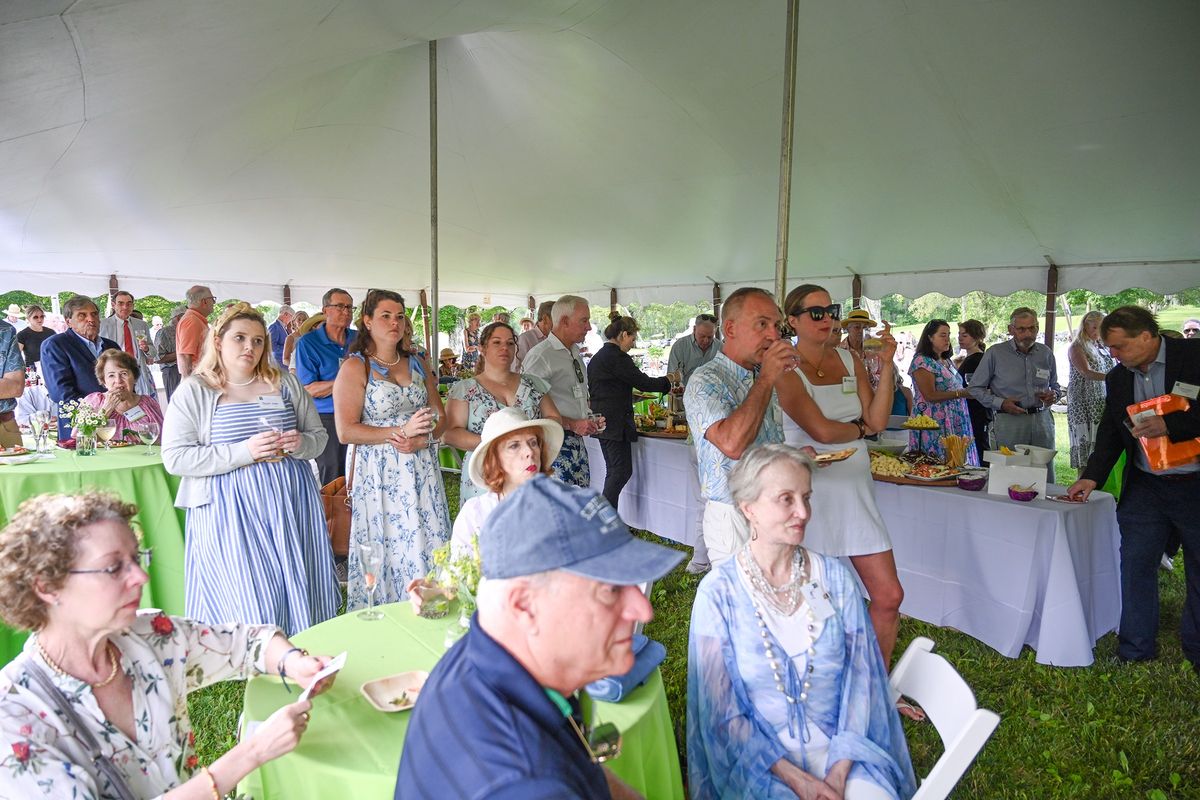
MILLBROOK — The North East Community Center raised $403,500 in about 15 minutes of paddle raising Sunday, July 19, at its annual Chef & Farmer Brunch fundraiser.
The annual fundraiser — a major source of income for the Millerton-based nonprofit held this year at Millbrook School — supports the NECC’s programs throughout the year, including the regular food pantry program, youth programs and the weekly farmers market.
Co-Interim Executive Director and Board Chair Irene Banning praised attendees and donors for contributing to the organization’s work in a year that has seen high-ranking staff departures and the closure of the organization’s childcare program.
“This has been a challenging year for NECC,” Banning said. “But we are standing strong, working on finding an executive director and looking into an exciting future.”
Banning further praised the organization’s staff, saying NECC’s success would be impossible without the employees’ dedication to building community and supporting neighbors.
She championed NECC’s mission and expressed gratitude for the organization as a whole, as well, describing it as a refuge where she can contribute to good in the community.
“It is the place where I get to be a part of doing good, of caring for the members of our communities,” Banning said. “And being a part of making people’s lives feel less unsettled and more balanced.”
Following Banning’s remarks was an address from her counterpart, Julie Fajgenbaum, who is sharing the workload as co-interim executive director, while the organization searches for a replacement for former Executive Director Christine Sergent. Sergent resigned from her position at the organization in March 2026.
Fajgenbaum detailed some of the work NECC does, including giving away 15,000 diapers to 25 area families so far this year.
“That’s lightening the financial load for those new parents and allowing them to spend on other things like formula,” Fajgenbaum said.
But she acknowledged that the year’s successes have also exposed a downside — pointing to 19 additional families that remain on the waitlist for free diapers from the organization.
Other statistics underscore the challenges NECC faces in the coming year. The organization’s food pantry served 1,000 people in April alone, reflecting the growing financial pressures many households face as food and fuel costs continue to rise.
Fajgenbaum once again pointed to the benefactors taking part in the day’s fundraising, praising them for coming together to support the NECC’s mission to serve northeast Dutchess communities.
“Today is most definitely a high,” Fajgenbaum said. “We’re so grateful that you’re here with us. I don’t know what we would do without you.”
Following Fajgenbaum’s remarks, local auctioneer CK Swett led the annual “paddle raise,” a lightning-round fundraiser where donors raise auction paddles to commit to donations ranging in increments from $100 to $50,000.
This year’s paddle raise resulted in at least $403,500 in donations to the charitable organization after just 15 minutes of auctioneering.
“This is a community effort, this is a collective effort,” Swett said. “And we will help the community together.”

Want more of our stories on Google? Click here to make us a Preferred Source.
Eloise Pickering
Volunteers at St. Thomas Episcopal Church’s Food of Life pantry distribute vegetables and other food to patrons on Friday, July 17, in South Amenia.
A year after federal funding cuts to supplemental food programs, local farmers markets and food pantries continue adapting to ensure community members have access to food.
Farmers markets throughout the region accept a variety of food assistance benefits, and food pantries are switching to new choice models, allowing their guests and neighbors to choose their food rather than be sent home with a pre-packaged box.
Food assistance programs include Women, Infants, and Children (WIC) benefits, SNAP, Double Up Food Bucks, and Farmers’ Market Nutrition Program checks.
Double Up Tokens and FreshConnect Checks are both matching programs, where coupons and tokens handed out by local food pantries or the market are then matched through federal programs or farmers markets themselves.
Previously, local food pantries have made boxes with different foods to supply households for a set amount of meals. For example, St. Thomas Episcopal Church gives each household enough food for nine meals. Community members would show up and grab a box. Now, people can choose what foods they need for their family. For example, they can choose between pasta and rice, or between various types of vegetables.
“The hope is that people can really choose the food that meets the needs of their particular household,” said Jordan Schmidt, the food programs director at the North East Community Center.
Katie Cariello, one of the food programs coordinators at NECC, said it’s important that people feel heard, both through choice models and through conversations during delivery programs.
“There’s humanity behind this,” Cariello said. “We are here helping and supporting, and that feels very impactful.”
NECC helps between 200 and 250 households each week, and last year the organization saw around 4,400 households. St. Thomas’ pantry serves around 600 households weekly.
Paulo Rossi, the pantry manager at St. Thomas Episcopal Church in Amenia said that the choice model also helps with inventory and shipping.
The North East Community Center and St. Thomas Church work together to provide food assistance programs to the community.
“One of the things that I found most valuable and exciting is it’s really not about each individual organization. It’s about how we support each other across the region,” Schmidt said.
Following the One Big Beautiful Bill Act, signed into law July 2025, funding was cut to the Supplemental Nutrition Assistance Program. This has affected food banks that supply local pantries, limiting options and raising costs.
Interim Executive Director of the Missions at St. Thomas, Jim Wright, said that the regional food bank has “dramatically less food to offer either for sale and definitely for free. Forget for free.”
Wright said that the regional food bank is trying to expand its food options as much as possible, but federal funding cuts make it challenging.
At NECC, the pantry had to limit how often people could visit for food. Although they’re open weekly, they had to limit visits to twice monthly due to food limitations.
“We were having a really hard time with getting enough food on site to support everyone,” Schmidt said.
Both pantries partner with local farms for produce, and St. Thomas has onsite gardens. One is a teaching garden, and one is a giving garden. The giving garden has items like edible flowers, onions, and tomatoes.
“In addition to the vegetables we grow exclusively for our neighbors in the giving garden, we also have spectacular produce from local farms,” said Wright.
One of the more prominent issues that local food pantries face is access to protein, although it’s been slowly improving.
“It’s particularly impactful in terms of proteins,” Wright said. “It’s been getting a teeny bit better the last 2 weeks. There’s been at least some protein that our neighbors want to eat as opposed to canned chicken.”
Following federal cuts to SNAP, Schmidt has noticed some recipients are having a harder time receiving their benefits due to higher restrictions and an increase in required volunteer hours.
“These shifts seem like a disincentive to seeking or maintaining SNAP enrollment,” Schmidt said.
At food pantries, employees and volunteers make an effort to connect with their neighbors who come for food and toiletries. The teams also work to limit stigma around needing food assistance, and that the focus is keeping households fed.
“It’s about making people feel welcome and not ashamed when they’re accessing community food resources,” Schmidt said. “It’s about making sure the food is as nourishing as possible and also meets a wide range of cultural needs.”
NECC accepts a wide range of programs, including WIC benefits, SNAP, and offers Double Up Food Bucks and Farmers’ Market Nutrition Program checks.
Double Up Food Bucks and FMNP checks can be used at local farmers markets, including the Millbrook and Copake Hillsdale markets.
Millbrook Farmers Market introduced SNAP, FreshConnect and Veterans Benefits in 2025, and is continuing to expand throughout this summer.
The Copake Hillsdale Farmers Market started accepting SNAP in 2004, and has since introduced Double Up Tokens and Fresh Connect Checks.
The Copake Hillsdale market is a nonprofit, so it receives grant funding to match dollar for dollar. The market is also working towards funding for a van, which would provide transportation to the market for community members that need it.
“These programs help people,” said Copake Hillsdale Farmers Market Offsite Manager Nicole Friedrich. “There’s a lot of need.”
The Hillsdale Farmers Market sees between 10 and 12 customers each week who use some method of food assistance.
Eloise Pickering
About to begin dispensing ride tickets at the opening day of the annual Millbrook Fire Dept. Carnival on Wednesday, July 15, the ticket booth was a focus for visitors as they awaited the opening and the start of the rides.
MILLBROOK — Millbrook’s four day Fire Department Carnival that took place between July 15 through July 18 saw community turnout through rain, heat, and poor air quality.
With a looming storm and Canadian wildfires lowering air quality, residents and families still lined Franklin Avenue during the July 18 parade, cheering on local fire departments.
At 6 p.m. sharp, over a dozen fire apparatus, marching bands, and firefighters began rolling and marching through the heart of Millbrook from Front Street to Maple Avenue. Millbrook Mayor Peter Doro also marched in the parade with his two young boys, both waving American flags.

The smell of burgers and the sound of rides filled the carnival as goers waited in lines, ate cotton candy, played games, and got their faces painted. Rain didn’t stop the party, as people took the break to eat, dance or try their hand at ring toss.
The final day began with a parade that featured marching bands, fire trucks and apparatus, and firefighters from across Dutchess County. Afterwards, onlookers travelled to the carnival.
Fire departments that participated in the parade were judged across various categories with over 10 winners.
Proceeds from the carnival benefit the Millbrook Fire Department.

Graham Corrigan
MILLBROOK — Washington’s town board will begin workshopping plans for renovations to the town pool next week.
At a regular meeting on Thursday, July 9, the board discussed a preliminary feasibility study on the pool and surrounding park. A monthly workshop, hosted at Town Hall, will begin to address concerns and solidify plans on how to improve the park. The first session will take place on Thursday, July 23, at 6 p.m.
Members of the public are encouraged to attend, but only as observers to the proceedings.
The feasibility study was originally presented in May. It was prepared by Mike Murphy, the Chairman of the Reimagine the Town Park Committee, and found that residents are interested in a variety of recreational improvements. The proposals include pickleball courts, extended park hours, splash pads, a third pavilion, a new pool, and updated playground facilities. Murphy estimates the cost at between $2.5 and $3.7 million.
In other business, discussions over the town’s mass appraisal grew heated.
Assessor Lisa Evangelista detailed her findings, and emphasized the incompleteness of past data collection and site surveys. She claimed at least 100 properties are still missing from their collected data. Washington’s last home valuation took place in 2006.
The town debated the merits of passing off the task to an outside mass appraisal company, and pushed to determine a timeline for completion of the town-wide property assessment.
Part of the board’s concern stemmed from the shifting nature of property values: if data collection takes too long, the information collected at the beginning could be out of date by the end of the process.
Washington and Millbrook’s wide array of properties, from single-family homes to large farms, present unique challenges. The board agreed to begin discussions with mass appraisal firms in an attempt to expedite the process.
An application for high-density housing at the former site of Green Briar Nursing Home was also discussed. The proposal would include a number of townhouses and standalone homes, for a total of 12 units. The board highlighted the complications of the application — either a use variance or rezone would be required to facilitate the build.
The town board also approved several motions. The first will allow Washington to sell surplus highway vehicles at public auction. Another motion concerned town employees’ unused sick days: under the new resolution, town employees will be able to convert unused sick days to retirement funds at the time of an employee’s retirement, with a maximum allowance of 120 days.

Want more of our stories on Google? Click here to make us a Preferred Source.

Want more of our stories on Google? Click here to make us a Preferred Source.