A family legacy: Roxana Robinson tells Harriet Beecher Stowe’s story for America’s 250th

Harriet Beecher Stowe, author of “Uncle Tom’s Cabin” and great-great-great aunt to author Roxana Robinson.
Courtesy of the Library of Congress


Harriet Beecher Stowe, author of “Uncle Tom’s Cabin” and great-great-great aunt to author Roxana Robinson.
The award-winning novelist, biographer and scholar Roxana Robinson, who has longstanding ties to Litchfield County through her family’s centuries-old roots in Cornwall, was recently invited to tell the story of her great-great-great-aunt, Harriet Beecher Stowe, the abolitionist author born in Litchfield in 1811.
The invitation came from historian Heather Cox Richardson, whose national storytelling initiative, “250 to 250,” is marking the nation’s semiquincentennial with a series of short videos highlighting 250 people, places and moments that helped shape American history.
“We designed the videos to emphasize the agency of Americans — mostly everyday Americans — to change the country,” wrote Richardson. “Each falls into a category that defines what it means to be an American, including community, democracy, innovation, mobility, civil rights, education, conservation and creativity.”
According to an article Robinson wrote for The New York Times, she grew up hearing her family refer to “Uncle Tom’s Cabin” simply as “The Book,” a work that was treated as both a literary achievement and a source of family pride.In telling Stowe’s story for 250 to 250, Robinson reflects on not just a family lineage but a moral one.
“I am very proud of Great-Aunt Harriet,” Robinson said. “In an act of extraordinary courage, she challenged the economic, political and ethical structures of the entire country.”
That courage can be difficult to appreciate from the vantage point of the 21st century, she said.
“The main thing that amazed me about ‘the book’ was HBS’s courage. From this vantage point, now, ‘the book’ seems a bit obvious and heavy-handed, melodramatic ladies’ fiction, but at the time it was a deadly serious critique of the entire United States of America.”
Published in 1852, “Uncle Tom’s Cabin” arrived at a moment when many Americans, particularly in the North, could afford to look away from slavery.
“Slavery was a linchpin in the American economy,” Robinson said. “It was something the North could allow itself to ignore, since northern agriculture did not depend on slavery as southern agriculture did. But HBS, with these intertwined narratives of pain and love, made it impossible for northerners to ignore the human costs of slavery.”
Stories do that. They collapse distance. They insist that someone else’s child is your child. Someone else’s grief is your grief. Someone else’s freedom is bound up with your own.
“All people,” Robinson said of Stowe’s theology, “meant all people.”
It sounds simple. It was revolutionary.
“She wrote the Black experience just as she wrote the white experience, and showed readers, in heart-wrenching terms, that these stories were family stories, and that what the readers had been ignoring was a human tragedy. She made that tragedy impossible to dismiss.”
“Her book started a shift in public response to slavery, a movement toward revulsion and condemnation,” Robinson said. “Stowe’s book, like those of her peer Charles Dickens, lit up the dark places within the republic, and cast upon them the light of moral clarity.”
After all, movements most often begin this way — not with certainty, but with imagination. With someone refusing the accepted story and offering another one. For Robinson, Stowe’s story is also inseparable from the landscape that shaped her.
“The Litchfield Hills have always been a place where people have stood up for their own beliefs, tended their fields and raised their children to be responsible.”
Her own family’s roots in Cornwall stretch back to before the American Revolution.
“My corner of it, Cornwall, where my family the Scovilles have been since before the Revolution, has been populated by farmers and ministers ... and in the last century or so, writers and artists.”
She describes people from this region who felt and feel a deep responsibility to this country.
“I’m very proud of our state, with its strong history of support for public education, public health, gun control, agriculture and culture in general.”
For Robinson, civic engagement begins close to home.
“Politics begin at the bottom of your driveway,” she said. “Our neighborhood is made up of smart, kind, generous, engaged people whom I trust and love. Our first selectman is also our local organic farmer and a member of the EMT. How much more American can you get?”
That local focus is precisely what attracted her to Richardson’s project.
“I love the HCR project, linking our national history to these stories of individuals,” Robinson said. “This kind of story — one person committed to something about which they feel passionately — is the story of our country.”
To learn more about “250 to 250” and to view the videos, visit250to250.substack.com
D.H. Callahan
On Saturday, July 18, Boondocks Film Society heads west to Catskill for its exclusive screening of the indie comedy darling “Maddie’s Secret.”
The group, which has been putting on one-night-only screening events throughout Litchfield, Dutchess and Berkshire counties for the past nine years, is crossing the Hudson yet again to take over its new home away from home, the Community Theatre. Last month, the society returned to the theater for its second screening there, bringing in Ira Glass, host and producer of NPR’s “This American Life,” to discuss comedian Mike Birbiglia’s “Sleepwalk With Me.” Glass, who produced the film, was joined on stage by his wife, writer and director Susanna Fogel. Connecticut-based indie-pop duo Mates of State also got in on the action, performing original songs, including “Now,” which was featured in the film.
Boondocks has earned a reputation for exactly this kind of enhanced screening. The society offers much more than just a movie. For each event, it works with local eateries to create custom food and cocktail menus inspired by the night’s film. There is usually film-themed music from local acts, though booking a band with a song featured in the film was a particularly fitting touch. But what Boondocks has become best known for is its conversations with actors, directors and other key figures behind the films. For “Maddie’s Secret,” the society is bringing in a quadruple threat: actor, director, writer and producer John Early.
Early has gained recognition for his roles in “Search Party,” “Eternity,” “Wet Hot American Summer: Ten Years Later” and “At Home With Amy Sedaris.” But beyond those larger titles are the projects he has developed himself, including the HBO stand-up special “Now More Than Ever,” an episode of the Netflix series “Characters,” and the web series “555,” which he created and starred in with his longtime comedic collaborator Kate Berlant.
All of those projects demonstrate an extraordinary commitment to a particular style of cringe comedy. Early often embodies deeply unlikeable characters, mining humor from their boundless self-interest. His character in “Search Party” falsely claimed to have had cancer as a child. In “555,” he stole from a wheelchair-bound fan. His characters in “Characters” revel in awkwardness and unabashed narcissism.
While Early is accustomed to writing his own characters, “Maddie’s Secret” marks his first time directing and producing a feature film. Supporting him is a standout ensemble that includes Vanessa Bayer, “3rd Rock From the Sun” star Kristen Johnston, Conner O’Malley and, of course, Kate Berlant. Festival audiences have embraced the film, which, after a modest initial release, is now receiving wider distribution as word of mouth continues to spread.
Patrick L. Sullivan
A cold mountain brook that enters one of the New York City reservoirs.
PHOENICIA, New York My annual week off in the Catskills in early June got off to a satisfactory start. The first week or so of June usually means a lot of different bugs hatching, which in turn means the angler can sling three or four patterns with a fair bit of confidence.
This time around the isonychia were dominant. This is a big reddish-brown mayfly, sometimes known as a Slate Drake and most frequently imitated on the Esopus Creek with a traditional winged wet fly, the Leadwing Coachman.
I remember as a callow youth of 12 being instructed by an impossibly ancient codger -- hell, he was probably 65 -- that a Leadwing Coachman wet fly, size 10-14, would produce on the Esopus when nothing else would. In the intervening half century I have put this proposition to the test and found it accurate.
What was different this year was the isos were flying around. Usually we see their casings on the rocks, but not the adult mayflies in the air.

The first night it was all browns in the 14-18 range. The second night it was all rainbows in the 10-14 range.
That was early in the trip. Three days in, things warmed up considerably, and without any mitigating rain.
So the range of options was limited, and the preferred time of day was just before dawn. Note I said “preferred.” The actual start time varied depending on how late my attorney, Thos., and I stayed up watching Fu Manchu movies.
I low-crawled up a mountain brook at dawn with a Tenkara rod and did okay with wild browns. On the scramble out I had a brief and alarming encounter with a descendant of the Hound of the Baskervilles, whose owner helpfully said “Don’t make any sudden moves.”
“Any chance of a leash here?” I said in what I hoped was a cheerful, non-threatening tone of voice.
So there’s that.
Gary Dodson alerted us that the Spot That Must Not Be Named was in play. This is a cold mountain brook that enters one of the New York City reservoirs and depending on how full the latter is, forms a channel of cold water that mixes in with the warmer reservoir water. If the timing is right, the angler can latch into some decent trout and whatever else has fins and an inquisitive nature.
So one morning, while the boys worked the big deep cold pool by the bridge, I made my way downstream, deploying the stream thermometer frequently to try and figure out the magic spot where trout would be comfortable enough to hang out and nosh.
I used a favorite tactic: a dry/dropper rig, with a Chubby Chernobyl as the top fly and de facto bobber, and a series of nymphs and wet flies on an 18-24 inch fluorocarbon tipper dropper, 4X or 5X, tied directly to the bend of the Chubby’s hook.
This worked immediately, with good browns in the 16-18 inch range hitting the nymphs and a Jerry Shillcock isonychia wet fly pattern.

In a nod to tradition, I used one of my late father’s Orvis Battenkill bamboo rods for the purpose. It is eight feet long in three sections and weighs about 100 pounds. At least that’s how it feels after using graphite rods.
On the last morning the cold to warm water ratio was getting less favorable at the Spot. It was now or never.
Thos. was chucking dries up the big pool.
I waved him down, rerigged him with the dry-dropper combo and gave highly technical instructions.
“Walk around the left of that clump of vegetation, slowly so you don’t make a huge wake, and when the waves die down heave this in there and let it sit, and count to 30. Then twitch it a bit.”
Lo and behold, it worked.
On the medical front, my new right hip didn’t give me any trouble. I didn’t push it either.
Brian Gersten
Members of BalletCollective.
The community here has become an essential part of our creative process.
— Troy Schumacher, Founder of BalletCollective
For the 12th consecutive summer, the acclaimed New York City-based dance company BalletCollective will return to Millbrook, continuing a residency that has become a vital part of the organization’s creative process and an increasingly significant cultural event for the Hudson Valley.
Founded by Troy Schumacher in 2011, BalletCollective was created as an interdisciplinary laboratory where choreographers collaborate with composers, writers and visual artists from the earliest stages of a work’s development. Rather than simply commissioning a score or set design, the company builds each ballet through a creative exchange among artists working across disciplines. The company has produced 26 world premieres and has performed at venues including Lincoln Center, the Metropolitan Museum of Art and the Joyce Theater.
This summer’s residency will feature new works by choreographers Shane Urton and Noelle Kayser, alongside Schumacher, all of whom are creating pieces for BalletCollective’s fall season. Running from July 13 through Aug. 2, the residency will bring dancers, choreographers and composers to the village as they develop new works that will premiere later this fall at New York City’s Cathedral of St. John the Divine. Joining the company in Millbrook will be dancers from New York City Ballet, including Davide Riccardo, Maya Milic, Simeon Neeld and Keenan Kiefer.

The residency culminates with two public performances at Millbrook School on Aug. 1 and 2, offering audiences a rare opportunity to experience works in progress before they premiere in New York.
“Millbrook continues as the spine of how we develop new work,” said Schumacher. “The community here has become an essential part of our creative process.”
Schumacher’s connection to the region extends beyond the company’s annual residency. During the height of the COVID-19 pandemic in 2020, he organized “The Nutcracker at Wethersfield,” an ambitious outdoor production staged at the Wethersfield Estate in Amenia. The production became a symbol of artistic resilience during one of the performing arts’ most challenging periods and was later chronicled in the feature-length documentary “The Nutcracker at Wethersfield,” directed by acclaimed filmmaker Anne Sundberg.
As BalletCollective celebrates its 15th anniversary season, Millbrook remains at the heart of the company’s creative process. For three weeks each summer, the village becomes a creative laboratory where choreographers, dancers and composers experiment, collaborate and refine new work before sharing it with the community that has helped nurture the company for more than a decade.

Want more of our stories on Google? Click here to make us a Preferred Source.
Christian Murray
Paul Ramunni playing polka music.
For visitors stepping into the New England Accordion Connection & Museum inside North Canaan’s historic railroad station, the first thing they notice is the sheer number of accordions.
Rows upon rows of instruments line the walls. Some are polished, while others show the wear of decades spent traveling across continents and sitting in family attics.
“There are about 500 accordions in this room,” museum founder Paul Ramunni said during a recent tour. “We have another 200 in the basement, so we’re cracking 700.”
But Ramunni insists the collection is not really about accordions.
“It’s the stories,” he said. “The instruments are just the carriers.”
For more than a decade, Ramunni and his wife, Marsha, have been collecting not only instruments but also the family histories attached to them. The result is what may be one of the most unusual museums in New England — a place where music, immigration, war and local history come together.
A Childhood Instrument Rediscovered
Ramunni’s own relationship with the accordion began on Long Island in the 1950s. His mother, who was of Italian ancestry, insisted he learn to play.
“I said, ‘Anything but that,’” he recalled. “The kids are going to make fun of me.”
He played for about three years before eventually putting the instrument away when he went to college.
More than four decades later, while spending time with Marsha in rural Vermont, something unexpected happened.
“I woke up with the urge to play the accordion again,” he said.
Soon after, he found a collector who was preparing to send several accordions to a Holocaust museum. The instruments had reportedly come from Dachau, a WWII concentration camp, where the victims were forced to give them up or perform for the guards.
The story stunned him.
“You mean to tell me every one of these accordions has a back story?” he remembered asking.
From that moment, Ramunni began seeking out instruments to collect and asking their owners about the back stories.

More Than A Collection
One of the first stories involved an elderly woman in Torrington whose late husband’s accordion sat unplayed for years.
When Ramunni picked up the instrument and began playing it, the woman broke down in tears.
“That was my husband’s voice,” she told him, referring to the sound of her late husband’s favorite instrument.
The couple had fled Europe during WWII with little more than a suitcase and the accordion.
“It was the family album,” Ramunni said.
Many of the instruments tell stories of immigration and war.
One accordion currently in Ramunni’s museum belonged to a World War II veteran who operated a landing craft during the Normandy invasion and often played it for his fellow marines.
The museum displays a photograph the veteran took of the soldiers aboard the vessel before they landed on the beach. Family members said many of the young men pictured never returned home.
More recently, a Ukrainian immigrant donated an accordion after losing family members during the current war with Russia.
“He said, ‘I can’t play it anymore,’” Ramunni recalled, noting that it had too many memories that he wanted to forget.
A Labor Of Love
The museum’s location is closely tied to Ramunni’s own history. In the early 1980s, he and a business partner purchased the North Canaan railroad station, where he operated a CPA firm.
He sold the building after a 2001 fire devastated the station. Two decades later, when space became available in the restored building, he returned to house the collection that had outgrown his North Canaan home. Since opening the museum in 2021, he said, it has welcomed more than 9,000 visitors.
Visitors come from throughout New England and beyond, many bringing their own stories along with old accordions. Some arrive hoping to repair an instrument.
The museum functions as more than just an exhibition space; Ramunni repairs accordions. The couple also buys and sells instruments. They host events, tours for school groups, senior centers, day-care programs and historical societies.
Sometimes they take the collection on the road.
“Everything fits in a Subaru,” Marsha said.
She sees the museum as both an educational resource and a community gathering place.
“We’re trying to make an impact here on the town and the area,” she said. “Bringing people in, educating them, giving them a place to learn about history.”
The collection continues to grow through donations.
On a recent afternoon, Salisbury resident Gary Peterson arrived carrying an accordion that had belonged to his grandmother, a Swedish immigrant who played polka music. Now retired and downsizing, Peterson said his family wanted to find someone who could appreciate the instrument rather than simply discard it.
Looking around at the hundreds of accordions on display, Peterson said he was struck by the variety and craftsmanship of the collection. “There are so many different types of accordions,” he said. “It’s awesome.”
Nathan Miller
Joey Duncan decorates his bicycle at the Irondale Schoolhouse on Saturday, July 11, in anticipation of wowing visitors and spectators as part of the kickoff parade for Millerton’s nine-day 175th anniversary celebration.
MILLERTON — The village’s 175th anniversary celebration kicked off Saturday, July 11, with a full day of activities for children, families and attendees of all ages.
Millerton will spend the next week celebrating its anniversary, commemorating the village’s history since the arrival of the Harlem Valley Railroad in 1851, a moment that the village’s founding fathers and historians have long heralded as the birth of the community.
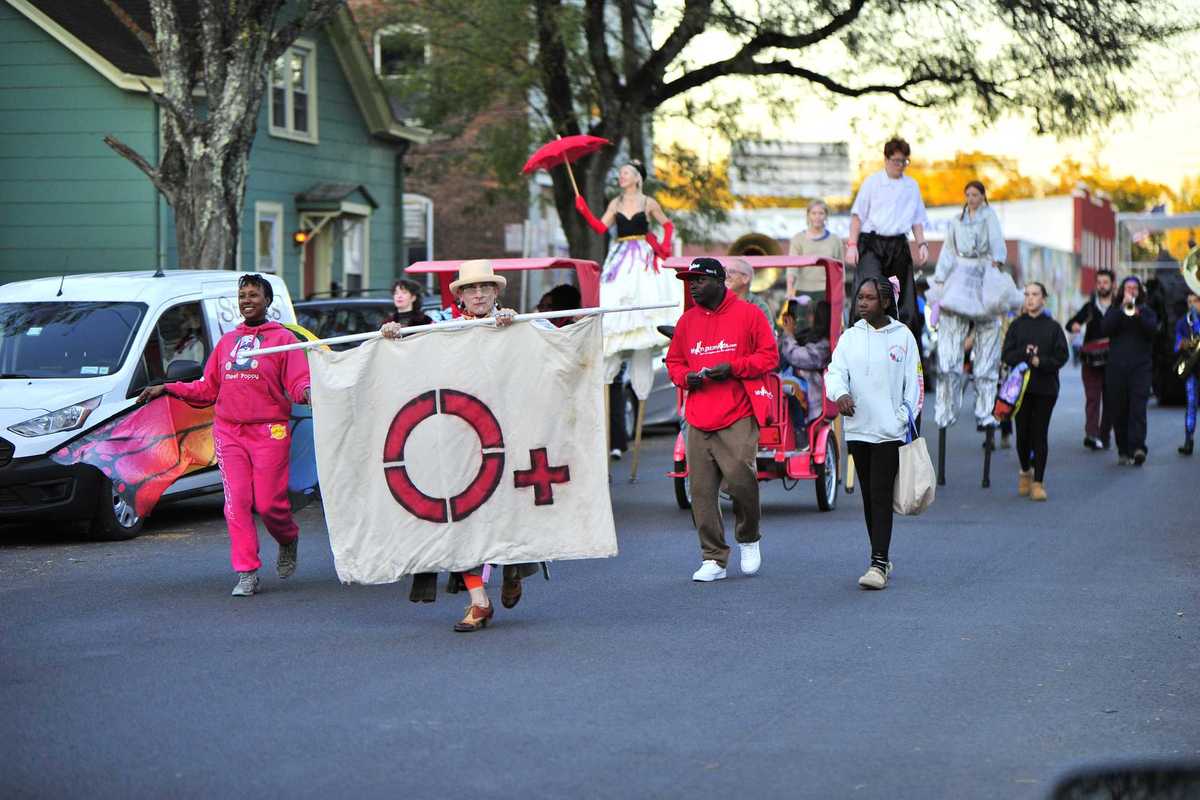
The Saturday’s main event was the parade, which rolled down Main Street around 4 p.m., marking the official start of the nine-day celebration. About 200 people gathered along Main Street’s sidewalks and beneath the shade trees in Veterans Park to watch.
More than two dozen craft vendors set up shop in Eddie Collins Memorial Park on Saturday, selling a myriad of handmade goods ranging from decorative to practical including pottery, jewelry and soaps.
Also taking up residence in the park was a community flea market. Millerton and North East community members peddled gently used items at the park, and two residents in the village signed up to have yard sales put on a map of the town for interested shoppers to go visit.
The day included a dedication ceremony at the Town of North East’s Highway Garage, where town officials dedicated the building to the late Bob Stevens. Stevens served as the town’s Highway Superintendent for more than 20 years at the time of his death in March.
Millerton resident Tim Watson was sitting in his wheelchair underneath the shade at Veterans Park around 2:45 p.m., waiting for the parade to start. He said the week-long celebration coming to fruition and the crowd downtown that came out to celebrate demonstrated a strong sense of community.
“This is a perfect example of community support,” Watson said.
Graham Corrigan
A Flock Safety-manufactured license plate-reading camera near Millerton.
License plate reading cameras have sprung up on private property across northeast Dutchess County, but property owners have said they don’t have formal agreements and often disagreed with the chosen install locations.
Julie Schroeder, the owner of Silamar Farm just outside Millerton, said she agreed to let the Dutchess County Sheriff’s Department install a Flock Safety camera on her property more than two years ago. “I wanted them to put it by the woods,” she said, “to the north of us.”
Instead, Schroeder woke up one morning to find the camera roadside, on the edge of her northern field. “They didn’t give me any heads up,” Schroeder said. “It kind of gets in the way of our farm machinery.”
This was a handshake agreement: Schroeder has no formal contract signed with the sheriff or Flock, the Austin, Texas, -based company behind the cameras. One sheriff left her a business card, but it’s since gone missing. “I get a lot of business cards,” she said.
Schroeder’s Flock camera is an Automatic License Plate Reader, sometimes called ALPRs, and it’s one of a growing number in Northern Dutchess County.
By reading the license plates of passing cars, the camera is able to inform law enforcement of a suspect’s retroactive whereabouts. Nationally, there are over 100,000 ALPR cameras — most of them operated by Flock.
In northeast Dutchess, there are at least four Flock cameras so far. One is on Route 343, east of Amenia at the former Willows Motel.
That property was purchased in 2025 by an affiliate of Discovery Land Company, the parent company of members-only community Silo Ridge Field Club. A Discovery Land Company spokesperson said in April the plan is to rehabilitate the Willows and use it for seasonal employee housing, but could not be reached for further comment on the camera’s installation.
Another ALPR is on Route 82 in Pine Plains, on a private property adjacent to Hammertown Kennels.
A camera in Milan is on land owned by Mirror Lake Retreat on Route 199. Like Julie Schroeder, camp director Ron Pankey agreed to host a Flock camera, but said he was not informed where the camera would be installed, according to news reports.
In Millbrook, Flock cameras were deployed “as covert resources in response to a judicial threat made against a sitting judge residing in Millbrook,” according to Dutchess County District Attorney Anthony Parisi.
Parisi said in February the devices were “temporary in nature,” and have since been removed.
Schroeder has had an experience similar to Ron Pankey’s in Milan. “In the event of an emergency, we’ll be happy we have it,” she said. “But I wanted it up in the woods, north of us…they just put it up so quickly.”
Still, Schroeder doesn’t regret the partnership. “Big Brother is watching you,” she said with a laugh. “I value my privacy, but with cell phones and credit cards, they know exactly where you are.”
Flock cameras can also be found on properties in Amenia, Pine Plains, and Milan. The owners have volunteered to host the cameras on their property, providing Flock a way into communities that bypasses the local town boards.
In February, the Pine Plains town board came under fire for an undisclosed contract with Flock. The town was forced to cancel the contract and pending camera installations. An oversight resolution was adopted to require board approval for any additional cameras operated on behalf of the town.
Nationally, there are over 100,000 ALPR cameras — most of them manufactured by Flock.
Law enforcement in Dutchess County has championed the technology. “It’s been a huge success,” said Deputy Chief Sheriff Steve Reverri. Recent operations aided by Flock include cases concerning illegal guns, school bus safety, and garbage dumping.
The arrests are catalogued on the county’s “Transparency Portal,” a Flock Safety website the sheriff’s office uses to disclose camera locations, share policies, and highlight Flock’s contributions to arrests.
All of the seventeen locations listed in Dutchess County fall within three towns: Poughkeepsie, Fishkill, and Wappinger. The Flock cameras in Milan, Pine Plains, Amenia and North East are not listed on the transparency portal. The county doesn’t disclose the location of cameras on private property.
Reverri is thankful for the residents volunteering to host Flock cameras. “It’s a community project,” he said, and pointed towards the county’s ARTCIC site for a list of camera locations employed directly by law enforcement.
There are 64 total license plate reader cameras in the county, but the locations of cameras hosted by private residents are not listed.
Dutchess County District Attorney Anthony Parisi, in a February 2026 response to questions regarding the Flock camera on Schroeder’s property , said “we must balance transparency with the legitimate privacy rights and safety concerns of those private individuals who elect to cooperate.”
Flock Safety has not been immune to controversy amidst its national rollout. Two detectives in Wisconsin were accused this month of using the cameras for personal tracking and stalking. Five officers in Georgia were arrested for similarly non-professional use of the technology. Los Angeles Police Department suspended their use of Flock cameras this week, citing privacy concerns.
Flock has also made backdoor data access available to U.S. Border Patrol agents for purposes of immigration enforcement. Their security features have come under scrutiny from national lawmakers, who accuse Flock of lax protocols that have led to stolen police logins and international cybersecurity threats.

Want more of our stories on Google? Click here to make us a Preferred Source.

Want more of our stories on Google? Click here to make us a Preferred Source.