

On October 6, 2026, the Pine Plains Board of Education voted unanimously to close Cold Spring Early Learning Center and move roughly 150 pre-K through first-grade students into Seymour Smith beginning in 2027-28.
Superintendent Brian Timm presented the district’s own numbers that night — a document titled “Financial Savings of Consolidation” — and those numbers, taken at face value, still don’t justify what the board did. This process didn’t start with those numbers though. It started with fear. In 2025, Dr. Timm presented to town boards across the district through the fall warning that Pine Plains would lose its Foundation Aid and face a four-million-dollar hole. That turned out to be a story that didn’t hold up. The district used a hypothetical threat that had already been rejected by both the governor and the legislature to manufacture urgency for a decision the actual numbers can’t support.
The only serious proposal to touch save harmless, the state aid minimum, came from a Rockefeller Institute report in December 2024, which proposed phasing out half over five years. Hochul’s office publicly distanced itself from that recommendation within a week of its release. When she tried to move on it anyway, 40 of Long Island’s 117 districts faced aid cuts of up to 10%, and the legislature rebuffed her on a bipartisan basis. Her own January executive budget proposed no formula changes at all, preserved save harmless, and added a 1% minimum for every district. The legislature pushed back even on that — and the 2026-27 enacted budget ended up replacing save harmless with a 2% floor for all districts, which is save harmless with a higher number attached. More than 500 districts statewide are still on it.
The Superintendent’s report offers two scenarios. Scenario one: eliminates 6 paraprofessionals, 2 custodians, and .5 food service worker: $482,337 in personnel plus $200,000 in transportation, for $682,337 total. Scenario two: additionally eliminates a typist and 2 classroom teachers, reaching $1,135,266. Both figures include that same $200,000 transportation line. And both are explicitly labeled estimates subject to union negotiations.
Start with the personnel
The report’s own labels give it away. The paraprofessionals aren’t redundant — Cold Spring runs pre-K through first, Seymour Smith runs 2 through 5, and there’s no grade overlap at all. Those are staffing reductions the district could pursue in any budget year whether Cold Spring stays open or not. The 2 classroom teachers in the high-end scenario are the same story: no overlapping grades means no positions eliminated by the merger, just roles relocated. If the district thinks it can operate with 2 fewer teachers, that’s an argument for any year, not a consolidation savings.
And paraprofessionals deserve better than being the first name on a consolidation list. They’re the adults in the room when a five-year-old melts down, when a child can’t read the worksheet, when a kid needs one more minute before the bus. Cutting them to hit a number means cutting the extra adult that turns a room of 20 five-year-olds into something a teacher can actually manage.
Custodians and food service are the one place where closing a building does create some genuine overlap — you’d likely need fewer of both. But that’s a narrow slice of the total, and it doesn’t rescue the framing. The report dresses up ordinary budget cuts as consolidation savings across the board. The only number that truly depends on shutting the door is the $200,000 in transportation — and that exists only if the district is willing to put 4- and 5-year-olds on buses averaging over an hour each way, with some children riding considerably longer. That’s not a savings. That’s a trade of instructional time and early-childhood stability for a line item.
The cost of closing a building
Then there’s the building itself, and this is where the board’s story falls apart. Dr. Timm has pushed hard on leasing Cold Spring as the financial justification for closing it — a plan the board has signaled it wants to pursue. That framing doesn’t survive the district’s own report. The $300,000 a year in state building aid continues for 10 years whether the building is shuttered or leased.
Leasing is a net negative: the current rent is only about $26,500, far short of the utilities, maintenance, and insurance the district would still have to pay. Those carrying costs are why shuttering beats leasing by roughly $175,000 a year, even after subtracting the current rent. The lease isn’t a revenue stream. It’s a liability the board has chosen to keep.
Meanwhile, Seymour Smith needs $290,000 to $330,000 in playground, bathroom, and parking upgrades before it can absorb 150 more children. Subtract that from the high-end scenario and you’re at roughly $800,000 — less than 2% of a $40.5 million budget.
The district has a history of failing to address staffing. When the May budget failed, it claimed $291,000 in savings from 3 positions that either weren’t filled or were already gone. That’s not cutting. That’s taking credit for arithmetic.
So what would actually addressing staffing look like? A district of under 800 students doesn’t need a director of curriculum. It doesn’t need 3 guidance counselors stretched across a middle school and a high school that together enroll fewer kids than most single buildings. It doesn’t need an assistant principal on top of a principal. Those aren’t luxuries that happen to exist — they’re a staffing model built for a district twice its size, and every dollar in them is a dollar not going to the classroom. The school stays open. The kids stay put. The money’s still there.
The board’s job was to find savings. It found a school to close instead.
I served on the Building Utilization Advisory Committee and was one of the members who dissented from its recommendation. What they presented to this community wasn’t analysis. It was a justification written after the decision was already made.
Kyle Odell served on the Building Utilization Advisory Committee and is a resident of Stanfordville.




 Bahr’s new space occupies about a quarter of a historic dairy barn in the hamlet center.Photo by Graham Corrigan
 Bahr shares her new space with fellow makers Veronica Tyson-Strait and J.Y. Lym. Photo by Graham Corrigan



 A group of English white cattle graze a pasture off of Downey Road in Millerton. The cattle are contained using “virtual fencing” technology that uses GPS-enabled electric collars rather than physical barriers.Photo by Nathan Miller
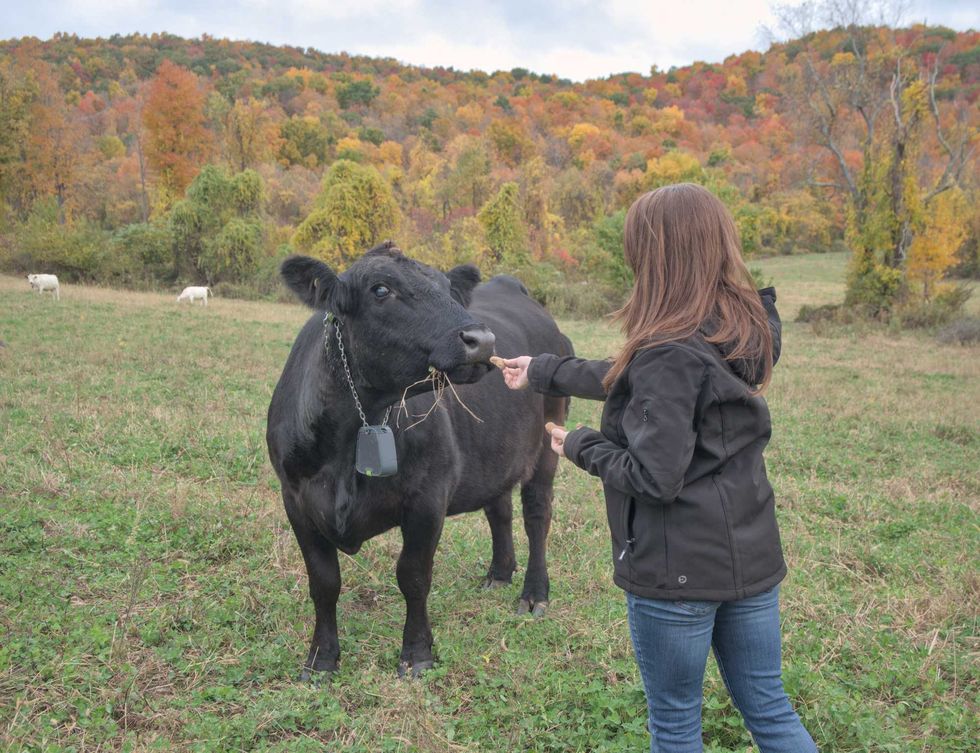 Heather Kading feeds a black angus cow at the former Kaplan dairy farm along Route 22 south of Millerton. Around the cow’s neck is a Nofence GPS-enabled collar.Photo by Nathan Miller



The board’s job was to find savings — it found a school to close instead