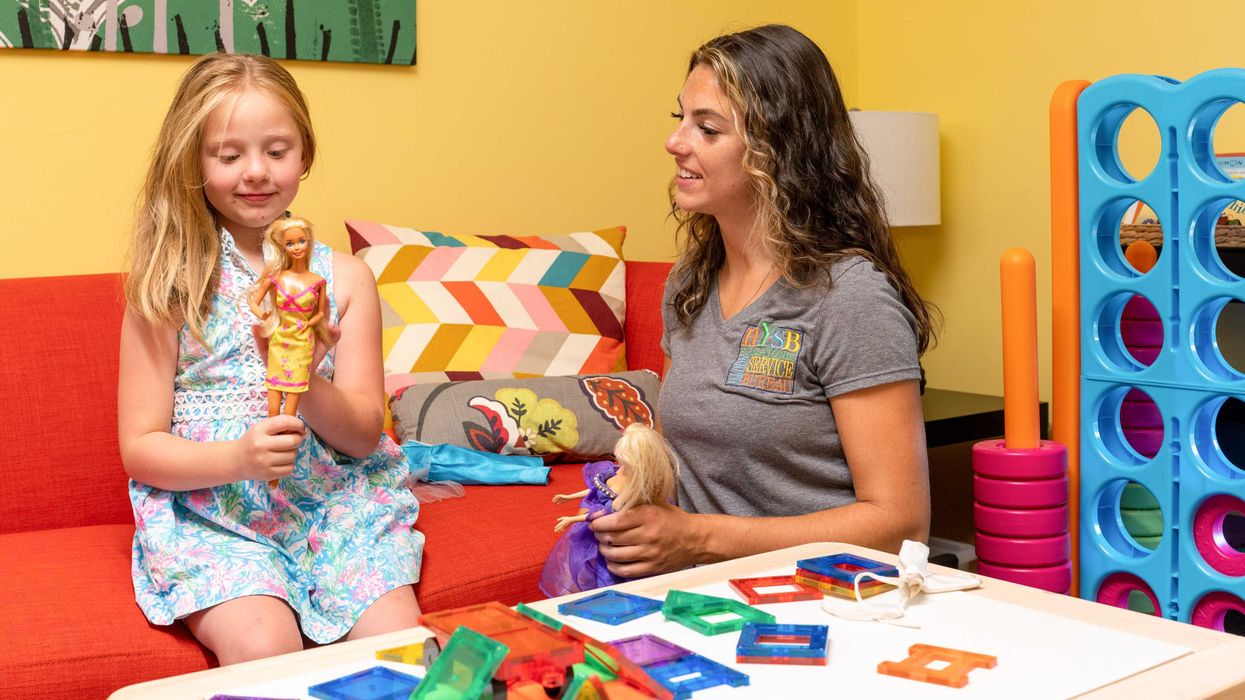
HYSB clinician Taylor Rousseau works with a young client.
Patrick L. Sullivan

HYSB clinician Taylor Rousseau works with a young client.
The Housatonic Youth Services Bureau, with offices on the campus of Housatonic Valley Regional High School, provides a wide range of services and programs to all students living in Region One.
In a phone interview Sept. 10, in response to a query about getting a photo of the entire staff, HYSB Executive Director Kelly Parker said that would be difficult to arrange because most of the time the HYSB staff are out at the six K-8 schools or the high school.
HYSB has a total of eight staffers: three full-time clinicians, one part-time art therapist, one part-time prevention coordinator, a finance employee (part-time), an office administrator (part-time) and Parker (full-time).
The clinical staff deals with mental health and behavioral issues such as anxiety and depression, school-based issues such as fighting, and problems students may encounter following a divorce or a death of a parent.
Parker said HYSB typically does not get involved in substance abuse issues, but will make a referral. HYSB works with the McCall Behavioral Health Network on substance abuse matters, thanks to a federal grant.
HYSB also works with the State Police (Troop B) under the aegis of the Juvenile Review Board.

“It’s a diversion program,” Parker said, aimed at addressing problematic behavior before it gets to court.
Parker said the caseload as of Sept. 10 was 45 students. “That’s typical for the back-to-school period. We’ll probably get 30 referrals in the next couple of weeks.”
The average caseload is 90 clients. If the count gets up to 120, there is a waiting list.
Clinicians will see up to seven students a day, usually at their schools.
HYSB has worked with students at private schools as well.
“For 34 years, we have been honored to serve Region One, growing alongside this incredible community,” said Parker. “As a trusted partner to schools, students, and families, we are proud to continue providing services that support and strengthen the next generation.”

Millerton News
The following excerpts from The Millerton News were compiled by Kathleen Spahn and Rhiannon Leo-Jameson of the North East-Millerton Library.
Mr. and Mrs. Oliver W. Valentine are the parents of a son born Monday at Vassar Hospital, Poughkeepsie. The baby, weighing 8 1/4 pounds, has been named Richard. Both mother and son are getting along nicely, it was reported at the hospital. Mr. Valentine is chief of the Millerton Fire Department.
William Pulver, who has been a patient in the infirmary at Hotchkiss School, has recovered from his illness.
Bill Vogt, noted fly fisherman, is visiting Arthur Terni.
Kenneth Brusie has resumed his duties as gate tender at the New York Central Railroad crossing after a week lay off because of illness.
John Brusie is ill at his home.
Mr. and Mrs. Wesley MacMaster attended the funeral of Mrs. Elia Nodine MacMaster on Monday at Amenia Union.
Penn Central has postponed abandoning freight service on the Harlem Division for at least a month, a member of the New York State Department of Transportation (DOT) said Tuesday.
Robert Colucci, a DOT transportation regulatory analyst, said that the date of Harlem Line’s transfer of ownership from Penn Central to the Consolidated Rail Corporation (ConRail) has been changed from March 1 to April 1, but added that it may occur as late as May 1.
Colucci said that the delay is due to President Gerald Ford’s late approval of the Railroad Revitalization and Regulatory Reform Act of 1976. The bill was not signed until this month and Colucci said that ConRail needed more time to conduct the rail line transfers.
The State DOT excluded the section of the Harlem Division north of Millerton to Chatham in its State Rail Plan released last December. This means that the Harlem Line will become a stub line ending at Millerton once the Penn Central-ConRail transfer is complete. The line is presently a through line that connects with the Boston and Albany line at Chatham.
The State plans to maintain the Harlem’s right-of-way north of Millerton until a connection is built at Dykeman’s in Putnam County, Jim Cartin, DOT principal rail specialist, said this, week. Dykeman’s marks the Harlem’s connection with the Maybrook Line. Freight service, the DOT has said, could be rerouted to or from the Hudson Line via the Maybrook Line. This, the State contended, would eliminate the need for the upper section of the Harlem Division north of Millerton.
Because most accidents there occur in the daytime and most victims are out-of-towners, the State Transportation Department has refused to install a flashing beacon at the infamous checkerboard curve south of the village.
In a Jan. 9 letter to the North East Town Clerk, R.M. Gardeski, regional traffic engineer for the State, said: “A review of the accidents supplied by you shows that (1) they are all out-of-town drivers, (2) the accidents occurred during daylight hours. Therefore, we feel that the installation of a flashing beacon is not appropriate.”
Gardeski did admit in his letter, “your point that cars do not observe this curve far enough in advance is well taken.”
North East Town Clerk Barbara Wickwire read Gardeski’s letter to the Town Board at its Thursday, Feb. 12 meeting.
Gardeski explained that the State has raised the warning arrow already at the curve, added another arrow to the sign, and proposed the addition of yet another set of warning arrows.
Gardeski told The News this week that flashing beacons are usually placed in school speed zones, and in areas to warn motorists of approaching signals. Gardeski said, “If you use the beacons too often, drivers become conditioned to them and they lose their effect.”
Gardeski then got into some bureaucratic lingo. He said the checkerboard is what traffic experts call a “geometric change.” Before we could ask him what, exactly, a geometric change was, he said flashing beacons aren’t usually placed there. Oh.
Next, we wondered why the beacon request was turned down just because most of the people who get creamed on the curve are passing through from out-of-state during the day (We hazard a guess that after getting racked [sick] up on the curve, people are not likely to be too anxious to make a return visit to our Village).
MILLERTON — “What I’d like to do is just throw open the doors,” said Jenny Hansell, the new director of the North East Community Center (NECC), referring to her desire to “reach out to the community and make the NECC a place for everybody.” Ms. Hansell said her first priority is to support and enrich the programs alredy in place at the center, and then “start from scratch” on new projects. And she is not without experience in program development.
A graduate of Yale University, Ms. Hansell has a long history of work in volunteer and philanthropic organizations.
Her focus has always been to educate children and teens while encouraging social activism. Ms. Hansell described several of her past assignments for an organization called Heaven, at which Ms. Hansell attempted to “make volunteering and philanthropy hip for young adults;” while at another job she “developed curriculum for teens to learn technology while volunteering.”
However, Ms. Hansell welcomes the change from working on-line to hands-on.
“Working on-line for three years has caused me to become a couple of steps removed,” said the new director. “I could reach millions of faceless people before, but it’s worth it if I can reach 10, face-to-face, now.”
One of the first steps Ms. Hansell plans to take is to revive teen involvement at the center, including developing and/or reinstating programs geared towards youth enrichment and environmental awareness. Also, she hopes to help the center to further incorporate the growing Hispanic community.
MILLERTON - Riley’s Furniture has opened its online showroom on FurnitureFan.com.
Furniture shoppers may browse Riley’s Internet showroom 24 hours a day, every day of the year.
FurnitureFan.com is the largest-of-its-kind furniture search engine in the country, according to its sponsors. Its concept allows consumers to narrow their search for furniture online and then “see, feel and buy” it at a local store such as Riley’s Furniture.
Riley’s Furniture is located at 135 Main St., Millerton.
Christine Bates
Located in the center of Amenia on Route 343, this house built in 1790 was renovated and sold as a turn key property for $405,000.
AMENIA — Home prices in Amenia reached their highest level of the year in December, capping off a 2025 market that saw both rising values and increased sales activity.
The median sale price for a single-family home in Amenia was $389,000 in 2025, up 11% from $351,000 in 2024. The number of house sales also increased to 29, up from 25 the year before.
December’s trailing 12-month median marked the high point of the year, with every recorded residential transfer that month closing above the $389,000 annual median. Three single-family homes sold in December.
Despite rising prices, Amenia remains more affordable than much of northeastern Dutchess County. In 2025, the median single-family house price was $529,000 in Pine Plains, $661,000 in Washington, $662,500 in Stanford and $427,000 in North East.
Inventory in Amenia remains limited. In mid-February, 12 single-family homes were listed for sale — roughly a five-month supply — including five priced under $400,000 and three listed above $2 million. Among them was a publicly listed 6,500-square-foot lakeside home in Silo Ridge offered at $8.9 million.
3343 Route 343 — 3 bedroom/2 bath home on 0.5 acres sold to Shauna Henschel for $405,000.
174 Perry Corners Road — 3 bedroom/3 bath home on 1.93 acres sold to Emily Kate Higgins for $513,000.
18 Furnace Bank Road — 4 bedroom/2 bath two family house on 0.2 acres in Wassaic sold to Trent Morey for $450,000.
4848 Route 44 — 3 bedroom/2 bath house on 102.36 acres to Buck Ripley LLC for $2.08 million.
Old North Road (#356987) — 0.19 acres of rural vacant land at the intersection with Route 44 sold to Frederick Lattrell for $7,500.
*Town of Amenia property transfers in December are sourced from Dutchess County Real Property Office monthly reports. Details on all parcels from Dutchess Parcel Access. Only arm’s length transactions with compensation are included. Recorded transfers typically lag closed sales. Market data from Smart MLS Info Sparks does not include private transactions or Silo Ridge sales. The Dutchess County parcel number is indicated when no specific street address is included. Compiled by Christine Bates, Real Estate Advisor with William Pitt Sotheby’s International Realty, Licensed in Connecticut and New York.

Want more of our stories on Google? Click here to make us a Preferred Source.
Natalia Zukerman
For Brooklyn-based artist Taha Clayton, history isn’t something sealed behind glass. It breathes, moves and stands before us in the bodies of everyday people. His upcoming solo exhibition, “Historic Presence” at the Tremaine Gallery at Hotchkiss, takes its philosophical cue from James Baldwin’s declaration that “History is not the past. It is the present.”
Clayton’s luminous portraits center on elders, friends and acquaintances whose quiet dignity embodies what he calls “the common everyday story” often missing from official narratives. “The historical is talking about something from the past,” Clayton said, “but these are men and women that are living in this day, walking with the ancestors, creating the stories.”
Clayton describes the series as rooted in a search for these overlooked narratives. “It started with Baldwin and John Coltrane… and then it blossomed to the people of the times, the stories that get overlooked.” His subjects are people he knows or meets through everyday encounters. “It’s the models, it’s their lives. It’s us collaborating, as opposed to me putting a costume on someone,” he said.
Born in Houston, raised in Toronto and now based in Brooklyn, Clayton brings a cross-cultural sensibility to classical realism. His figures frequently appear in clothing inspired by mid-20th-century style, echoing the visual language of the 1930s through ’50s. But rather than nostalgia, he’s after something more layered, a kind of collapsing of timelines. “I’m documenting this moment,” he explains, “but I’m also challenging myths and creating new ones.”
The use of fabric is a striking element in Clayton’s work, operating on both aesthetic and symbolic levels. “I’m playing on ideas like ‘being cut from the cloth,’ ‘the thread’ of an idea,” he explained. The act of painting on cotton alone carries layered historical meaning, but he deliberately reframes it as a site of empowerment. For him, cloth/cotton signals ceremony, resilience and transformation.

Clayton has an evolving and deepening relationship with this area. As an artist-in-residence at the Wassaic Project in Amenia, he said, “We were the first residency out of the pandemic, and I brought my wife and daughters. It was a two-week residency that ended up being the whole summer. It just kind of evolved and that’s how my relationship upstate has been.” His series “The Cloth” was presented at Troutbeck in Amenia in 2022 and he has returned as a featured speaker and educator for the Troutbeck Symposium, the multi-day gathering at Troutbeck where middle and high-school students present year-long research projects on under-told local and national histories. “It’s been four years I’ve been with them, so I’m like artist/mentor now,” said Clayton.
Clayton will be in residence again at Hotchkiss for the week leading up to the opening, offering students multiple ways to engage with the artist and providing a rich, hands-on experience of his practice as well as his guidance. “Taha is a remarkable artist to work with because he meets students where they are,” said Tremaine Gallery director, Terri Moore. “He listens deeply, treats their ideas with real respect and shows them that their own stories are worthy subjects. That combination of humility, rigor and generosity is rare — and it’s why students respond to him so strongly.”

Clayton’s career has garnered international — even interstellar — recognition, including exhibitions in cities from New York to Barcelona. One of his works was selected for the Lunar Codex’s “Nova Collection” in 2024, part of an ambitious global archive designed to preserve creative works on the Moon as a time capsule of human culture. Clayton recalled the moment the capsule landed with characteristic understatement: “I’m just on the computer watching with a beer thinking, ‘Ok, this is cool.’ But, like the next day, I still had to get up and take the kids to school.”
Interspersed throughout the gallery are ceramic shields that add to the warrior-like quality of some of the subjects. The repetition of a water fountain is particularly evocative, another reclamation that amplifies history without obscuring the truth that shaped it.
Clayton describes his practice as a form of meditation, saying he feels time dissolve while working. “It’s like past and future is all happening,” he said. That sense of temporal layering resonates with the exhibition’s central idea that personal memory and collective history are inseparable. Clayton’s portraits are about recognizing and celebrating the magnitude and multitudes contained in ordinary lives, the reclamation and attention to historical detail and the carrying of history forward with incredible beauty and unwavering dignity.
“Historic Presence” will be on view Feb. 14-April 5 at the Tremaine Gallery at Hotchkiss, 11 Interlaken Road, Lakeville. An artists’ talk is scheduled Thursday, Feb. 19, at 7 p.m., followed by an opening reception Saturday, Feb. 21, from 4 to 6 p.m.
Jennifer Almquist
"This truly is a dream come true...to create something containing all the things I’ve loved."
Bobby Graham
Bobby Graham and his husband, Matthew Marden, opened their home and lifestyle shop, Dugazon, in a clapboard house in Sharon six months ago. Word spread quickly that their shop is filled with objects of beauty, utility and elegance. Graham and Marden tell a story of family, tradition, joy, food, community and welcome.
Jennifer Almquist sat down with the couple for a conversation about design, storytelling and building a life — and business — together.
Jennifer Almquist: When did this dream begin?
Bobby Graham: This truly is a dream come true. I wanted to open this shop for more than 30 years, to create something containing all the things I’ve loved that have inspired me.
Matthew Marden: Dugazon has exceeded our expectations. Having our own business, no longer part of a large corporate structure, allows us to tell our stories and work together.
JA: What is your earliest memory that set you on your journey?
BG: My earliest memories include going to flea markets and antique shops with my mom. I still have my vast collection of wooden animals that my mom started when I was a little boy.
JA: What are your earliest memories that drew you to beauty, design and fashion?
MM: I’ve always been a visual person. I was fascinated with The Muppet Show and Sesame Street. I loved their imaginative worlds. It was the late ’70s, and I remember being oddly interested in pop culture, loving the colors and textures of the different puppets, their crazy hair or colorful fur.
JA: What were your favorite stories growing up?
MM: I grew up in Hopkinton, a small town in New Hampshire. I loved “Goodnight Moon.” I remember C.S. Lewis’ Narnia books and their combination of fantasy and reality. I was a voracious reader, drawn to the more macabre world of Stephen King. My dad read me “Watership Down.” I remember the “Madeline” books. I was terrified by the nuns.
BG: I loved books that were visual, especially a pop-up book called “The Great Menagerie,” published by the Metropolitan Museum in the ’70s. I loved “Danny the Dinosaur” and “Cloudy With a Chance of Meatballs.”
JA: What roles do family and tradition play in your lives?
BG: My mom was a homemaker in Sioux Falls, South Dakota, where I grew up, but she was from Baton Rouge. I spent three weeks every summer with my grandparents in New Orleans. It was all about food and family. In our home, Matt and I keep those traditions alive.
MM: We have been married almost two years, but we’ve been together 20 years. When we first started dating, we discovered that despite being from different parts of the country, we had much in common. Family is important to us both.
JA: Are your families supportive of your new venture?
BG: They’re so proud of us. My dad calls every day.

JA: Matt, what drew you to fashion as a career?
MM: I studied art history in college. For five years, I worked at a New York fashion photography gallery, Staley-Wise. I worked at Town & Country, was a fashion director at Interview, then fashion director at Details magazine, where I stayed most of my career. I became style director at Esquire.
JA: Bobby, what was your experience in advertising and publishing?
BG: I worked in banking for a couple of years using my business degree, but it just wasn’t right. I went to work at Condé Nast as a sales executive for Vogue, GQ, Vanity Fair, AD and The New Yorker.
JA: How did you meet? When did you marry?
MM: It was my first morning at Details. I noticed Bobby in the elevator. We were married in August 2024.
JA: What is your business philosophy?
BG: My business philosophy is that you work hard, you have integrity, you have fun and the money will come. There are no shortcuts in life.
MM: At Dugazon, we sell what we love.
JA: What is your most beautiful, most favorite item in Dugazon?
MM: A photograph by our friend Matt Albiani called “Lost,” shot under a pier in the summer. We had a copy in our house on Fire Island for years.
BG: My favorite item is our candle wall. I just love the way it presents visually. I love the colors.
Dugazon is located at 19 West Main Street, Sharon. For more information and shop hours, visit: dugazonshop.com.
Sally Haver
Jack and Dolly Geary outside the new location in Salisbury.
Geary, a contemporary art gallery with roots on New York City’s Lower East Side, is opening a new chapter in Salisbury, relocating to a restored 1840 building at 14 Main St. after five years in Millerton. Owned by Jack and Dolly Bross Geary, it was at 34 Main St. in Millerton and is reopening in the handsome teal-colored, two-story building built in 1840 and until recently owned by the interior design and architecture studio of Hendricks Churchill. Geary’s first show in the new building is scheduled for Feb. 21 and will feature the work of one of the gallery’s five artists, Alan Prazniak.
“Our lease on the gallery space in Millerton was coming up in March, and we questioned whether or not to renew,” Jack Geary said. “We were interested in owning our next space, and fortuitously, the Salisbury building came on the market.” The new building offered more space than the Millerton location — 5,000 square feet on two floors in turnkey condition. “In addition to three exhibition rooms, there’s even a bedroom with an en suite bathroom for a visiting artist to stay,” said Jack.
The Gearys founded their gallery in 2013 on the Lower East Side in New York City, then moved to Varick Street in SoHo before landing at their final New York City location on the Bowery in 2020. When the COVID-19 pandemic hit and the Gearys found themselves living primarily in their Lakeville home, they discovered the Millerton space on Main Street. With its white walls and track lighting, they determined it would be the perfect spot for a gallery. As it turned out, having two geographically disparate spaces proved cumbersome to program and maintain, so they consolidated their efforts in Millerton which they will transfer to Salisbury.
The Gearys are already planning events for the new space, including art classes, lectures, readings and parties. During the gallery’s time in Millerton, from 2020 to the present, Geary hosted 28 exhibitions, as well as performance art events, poetry readings and dinners celebrating exhibitions. Most recently, they hosted a dinner for artist Dana Sherwood in conjunction with her exhibition. Ever the creative artist, Sherwood made all the plates, candlesticks and serving bowls used at the dinner.
The gallery currently represents five contemporary artists: Will Corwin, Tura Oliveira, Alan Prazniak, Reeve Schley and Sun You. Most are painters, though some also work in sculpture and installation. “We are focused on showing our represented artists,” Dolly said, “but we also enjoy showing other artists with whom we have relationships.” The Gearys have exhibited at art fairs in Miami, Chicago and San Francisco and have placed works in museum collections and exhibitions, raising artists’ profiles and building momentum for the gallery’s future.
Alan Prazniak, whose work will be featured in the opening exhibition, describes the show, “Earth Tones,” as “a collection of work that chronicles the time after moving my studio to the Catskills from Brooklyn in 2024. ‘Tones’ refers to the colors, but also — maybe more importantly — to the frequencies of the mountains. There’s a music to them; it can be overwhelming if you let it in. Staring at a giant hill in the distance, listening to it hum, falling under the spell of whatever’s out there. But finally turning your back to it to go into the studio, trying to make something of it.”
Geary is open Friday through Sunday from 11 a.m. to 5 p.m. and by appointment. Information is available at info@geary.nyc

Want more of our stories on Google? Click here to make us a Preferred Source.

Want more of our stories on Google? Click here to make us a Preferred Source.