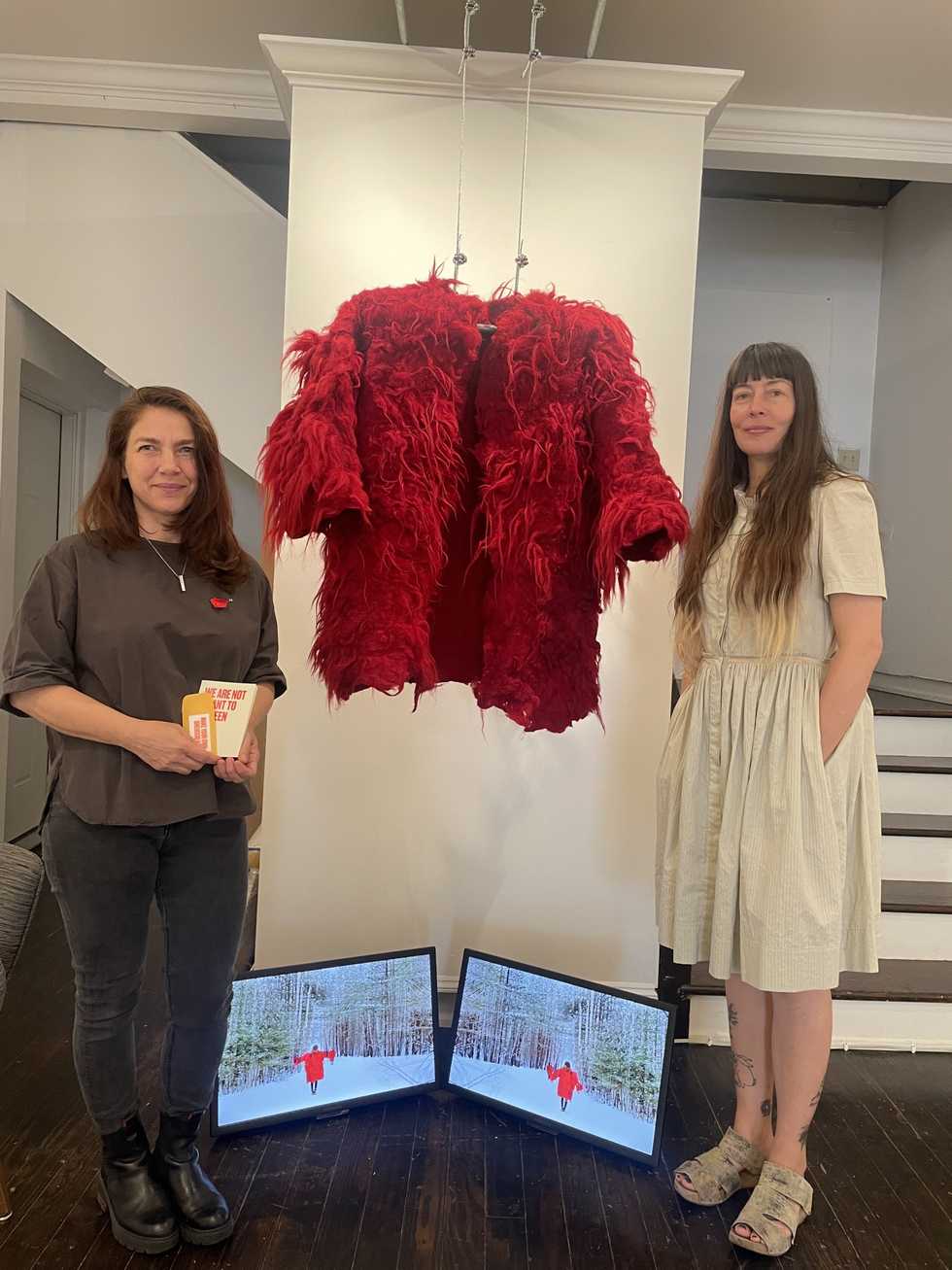
MILLERTON — “I felt an instant buzzing throughout my whole brain and body,” said artist Brigitta Varadi of the moment at age 16 when she first experienced the process of felting wool. This kind of visceral knowledge, coupled with a lot of intellectual and clerical footwork, are the hallmarks of the multidisciplinary art of Varadi, whose video/sculpture installation piece was in the back room of Geary Contemporary’s mid-June to late July show, “Who Is To Say I’m Awake; Are You?”
Varadi (accent on the first syllable), whose work has been supported by numerous awards, grants and residencies, is also currently director of residencies at ChaNorth, the Pine Plains branch of ChaShaMa, a New York organization that arranges artist residencies in work spaces in otherwise unused buildings in the region. A resident of Pine Plains, Varadi travels extensively worldwide, with her two most recent distant residencies having been in Ireland and in Italy.
The theme underlying much of Varadi’s work is the everyday working life of people around the world, disappearing traditions related to those lives, and the toll taken on those populations. In Ireland, one of her projects involved tracking the use of sheep, marking with various colors related to age, condition and so on. She also did textile and felting projects in prisons in Limerick and Roscommon.
“Why the obsession with felting?”, she asked in a presentation on Saturday, July 29, as if standing in for the audience, and proceeded to link it with her own family history as part of the stateless Carpatho-Rusyn population group, a people without a homeland, dwellers in the high valleys of a shifting area of east central Europe, subject to various pressures from the governments where they live, including Magyarization, the forcing of Hungarian culture and language on Carpathians.
The question of language—itself varying according to region—is even more vexing for people who speak and think in two languages, with their particular stress patterns, semantics and pronunciations. In perplexity as a child, Varadi says, she would ask her grandmother, “Who are we? Are we Ukrainian? Polish? Czech?” When all the answers were “No,” she asked, “What is this language we speak?” The response? “We speak /Po Nashomu—the [language of the] people who speak like us.” With the many shifting borders attending the historical changes, this was as close to an identity as they got.
A quarter-million Carpatho-Rusyns immigrated to the U.S., particularly to Pennsylvania, to work in coal mines and steel factories in the period from 1870 to 1930. Until the end of that period, when unionization improved their pay and conditions, men worked 12-hour shifts seven days a week, switching shifts every two weeks, which meant one shift of 24 hours every two weeks, and one period of 24 hours “off.” Their pay averaged $5 per week. But to leave such thankless misery to return would have been worse, since the Austro-Hungarian empire was no friend of the Carpatho-Rusyns.
In 1939, Carpathians in Khust in present-day Ukraine declared independence from Czechoslovakia, only to be formally annexed by Hungary one day later. The Carpathian state thus existed for a mere 24 hours, the shortest-lived state in history. In our time, Carpatho-Rusyns live as a national minority in Hungary, Slovakia, Poland and Ukraine.
Varadi’s approach to this story of longing to belong centers around solitary walks she took in the forests of New Hampshire last winter as a resident at the famed MacDowell Colony, when the temperature on some days dipped to minus 40 degrees. With no cameraperson other than herself, she wandered the woods—carefully so as not to unduly disturb the snow’s surface—wrapped in the mammoth bright red felted coat that hung, suspended from steel cables in honor of the workers in Pennsylvania.
She edited the 58 takes she filmed over two weeks into a looping video in which camera changes are invisible. The resulting dreamlike quality, where some close-ups of the red coat stain images of long shots, reminiscent of blood, are, for Varadi, intimately linked to memories of walking the woods in Carpathia with her great-grandfather, her personal archive of a family that itself did not allow recording of their lives.
“The thrill of connecting with others, their stories and memories brought up by seeing the work, all crept into the editing of this film,” Varadi said.

 Photo by Graham Corrigan