The very backbone of any global possibility of peace is arms’ control. In the past 100 years, every world war has started with adversaries (not enemies yet) secretly building up arms and weapon development. Flying machines in WWI and then German battleships and bombers in WWII. We came close with the Cuban Missile Crisis and outer space weaponization and, yes, the collapse of the USSR could have gone either way, especially with President Reagan threatening a “Star Wars” program (that thankfully never left the drawing board).
Here’s a simple fact: If we had the U2 Spy Plane in 1938, Germany could never have built the Tirpitz or Bismarck battleships, never could have built factories to make thousands of bombers. They would have been “seen” and stopped, early, before they could become a force diplomatic words alone (let alone worthless paper treaties) could not thwart.
The Cuban Missile Crisis was averted by a series of U2 black and white photographs. It was that simple. The White House decisions taken were not simple, but the proof, evidence, was basically a Kodak under a spy plane. Before the USA and USSR and 34 countries decided to de-escalate tensions by agreeing to an Open Skies policy in 1992 — meaning we can overfly you and you can overfly us to see and check what’s going on — only spies and spying would provide critical adversary intel.
Aircraft with four types of sensors — optical panoramic and framing cameras, real-time video cameras, infrared line-scanners and sideways-looking synthetic aperture radar — may make observations anywhere over a country’s national territory. Treaty rules say that the flight may only be restricted for reasons of flight safety, not for reasons of national security.
So, what’s happened now that has me worried? The United States, at the executive order from the White House, has decided to abandon the Open Skies Treaty. In a statement put out by the administration, they claim that it was “no longer in the United States’ best interest to remain a party to this Treaty when Russia does not uphold its commitments.” Meaning? Russia may be cheating near St. Petersburg and, if they cheat, we’ll simply stop acting under the treaty and withdraw their right to observe us and, by return, we lose the right to observe them. In short, the closed society of Russia and now China will become a dangerous, unknown, weapons’ builder as it was during the time of Gary Powers and the U2 shoot down.
Interestingly, 33 countries have said they think this is a dangerous escalation of the risk of war — including Russia — all of whom plan to keep the Open Skies treaty. All the European, NATO, allies overfly most of Russia regularly and share intel with the Pentagon. So, what was the real reason for the U.S. to drop out? The administration wants to stop them overflying us. We may be weaponizing without public awareness. And, indeed, with the new Space Force, which is a military endeavor, weapons systems and capabilities are under development.
On March 13, the Space Force received its first “counterforce” weapon: The Counter Communications System Block 10.2, which jams selected satellite communications. “CCS is the only offensive system in the United States Space Force arsenal,” said Lt. Col. Steve Brogan, in the Space Force’s Space and Missile Systems Center Special Programs Directorate. “This upgrade puts the ‘force’ in Space Force and is critical for space as a warfighting domain.”
In development since 2014, you just know they have dozens more closed skies’ weapons in line for deployment.
Peter Riva, a former resident of Amenia Union, now lives in New Mexico.






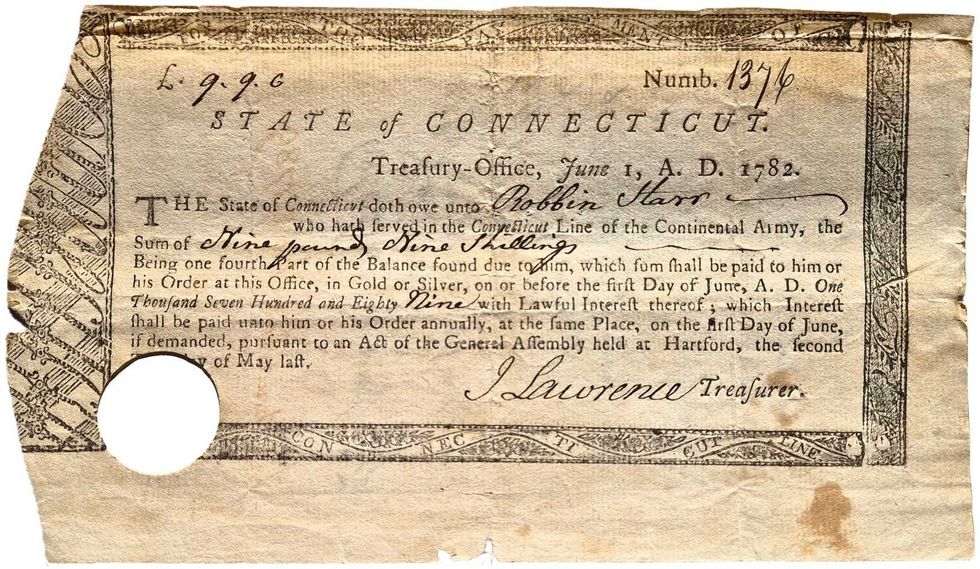 Pay Bill for Robin Starr’s service in the Continental Army.Courtesy the Alex Breanne Corporation
 John Mills speaking at Quinnipiac University.Courtesy the Alex Breanne Corporation
 Stephanie Saetta,with her rescue dog George and Blue (left), a shepherd mix awaiting his forever home.Madi Long