At North Canaan’s accordion museum, every instrument has a story

Paul Ramunni playing polka music.
Madi Long


Paul Ramunni playing polka music.
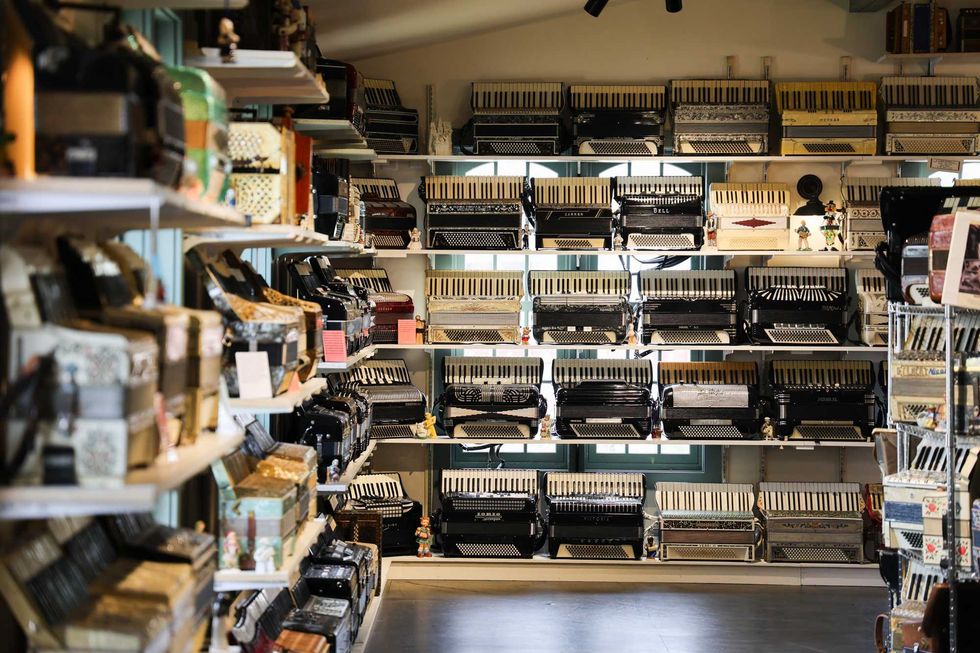
For visitors stepping into the New England Accordion Connection & Museum inside North Canaan’s historic railroad station, the first thing they notice is the sheer number of accordions.
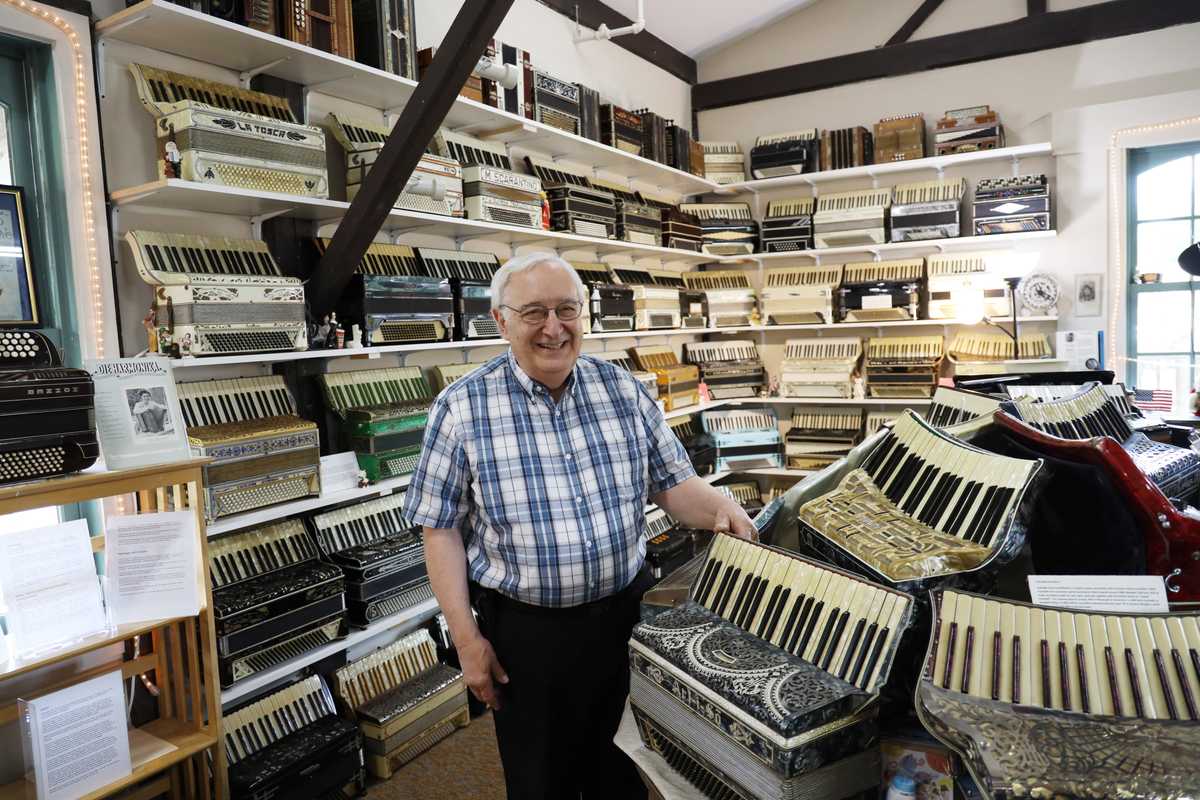
Rows upon rows of instruments line the walls. Some are polished, while others show the wear of decades spent traveling across continents and sitting in family attics.
“There are about 500 accordions in this room,” museum founder Paul Ramunni said during a recent tour. “We have another 200 in the basement, so we’re cracking 700.”
But Ramunni insists the collection is not really about accordions.
“It’s the stories,” he said. “The instruments are just the carriers.”
For more than a decade, Ramunni and his wife, Marsha, have been collecting not only instruments but also the family histories attached to them. The result is what may be one of the most unusual museums in New England — a place where music, immigration, war and local history come together.
A Childhood Instrument Rediscovered
Ramunni’s own relationship with the accordion began on Long Island in the 1950s. His mother, who was of Italian ancestry, insisted he learn to play.
“I said, ‘Anything but that,’” he recalled. “The kids are going to make fun of me.”
He played for about three years before eventually putting the instrument away when he went to college.
More than four decades later, while spending time with Marsha in rural Vermont, something unexpected happened.
“I woke up with the urge to play the accordion again,” he said.
Soon after, he found a collector who was preparing to send several accordions to a Holocaust museum. The instruments had reportedly come from Dachau, a WWII concentration camp, where the victims were forced to give them up or perform for the guards.
The story stunned him.
“You mean to tell me every one of these accordions has a back story?” he remembered asking.
From that moment, Ramunni began seeking out instruments to collect and asking their owners about the back stories.
More Than A Collection
One of the first stories involved an elderly woman in Torrington whose late husband’s accordion sat unplayed for years.
When Ramunni picked up the instrument and began playing it, the woman broke down in tears.
“That was my husband’s voice,” she told him, referring to the sound of her late husband’s favorite instrument.
The couple had fled Europe during WWII with little more than a suitcase and the accordion.
“It was the family album,” Ramunni said.
Many of the instruments tell stories of immigration and war.
One accordion currently in Ramunni’s museum belonged to a World War II veteran who operated a landing craft during the Normandy invasion and often played it for his fellow marines.
The museum displays a photograph the veteran took of the soldiers aboard the vessel before they landed on the beach. Family members said many of the young men pictured never returned home.
More recently, a Ukrainian immigrant donated an accordion after losing family members during the current war with Russia.
“He said, ‘I can’t play it anymore,’” Ramunni recalled, noting that it had too many memories that he wanted to forget.
A Labor Of Love
The museum’s location is closely tied to Ramunni’s own history. In the early 1980s, he and a business partner purchased the North Canaan railroad station, where he operated a CPA firm.
He sold the building after a 2001 fire devastated the station. Two decades later, when space became available in the restored building, he returned to house the collection that had outgrown his North Canaan home. Since opening the museum in 2021, he said, it has welcomed more than 9,000 visitors.
Visitors come from throughout New England and beyond, many bringing their own stories along with old accordions. Some arrive hoping to repair an instrument.
The museum functions as more than just an exhibition space; Ramunni repairs accordions. The couple also buys and sells instruments. They host events, tours for school groups, senior centers, day-care programs and historical societies.
Sometimes they take the collection on the road.
“Everything fits in a Subaru,” Marsha said.
She sees the museum as both an educational resource and a community gathering place.
“We’re trying to make an impact here on the town and the area,” she said. “Bringing people in, educating them, giving them a place to learn about history.”
The collection continues to grow through donations.
On a recent afternoon, Salisbury resident Gary Peterson arrived carrying an accordion that had belonged to his grandmother, a Swedish immigrant who played polka music. Now retired and downsizing, Peterson said his family wanted to find someone who could appreciate the instrument rather than simply discard it.
Looking around at the hundreds of accordions on display, Peterson said he was struck by the variety and craftsmanship of the collection. “There are so many different types of accordions,” he said. “It’s awesome.”
Natalia Zukerman
You might recognize Sarah LaDuke’s voice without ever knowing what she looks like. For years, it’s a voice that has arrived through kitchen and car speakers, introducing authors, moderating conversations and helping listeners make sense of the day’s events. Her voice has become a familiar companion throughout the region. Now, after nearly two decades at WAMC, LaDuke has stepped away from public radio news and into a role that brings her closer to what she says has always animated her most: music.
“I’ve been at WAMC for almost 20 years, and I love it,” LaDuke said. “But I felt like I was ready for something. I didn’t know what.”
The longtime radio host, producer and arts advocate has been named executive director of Folk Alley, the member-supported folk music streaming station and website operated by the FreshGrass Foundation. LaDuke now leads the nationally respected platform from her home office in Albany while helping shape its next chapter.
The opportunity arrived unexpectedly.
“I was just talking to a friend,” LaDuke recalled. “And she said, ‘The executive director of Folk Alley wants to retire.’ I was like, ‘What? No way.’”
What followed felt remarkably organic.
“The first interview wasn’t billed as a job interview,” she said. “The pressure and stress weren’t there. I was just having a great conversation about loving music and radio and broadcasting.”
The move marks a significant shift for LaDuke, whose voice became a fixture on WAMC’s airwaves through programs including “The Roundtable” and “The Book Show.”
While she loved the work at WAMC, producing shows like “The Roundtable” and “The Book Show,” the demands of daily news coverage felt heavy.
“I’m not a news guy,” she said with a laugh. “The music and arts part of it has always gotten me the most enthused.”
Hosting discussions about politics and current events often brought anxiety, she admitted.
“To fill in as host of ‘The Roundtable’ and get ready to talk about news live on the air for two hours — it generated a tremendous amount of anxiety,” she said. “I would read all the news I possibly could at 9 p.m. and then go in and talk about it at 9 a.m. It was getting hard to bear on the old soul and skeleton.”
At Folk Alley, LaDuke sees an opportunity to focus on the cultural conversations that have always energized her.
Founded in 2003, Folk Alley offers a curated stream of folk, Americana, roots and singer-songwriter music alongside artist interviews, articles and specialty programming. Now part of the FreshGrass Foundation, the nonprofit behind the FreshGrass festivals, No Depression and Folk Alley, the platform reaches listeners around the world through its website and mobile app.
LaDuke believes its greatest strength is its human touch.
“People who care about and know about folk music are choosing the songs,” she said. “No song is selected because of an algorithm or AI. It’s human-curated music.”
One of her primary goals is simple: help more people discover it.
“I think the people who know Folk Alley love it and value it,” she said. “I think more people need to know about Folk Alley.”
She hopes to expand the organization’s presence at festivals and concerts while connecting artists and listeners more directly.
“We have this 24/7 marvelous coming together of folk music,” she said. “We’ve got to make sure people know about it.”
The role itself is broad. In addition to overseeing programming, LaDuke will manage memberships, donor relations, budgets, contractors and technical operations.
“It’s very adult,” she joked.
Though she’s only beginning to learn the intricacies of the job, she already has ideas for the future. Among them is the possibility of creating a podcast network focused on music, culture and conversation.
“I would like to start a podcast network of good talkers talking about music and art and humanity,” she said. “To be able to find and present conversation — that’s been my steez for the last 20 years.”
For now, she’s focused on learning from outgoing executive director Linda Fahey, who will remain through the summer to help with the transition.
LaDuke also sees Folk Alley as part of a larger mission.
“Music is one of our great unifying forces,” she wrote in announcing the position. “Folk music has always shared and preserved the stories of its communities’ historical struggles, current concerns and desire for a better future.”
In a world that is feeling increasingly fractured, she believes that mission matters more than ever.
“Alongside the important cultural impacts of folk music,” she added, “is the undeniable truth that music is fun — and having some good times in a world gone mad might just get us through.”
Patrick L. Sullivan
A cold mountain brook that enters one of the New York City reservoirs.
PHOENICIA, New York My annual week off in the Catskills in early June got off to a satisfactory start. The first week or so of June usually means a lot of different bugs hatching, which in turn means the angler can sling three or four patterns with a fair bit of confidence.
This time around the isonychia were dominant. This is a big reddish-brown mayfly, sometimes known as a Slate Drake and most frequently imitated on the Esopus Creek with a traditional winged wet fly, the Leadwing Coachman.
I remember as a callow youth of 12 being instructed by an impossibly ancient codger -- hell, he was probably 65 -- that a Leadwing Coachman wet fly, size 10-14, would produce on the Esopus when nothing else would. In the intervening half century I have put this proposition to the test and found it accurate.
What was different this year was the isos were flying around. Usually we see their casings on the rocks, but not the adult mayflies in the air.

The first night it was all browns in the 14-18 range. The second night it was all rainbows in the 10-14 range.
That was early in the trip. Three days in, things warmed up considerably, and without any mitigating rain.
So the range of options was limited, and the preferred time of day was just before dawn. Note I said “preferred.” The actual start time varied depending on how late my attorney, Thos., and I stayed up watching Fu Manchu movies.
I low-crawled up a mountain brook at dawn with a Tenkara rod and did okay with wild browns. On the scramble out I had a brief and alarming encounter with a descendant of the Hound of the Baskervilles, whose owner helpfully said “Don’t make any sudden moves.”
“Any chance of a leash here?” I said in what I hoped was a cheerful, non-threatening tone of voice.
So there’s that.
Gary Dodson alerted us that the Spot That Must Not Be Named was in play. This is a cold mountain brook that enters one of the New York City reservoirs and depending on how full the latter is, forms a channel of cold water that mixes in with the warmer reservoir water. If the timing is right, the angler can latch into some decent trout and whatever else has fins and an inquisitive nature.
So one morning, while the boys worked the big deep cold pool by the bridge, I made my way downstream, deploying the stream thermometer frequently to try and figure out the magic spot where trout would be comfortable enough to hang out and nosh.
I used a favorite tactic: a dry/dropper rig, with a Chubby Chernobyl as the top fly and de facto bobber, and a series of nymphs and wet flies on an 18-24 inch fluorocarbon tipper dropper, 4X or 5X, tied directly to the bend of the Chubby’s hook.
This worked immediately, with good browns in the 16-18 inch range hitting the nymphs and a Jerry Shillcock isonychia wet fly pattern.

In a nod to tradition, I used one of my late father’s Orvis Battenkill bamboo rods for the purpose. It is eight feet long in three sections and weighs about 100 pounds. At least that’s how it feels after using graphite rods.
On the last morning the cold to warm water ratio was getting less favorable at the Spot. It was now or never.
Thos. was chucking dries up the big pool.
I waved him down, rerigged him with the dry-dropper combo and gave highly technical instructions.
“Walk around the left of that clump of vegetation, slowly so you don’t make a huge wake, and when the waves die down heave this in there and let it sit, and count to 30. Then twitch it a bit.”
Lo and behold, it worked.
On the medical front, my new right hip didn’t give me any trouble. I didn’t push it either.
Natalia Zukerman
"This is phacelia,” Janna Siller said, as if introducing an old friend.
Pausing beside a patch of violet blossoms humming with the work of tiny insects, Siller, farm director at Adamah Farm in Falls Village, explained that it attracts some of the most beneficial insects on the farm because “they’re predators of the pests we don’t want.”
She continued, “If you spray and kill both the predators and the pests, the pests always come back faster. But if you create habitat for the good bugs, eventually the balance returns.”
At Adamah, where a vibrant Jewish life is cultivated in deep connection with the earth, farming goes beyond sustainability, which asks only how to keep things from getting worse. Here, they practice regenerative agriculture, which asks how to leave the land healthier than it was found.

Across the farm’s 20 acres, vegetables grow alongside perennial plantings, chestnut agroforestry, rotational grazing, compost systems and pollinator habitat. More than 100 pounds of food scraps from the Isabella Freedman Jewish Retreat Center, with which the farm shares the land, are composted every day, feeding both the soil and a flock of laying hens. Cover crops protect and enrich the earth. Trees pull carbon from the atmosphere. Native flowers welcome insects that do work no pesticide can replicate.
“Our goal is to leave the land even more prolific than it would have been without us,” Siller said.
That vision reaches back thousands of years.
Long before “regenerative agriculture” became part of the modern farming vocabulary, Jewish law contained agricultural teachings that assumed the land itself required care, rest and reciprocity.
“There’s so much wisdom in approaching farming from a perspective of partnership,” said Siller.
According to one ancient Jewish teaching, pe’ah, farmers should leave the corners of their fields unharvested to allow people experiencing hunger to gather food.
Now, instead of leaving literal corners untouched, the farm intentionally grows food destined for local emergency food providers. Through its Food Access Fund, produce is planned — not simply donated after harvest — to supply regional pantries with fresh, culturally appropriate vegetables. The farm provides food for The Corner Pantry in Lakeville, Tri-Corner FEED in Millerton and other community partners.
“The law is really asking how we make sure everyone eats,” Siller said. “We reinterpret that to meet today’s reality.”
Another ancient practice, shmita, instructs that farmland rest every seventh year.
For a farm committed to feeding hundreds of local families, abandoning production for an entire season would create another kind of scarcity. Instead, Adamah interprets the principle through ecology.
Roughly one-seventh of the farm remains in cover crops and wildflowers, restoring soil health while creating habitat for native pollinators.

Rather than treating Jewish law as a rigid historical artifact, Adamah treats it as a living conversation, one that asks not only what previous generations practiced but what those values require now.
That distinction feels especially meaningful in a moment when Jewish identity is often flattened into political shorthand.
“It’s like the opposite of the internet here,” said Siller. “Here, people are in community with each other, understanding each other as whole people.”
Each participant in the educational fellowship program run by the farm defines what being in Jewish community means to them. Some arrive hoping to reconnect with ancestral agricultural traditions. Others come because they want to farm in a pluralistic Jewish community.
Jewish programming is only one aspect of Adamah’s work. Beyond its religious affiliation, Adamah is a community farm with a wide reach in the local community. For many in the region who join the farm’s CSA, Adamah is a source of fresh, seasonal produce. For local composters bringing their scraps, it’s a place where they can transform their food waste into rich fertilizer. For attendees of the farm’s public programs and children’s activities, Adamah offers connection to local food, soil and the ecosystem.

This summer, Adamah educators are partnering with the David M. Hunt Library in Falls Village for four free, family-friendly workshops in the library’s community garden. On July 1, participants harvested basil to make pesto. On July 16, they’ll pickle cucumbers while learning the science of lacto-fermentation. On Aug. 4, they’ll press flowers and they’ll explore seed saving on Aug. 18.
“The library received a Sustainable and Resilient Communities Grant from the Association for Small and Rural Libraries,” Hunt Library executive director Meg Sher said. “That supported purchasing the seedings and compost for the garden from Adamah, as well as paying for the educational programming and supplies that go with it.”
The grant is also supporting a new Abundance Stand.
“The idea is for it to be a ‘leave what you want, take what you want’ stand,” said Sher. “When people have too many zucchinis, or kale, or flowers, they can drop them off at the Abundance Stand and other people can take what they want. It’s a way to share the abundance within our community.”

This spirit of sharing is one of Siller’s favorite parts of farming in this area. Knowledge itself is communal.
“Local farmers support each other,” Siller said. “We text each other all the time, like, ‘Are you seeing this bug? I’m seeing this bug. What are you doing about it?”
This openness is just another expression of a regenerative philosophy: Healthy ecosystems do not depend on sameness. They depend on diversity held in relationship.
The phacelia blooms for insects most visitors never notice. The compost nourishes organisms hidden beneath the soil. The corners of the field belong to someone the farmers may never meet.
And the work is rooted in trust that generosity, like healthy soil, becomes richer the more deeply it is cultivated.

Want more of our stories on Google? Click here to make us a Preferred Source.
Brian Gersten
Members of BalletCollective.
The community here has become an essential part of our creative process.
— Troy Schumacher, Founder of BalletCollective
For the 12th consecutive summer, the acclaimed New York City-based dance company BalletCollective will return to Millbrook, continuing a residency that has become a vital part of the organization’s creative process and an increasingly significant cultural event for the Hudson Valley.
Founded by Troy Schumacher in 2011, BalletCollective was created as an interdisciplinary laboratory where choreographers collaborate with composers, writers and visual artists from the earliest stages of a work’s development. Rather than simply commissioning a score or set design, the company builds each ballet through a creative exchange among artists working across disciplines. The company has produced 26 world premieres and has performed at venues including Lincoln Center, the Metropolitan Museum of Art and the Joyce Theater.
This summer’s residency will feature new works by choreographers Shane Urton and Noelle Kayser, alongside Schumacher, all of whom are creating pieces for BalletCollective’s fall season. Running from July 13 through Aug. 2, the residency will bring dancers, choreographers and composers to the village as they develop new works that will premiere later this fall at New York City’s Cathedral of St. John the Divine. Joining the company in Millbrook will be dancers from New York City Ballet, including Davide Riccardo, Maya Milic, Simeon Neeld and Keenan Kiefer.

The residency culminates with two public performances at Millbrook School on Aug. 1 and 2, offering audiences a rare opportunity to experience works in progress before they premiere in New York.
“Millbrook continues as the spine of how we develop new work,” said Schumacher. “The community here has become an essential part of our creative process.”
Schumacher’s connection to the region extends beyond the company’s annual residency. During the height of the COVID-19 pandemic in 2020, he organized “The Nutcracker at Wethersfield,” an ambitious outdoor production staged at the Wethersfield Estate in Amenia. The production became a symbol of artistic resilience during one of the performing arts’ most challenging periods and was later chronicled in the feature-length documentary “The Nutcracker at Wethersfield,” directed by acclaimed filmmaker Anne Sundberg.
As BalletCollective celebrates its 15th anniversary season, Millbrook remains at the heart of the company’s creative process. For three weeks each summer, the village becomes a creative laboratory where choreographers, dancers and composers experiment, collaborate and refine new work before sharing it with the community that has helped nurture the company for more than a decade.
Natalia Zukerman
The award-winning novelist, biographer and scholar Roxana Robinson, who has longstanding ties to Litchfield County through her family’s centuries-old roots in Cornwall, was recently invited to tell the story of her great-great-great-aunt, Harriet Beecher Stowe, the abolitionist author born in Litchfield in 1811.
The invitation came from historian Heather Cox Richardson, whose national storytelling initiative, “250 to 250,” is marking the nation’s semiquincentennial with a series of short videos highlighting 250 people, places and moments that helped shape American history.
“We designed the videos to emphasize the agency of Americans — mostly everyday Americans — to change the country,” wrote Richardson. “Each falls into a category that defines what it means to be an American, including community, democracy, innovation, mobility, civil rights, education, conservation and creativity.”
According to an article Robinson wrote for The New York Times, she grew up hearing her family refer to “Uncle Tom’s Cabin” simply as “The Book,” a work that was treated as both a literary achievement and a source of family pride.In telling Stowe’s story for 250 to 250, Robinson reflects on not just a family lineage but a moral one.
“I am very proud of Great-Aunt Harriet,” Robinson said. “In an act of extraordinary courage, she challenged the economic, political and ethical structures of the entire country.”
That courage can be difficult to appreciate from the vantage point of the 21st century, she said.
“The main thing that amazed me about ‘the book’ was HBS’s courage. From this vantage point, now, ‘the book’ seems a bit obvious and heavy-handed, melodramatic ladies’ fiction, but at the time it was a deadly serious critique of the entire United States of America.”
Published in 1852, “Uncle Tom’s Cabin” arrived at a moment when many Americans, particularly in the North, could afford to look away from slavery.
“Slavery was a linchpin in the American economy,” Robinson said. “It was something the North could allow itself to ignore, since northern agriculture did not depend on slavery as southern agriculture did. But HBS, with these intertwined narratives of pain and love, made it impossible for northerners to ignore the human costs of slavery.”
Stories do that. They collapse distance. They insist that someone else’s child is your child. Someone else’s grief is your grief. Someone else’s freedom is bound up with your own.
“All people,” Robinson said of Stowe’s theology, “meant all people.”
It sounds simple. It was revolutionary.
“She wrote the Black experience just as she wrote the white experience, and showed readers, in heart-wrenching terms, that these stories were family stories, and that what the readers had been ignoring was a human tragedy. She made that tragedy impossible to dismiss.”
“Her book started a shift in public response to slavery, a movement toward revulsion and condemnation,” Robinson said. “Stowe’s book, like those of her peer Charles Dickens, lit up the dark places within the republic, and cast upon them the light of moral clarity.”
After all, movements most often begin this way — not with certainty, but with imagination. With someone refusing the accepted story and offering another one. For Robinson, Stowe’s story is also inseparable from the landscape that shaped her.
“The Litchfield Hills have always been a place where people have stood up for their own beliefs, tended their fields and raised their children to be responsible.”
Her own family’s roots in Cornwall stretch back to before the American Revolution.
“My corner of it, Cornwall, where my family the Scovilles have been since before the Revolution, has been populated by farmers and ministers ... and in the last century or so, writers and artists.”
She describes people from this region who felt and feel a deep responsibility to this country.
“I’m very proud of our state, with its strong history of support for public education, public health, gun control, agriculture and culture in general.”
For Robinson, civic engagement begins close to home.
“Politics begin at the bottom of your driveway,” she said. “Our neighborhood is made up of smart, kind, generous, engaged people whom I trust and love. Our first selectman is also our local organic farmer and a member of the EMT. How much more American can you get?”
That local focus is precisely what attracted her to Richardson’s project.
“I love the HCR project, linking our national history to these stories of individuals,” Robinson said. “This kind of story — one person committed to something about which they feel passionately — is the story of our country.”
To learn more about “250 to 250” and to view the videos, visit250to250.substack.com
Millerton News
Canaan Carnival
6 to 10 p.m.
Bunny McGuire Park
Old Time Bingo
6 to 10 p.m.
Bunny McGuire Park Pavilion
Fire Truck Rides
6 to 10 p.m.
Canaan Carnival
6 to 10 p.m.
Bunny McGuire Park
Old Time Bingo
6 to 10 p.m.
Bunny McGuire Park Pavilion
Fire Truck Rides
6 to 10 p.m.
Canaan Carnival
6 to 10 p.m.
Bunny McGuire Park
Old Time Bingo
6 to 10 p.m.
Bunny McGuire Park Pavilion
Fire Truck Rides
6 to 10 p.m.
4th Annual Fly-In - CANCELLED
New England Accordion Museum
9 a.m. to 8 p.m.
Canaan Union Station
Canaan Union Depot Museum
10 a.m. to 6 p.m.
Canaan Union Station
Canaan Carnival
3 to 10 p.m.
Bunny McGuire Park
Barbecued Chicken Dinner
5 p.m. until sold out
St. Martin of Tours
4 Main St.
Canaan Fireman’s parade
6 p.m.
Bed Race
Following parade
Main street in front of
St. Joseph’s Church
Fireworks
Around 9 p.m.
Ambulance Buffet breakfast
8 to 11 a.m.
New England Accordion Museum
9 a.m. to 6 p.m.
Canaan Union Station
Canaan Union Depot Museum
2 p.m. to 4 p.m.
Canaan Union Station

Want more of our stories on Google? Click here to make us a Preferred Source.

Want more of our stories on Google? Click here to make us a Preferred Source.