Thank you!
Your support is sustaining the future of local news in our communities.

Village board discusses next steps for pool project, service agreement for LED lights

Village board discusses next steps for pool project, service agreement for LED lights
Eddie Collins Memorial Park in Millerton will the the site of a new community pool, with construction expected to begin by Spring 2025.
Archive photo

MILLERTON — The Village of Millerton’s board members met on Monday, Jan. 13, to discuss the Eddie Collins Memorial Park’s pool project, which is moving full speed ahead.

Total grant funding for the project is now over $7.6 million after an additional $675,000 in grant money from the state. The aim is for the project to be completed in time to celebrate a Millerton milestone next year.

“They’re expecting to start construction as early as mid-July,” Mayor Jennifer Najdek said of the project which will hopefully coincide with the celebrations marking the founding of Millerton. “So we’re really tightening up as far as being ready for the 175th anniversary,” she added.

The Village is planning to contact multiple banks in the area, such as Bank of Millbrook and Bank of Greene County, which can handle large money needs and associated requests to fulfill this project. “We know that all of that seven million dollars will be reimbursed. My conversation is how I would like us to do a short-term BAN [bond anticipation note] for the park,” said Najdek. “That way, as soon as we get into construction, we have a cash flow there to keep everything moving.”

With the bond anticipation note, the Village must remain mindful of its constitutional debt limit since the reimbursement will come after paying for parts of the project. “It cannot be more than seven percent, a full valuation of taxable river property for the five most recent years, you can’t go over seven percent of that,” Najdek said, “So that puts us at $7,461,395. Now that includes other debt that we’ve taken out. So, actually, our debt limit now is $7,000,301. I don’t want to borrow seven million dollars.”

Members discussed the best way to borrow money to pay for the construction and keep the project on their desired timeline for next year. According to Najdek, with some of the programs and grants the Village has received, the payments can be matched, one being 50/50 and the other 25/75. “Say we submit $100,000, they give us $50,000 back … Up to $500,000 and they hold on to the last 20 maybe 10% … We need to spend the money first, before we can get any of that money back,” Najdek said. “If we did somewhere in the middle, we don’t know what the cost of this project is going to be. We don’t know if it’s going to stay right at the 7.56 or if it’s going to be 7.9.”

If the Village exceeded its debt limit, it would have to contact the state comptroller’s office to get permission to spend. “Here we are talking about borrowing money that is being backed by an actual grant that’s coming to us,” said Trustee David Sherman. “This is not something that is going to cost the taxpayer money. We know if we have to pay the interest on the short term ourselves, but nevertheless, it’s not going to be six or seven million dollars that is coming out of taxpayers’ pockets.”

The board is currently working on a budget which outlines the spending schedule needed to keep the pool maintained throughout the year.

“The next thing I am not entirely keen on is the proposed one year service agreement for the LED lights,” Najdek said, “If something goes wrong, it’s going to happen within the first year, but there are warranties on the equipment itself. There’s a one-year workmanship warranty for it. I am not inclined to move forward with this.”

This additional service would cost the Village $150 a month or $1,800 a year. However, the Village would be charged an extra 20% of the commission the contractor receives. “In RealTerm [Energy], if something goes wrong with one of our lights, RealTerm will engage a third-party electrical subcontractor,” Najdek said, “We have to pay commission on top of whatever that subcontractor cost is.”

The board members chose not to move forward with the proposal for the LED lights in the Village.

The Village Board will hold a public hearing on Monday, Jan. 27, at 6:05 p.m. on the 2025 Community Development Block Grant.
“This is for the upcoming year, new money available,” said Najdek, “Typically, we’ve done Community Development Block Grant for sidewalks in the past.”
Latest News

Millerton wine shop owner organizes charity wine tasting for local child

Millerton Wine & Spirits owner Chris Jeans has organized a charity wine tasting to benefit the family of Crew Slater, a Millerton native with congenital kidney disease. The wine tasting is set for Thursday, Oct. 29, from 6 to 8 p.m. at Pasture Kitchen on Route 44 just east of the Village of Millerton.

Illustration provided

MILLERTON — Two local business owners have joined forces to put on a charity wine tasting benefitting Millerton's Slater family.

Crew Slater, a 5-year-old Millerton native, needs a kidney transplant to survive congenital kidney disease. Millerton Wine & Spirits owner Chris Jeans and Pasture Kitchen founder Austin Cornell have organized a charity wine tasting at Pasture Kitchen on Route 44 next Thursday, Oct. 29, from 6 to 8 p.m.

Keep ReadingShow less
Cornwall Historical Society celebrates Connecticut’s Black patriots

On Saturday, Oct. 24, at the Cornwall Historical Society, author and genealogist John Mills will breathe new life into the stories of some of Connecticut’s more underappreciated patriots. The reason these heroes were forgotten? They were Black.

At a time when white colonists were fighting for their own liberty and political independence, many Black men who fought alongside them remained enslaved. Some risked their lives only to return to bondage. Though enslaved people were promised freedom from both sides of the Revolutionary War in exchange for their service, Great Britain, too, was still deeply dependent on slavery. For Black people in America, the war presented both extraordinary risks and uncertain paths to the freedom that white colonists were demanding for themselves.

Keep ReadingShow less
google preferred source

Want more of our stories on Google? Click here to make us a Preferred Source.

A sanctuary for second chances

A sanctuary for second chances

Stephanie Saetta runs Charlie Chicken Bones, a sanctuary in Salisbury.

Madi Long
You only get one or two of these soul connection dogs, so I do this in his honor.
— Stephanie Saetta

Stephanie Saetta has spent much of her life caring for others. A physician at White Plains Hospital, she has another calling at home in Salisbury — one that has four legs and a wagging tail. She runs Charlie Chicken Bone Sanctuary, a nonprofit dog rescue that brings dogs from overcrowded pounds and the streets of Texas to foster homes in northwestern Connecticut, where they can begin again.

The sanctuary is named for Charlie, the dog who taught her how special a bond between a person and rescue animal can be.

Keep ReadingShow less
Big ideas come to Lenox for inaugural field festival

Hunter Runnette, founder and board chair of field, has spent years fostering arts and cultural programming in the Berkshires.

Provided

What do joy, gardening, artificial intelligence, the American experiment and the creative process have in common? Quite a lot, as it turns out, at least when some of the world’s most compelling thinkers get together to talk about them.

From Friday, Oct. 23, through Sunday, Oct. 25, Lenox, Massachusetts, will host the inaugural field festival, a three-day gathering of writers, artists, scholars and cultural figures at Shakespeare & Company. Billed as a festival of ideas, entertainment, learning and discovery, field brings together an impressive roster of voices to explore everything from the deeply personal to the profoundly political.

Keep ReadingShow less
The Pink House AM is serving up community

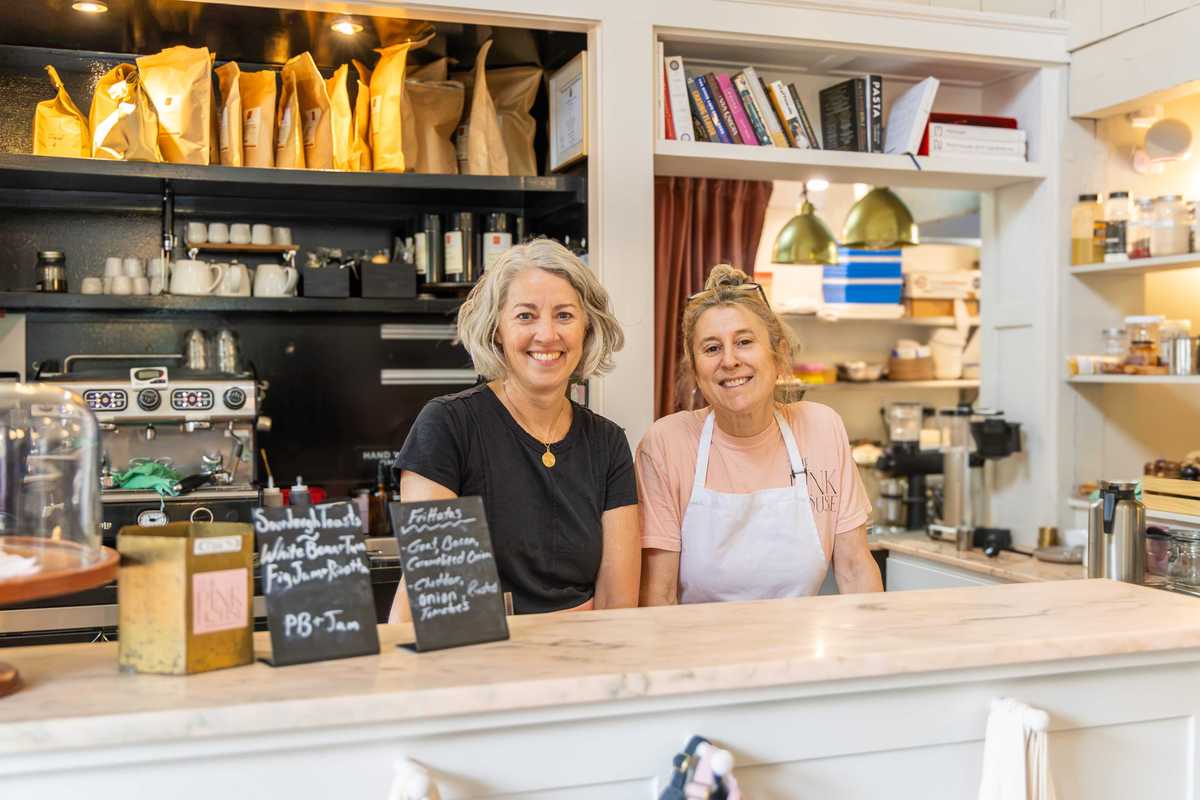
Mare Rubin and Maggie Levine of the Pink House AM.

Madi Long

It all started with a yoga class. Mare Rubin was working on her second act after leaving the Upper West Side, where she’d raised a family and worked in corporate marketing. Newly empty nesters, she and her husband decided to move to the wilds of northwestern Connecticut, where they had spent 15 years as weekenders, to see what life in the woods had in store for them.

Rubin started teaching yoga classes at the Union in West Cornwall, a space designated by the town of Cornwall as a community hub with couches, Wi-Fi, occasional events and a growing yoga class schedule. She was adjusting well but missed one important thing about city life: a casual coffee shop.

Keep ReadingShow less
google preferred source

Want more of our stories on Google? Click here to make us a Preferred Source.

google preferred source

Want more of our stories on Google? Click here to make us a Preferred Source.