Codependent Carrots


Subscribers get unlimited access to every weekly edition, the full archive, and all Special Sections.
Already a subscriber?
Already a subscriber but aren’t registered for online access? Click here .
You're signed in — but we couldn't find an active subscription.
Your subscription is active — you now have unlimited access to Millerton News online, including the e-edition and archives.

Robin Roraback
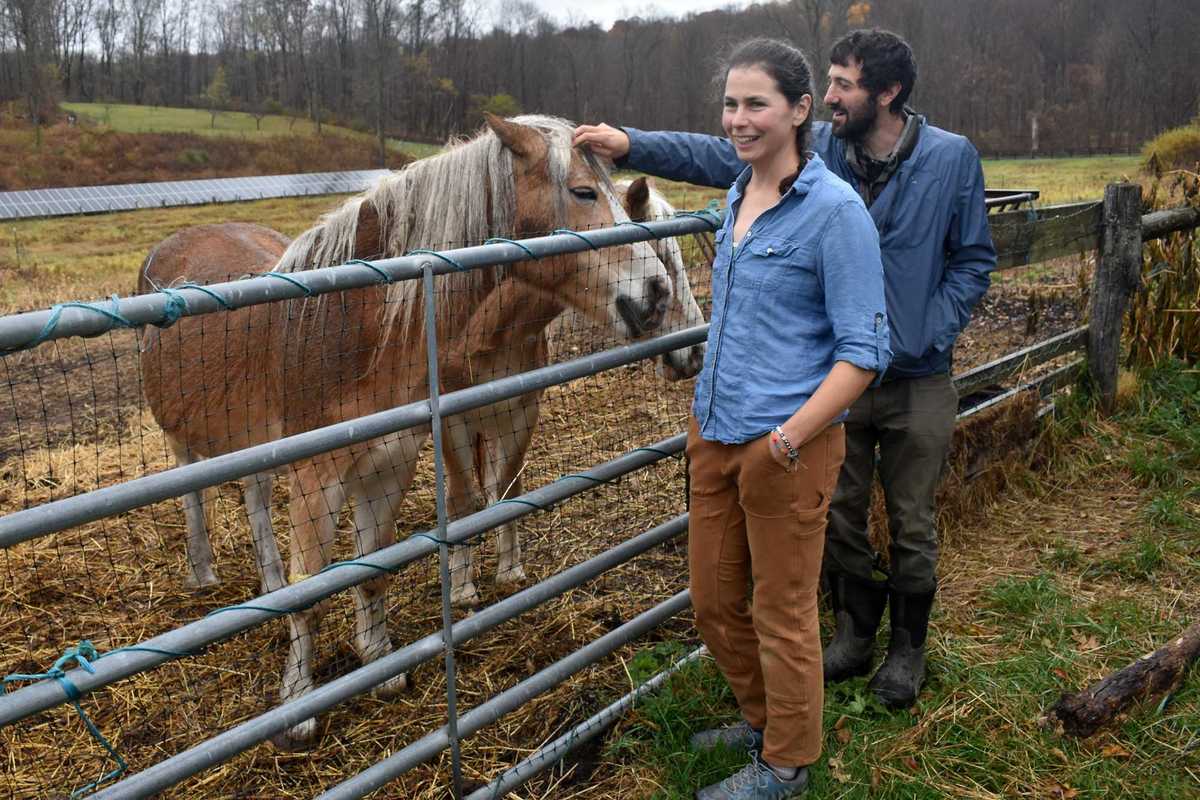
Miriam Goler and Mark Stonehill with their Haflinger horses, Sunshine and Sandy, at Full Circus Farm in Pine Plains.
We share this farm with such amazing human and nonhuman neighbors.
— Mark Stonehill
For Mark Stonehill and Miriam Stonehill Goler, the founder of Full Circus Farm in Pine Plains, farming has always been about more than what comes out of the ground.
“From the very beginning, we’ve envisioned the farm as a place not only for food production, but also merriment and community,” they said.
That spirit is reflected in the farm’s logo as well, designed and drawn by Goler, which depicts Stonehill as a juggler standing on the back of a horse and Goler as a jester.
They grew up in New York City and met when they were in high school. Stonehill said, “If you’d asked me in high school, I’d never have said I’d be a farmer.” And yet he and Goler have been farming at Full Circus Farm in Pine Plains since 2014.
Stonehill went to Macalester College for urban geography and environmental studies. Goler went to Cornell University planning to study biological and environmental engineering, but she took classes at the Cornell School of Agriculture and Life Sciences where and realized she could be a farmer. It soon became clear she had a passion for agriculture.
After graduation, they both apprenticed at organic farms: Quail Hill Farm in Amagansett, Long Island, then two along the coast of Maine.
They returned to New York State and searched for land to lease. “When we found this land and met the land owners, we knew it was the right place for us,” said Stonehill.
“Our farm is a primarily horse-powered farm. That means that we use our draft horses to plow, prep our field for planting, and knock out weeds, among other tasks,” explained Stonehill.
They use a tractor for things the horses can’t do, such as lifting 700 pound bales of hay.
Sandy and Sunshine, their Haflinger horses, are “a wonderful team,” said Goler. She explained why they prefer horses. “They are lighter on the soil, they provide fertilizer, and they eat down the grass.” She added, “And I just like horses. A tractor doesn’t talk to me and greet me in the morning.”
Full Circus Farm is certified organic. Stonehill explained, “There are so many reasons we choose to farm this way, but the simplest is that we share this farm with such amazing human and nonhuman neighbors.”
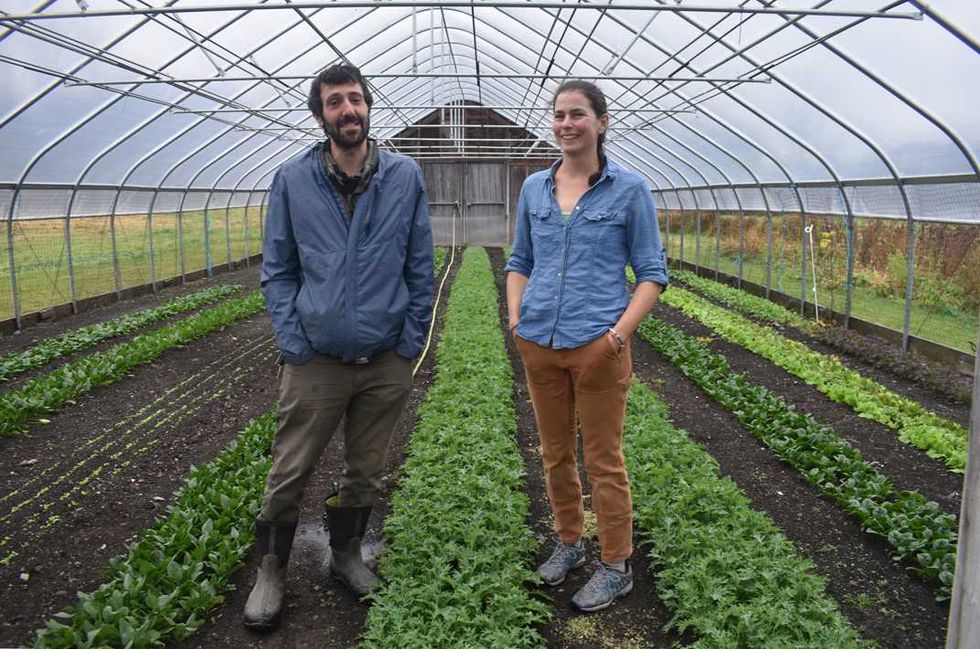
For their first decade of farming, they concentrated on growing vegetables. They were a community-supported agriculture (CSA) farm, growing enough to feed 40 families. The families invested in a share of the farm’s harvest, which gave them organic produce throughout the year.
A flood in 2023 caused Stonehill and Goler to rethink what they grew.
“The flood was a big wake-up call to do things differently and make the farm more adaptable to climate change and flash flooding,” said Stonehill. “We knew if we could make the nursery work, we’d have a chance to build a business that lasts for many years.”
“The heart of our business is pears, apples and figs,” said Stonehill. “We’ve expanded the nursery to include native trees and ornamental and fruiting bushes.” Among the trees and bushes they propagate are raspberry canes, several varieties of figs, currants, elderberry, pawpaw, strawberry, northern red oak, willow, lilac and oakleaf hydrangea.
Stonehill hopes to expand further. “In 10 years’ time, I’d like to see our nursery offering a much wider variety of plants.”
Goler developed an online store where plants from the nursery can be ordered for pickup in the spring and fall. Their nursery products are also available through Hudson Valley Seed Co. “We are now available in all 50 states,” said Stonehill.
Of vegetables, Stonehill said, “Tomatoes and kale make sense for us. Our greenhouse is trellised floor to ceiling with tomatoes in the summer.” They sell kale and tomatoes to Tri Corner F.E.E.D. Market in Millerton and Big Rock Market in Stanfordville.
“We’d love to find other outlets to sell to and get another hoop house to grow more tomatoes,” commented Stonehill.
In Pine Plains, local restaurants are putting the farm’s harvest to creative use: Stissing House makes ice cream with Full Circus Farm’s mint, while Champêtre incorporates fig leaves from the farm’s trees into its own ice cream.
Stonehill and Goler do most of the work themselves, with help from their two young sons, Ezra and Luca, who recently helped dig out young trees.
A special offering at Full Circus Farm is custom grafting. Stonehill explained, “We can graft from an apple tree you loved, your grandparent’s tree, a tree that is on its last legs that you want to preserve. Take a cutting and bring it to us. Miriam will graft it and make another tree.”
In addition, Stonehill offers classes at the farm or at homes on pruning. “I love education and working with people of all ages. It’s fun to teach pruning.” He will go to homes and prune trees from January through March.
Stonehill will also travel to homes to consult on the best spots for their plants and trees to grow.
Full Circus Farm grafts and propagates all its own trees and nursery plants at the farm.
To learn more and browse the online store, visit fullcircusfarm.com

Want more of our stories on Google? Click here to make us a Preferred Source.
Natalia Zukerman
At the Ancram Center for the Arts, the stage has been host to numerous award winning professional actors, but it also often belongs to a neighbor with a story to tell. Other times, the performance moves out of the theater altogether, transforming a pond, a field or a corner of town into a stage.
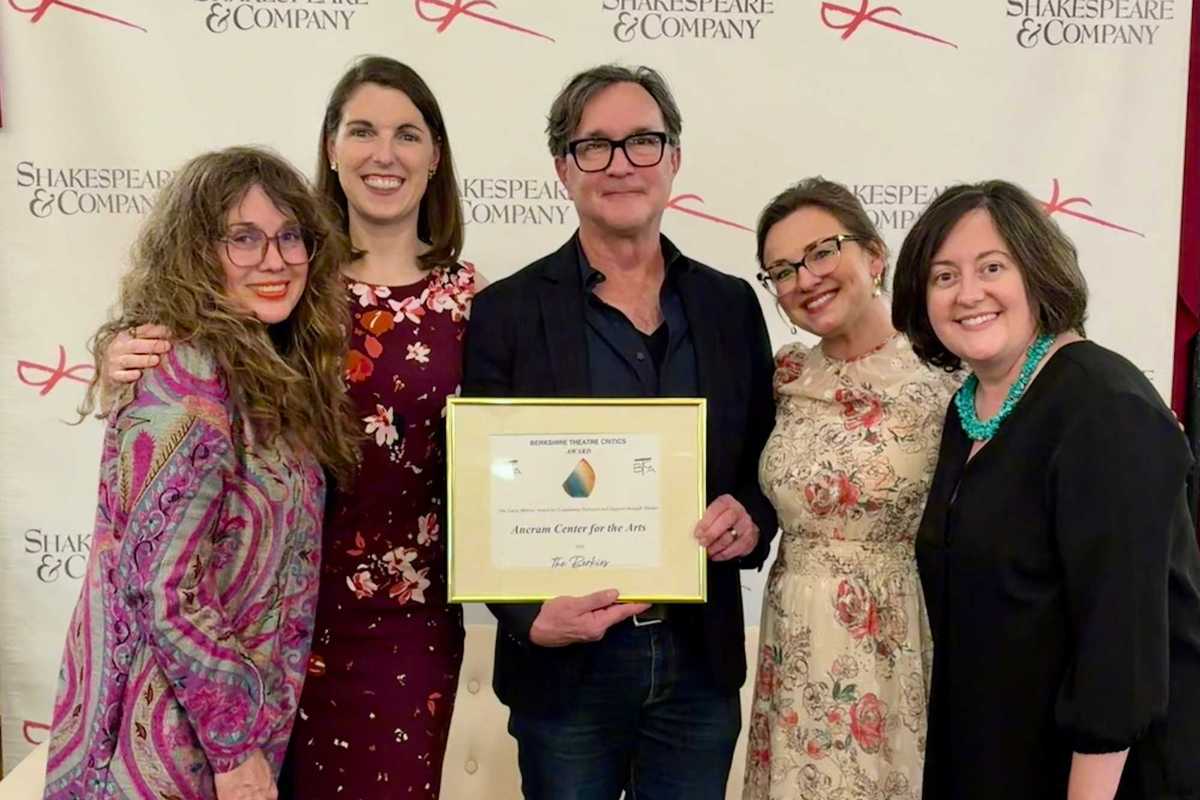
That commitment to bringing theater into the community — and the community into the theater — has earned the Ancram Center the Larry Murray Award for Community Outreach and Support through Theater, one of the Berkshire Theatre Critics Association’s annual Berkie Awards.
“We feel like we are contributing a lot to the community, so it’s nice to have that work recognized,” said Ancram Center co-director Jeff Mousseau.
For Mousseau, the award recognizes something fundamental to the theater’s identity.
“From the get-go, from when we first started running the joint here, the connection of community with theater is sort of central to our DNA,” he said. “It’s core.”
The award honors three of the center’s signature initiatives: “Real People Real Stories,” which helps local residents develop and perform personal narratives; “Writing on Your Feet,” which brings storytelling into area schools; and the biennial “Plein Air Plays,” which take theater into locations in and around Ancram.
The latter, Mousseau explained, was of particular interest to the Berkshire theater critics.
For each Plein Air Plays production, the center selects three locations and commissions site-specific performances. Audiences travel from one location to the next, experiencing what Mousseau describes as “a theater road trip or triptych.”
“Sometimes it’s the location that sort of drives what happens there. Sometimes it’s a particular artist that we approach to create a performance for that location,” he said.
The settings have ranged from idyllic ponds to the ball field beside the fire station.
“It’s very much celebrating performance in alternative locations, in that performance can happen anywhere,” Mousseau said. “But it’s also celebrating the town and what we love about Ancram.”
The performances also introduce new audiences to the theater. Some people who first encountered Ancram Center through the outdoor productions have since become regular patrons, Mousseau said.
Through “Writing on Your Feet,” the Ancram Center also works with hundreds of elementary school students at Taconic Hills and Webutuck, helping them identify, shape and share their own stories.
Mousseau said the school program grew naturally from the work with adults.
“We realized that the approach that we’re using with adults could be applicable in a school setting,” he said.
The program now reaches more than 300 students each fall, with some eventually coming to the Ancram Center to tell their stories publicly.
But perhaps the most intimate expression of the center’s community mission is “Real People Real Stories,” which returns to the mainstage Saturday, Nov. 21, at 3 p.m.
Developed by co-director Paul Ricciardi, the twice-yearly program has spent more than a decade inviting ordinary people to share extraordinary — or sometimes deceptively ordinary — moments from their lives. The stories are true, told live and without notes.
Participants don’t necessarily arrive with polished narratives. In fact, Mousseau said, they rarely do.
“Most of the time people are coming in with sort of an idea for a story, but they haven’t really ever told the story, nor have they shaped it or given it a structure.”
Ricciardi and lead teaching artist Sarah Katan work closely with each storyteller through a series of free workshops and individual sessions, helping participants discover what their stories are really about.
“A lot of times what happens is the story that they think they’re gonna be telling isn’t actually the story,” Mousseau explained. “Paul and Sarah are working with the storyteller to actually get to the core of the story.”
That process can involve five or six meetings before a storyteller takes the stage. Participation is free, and the center also offers storytelling workshops throughout the year, including at The Spark of Hudson, a nonprofit community learning hub in Hudson.
The Nov. 21 program features three area residents whose stories span different decades and experiences.
Ancram resident Frédérique Abramovici will recount unexpected moments of connection while swimming at Jacob Riis Park Beach on a sweltering July day in 1972.
Carol Morley of Castleton-on-Hudson will tell how a newspaper notice for a photography exhibition, first encountered in 2007, resurfaced in her memory during the COVID-19 lockdown of 2020, opening unexpected possibilities for happiness and changing her plans for the future.
And Ancramdale resident Marty Schwartz will share an unusual challenge he faced while growing his business.
The stories aren’t organized around a particular theme, and that’s part of their appeal.
“Their experience could be totally different life experience than mine, but you find yourself in these other stories,” said Mousseau. “And that’s the really cool part.”
The Ancram Center has become an integral part of the community, and its recognition by the Berkie Awards reflects the connections it has helped foster. For Mousseau, those connections begin with recognizing the complex lives behind familiar faces. “I think we all sort of know this privately, that we all carry a lot. And we often forget that about one another,” he said. “My hope is that we just grow a little bit more empathetic for one another.”
“Real People Real Stories” takes place Saturday, Nov. 21, at 3 p.m. at the Ancram Center for the Arts. Tickets and more information are available at ancramcenter.org.
Natalia Zukerman
Singer, songwriter and activist Taína Asili leads a social justice songwriting retreat Nov. 20-23 at Soul Fire Farm in Petersburgh, N.Y.
Music has long been a powerful tool for protest, solidarity and social change. From civil rights anthems to contemporary songs of resistance, songwriting has helped give voice to movements and inspire collective action. Singer, composer and activist Taína Asili will explore that tradition during a four-day Social Justice Songwriting Retreat, Nov. 20 to 23, at Soul Fire Farm in Petersburgh, New York.
The retreat comes amid a renewed interest in collective singing as a form of activism. Organizations such as Singing Resistance are bringing people together across the country to use songs as tools for solidarity, nonviolent resistance and community building. The movement draws on the long history of music in social justice struggles, emphasizing the power of singing together to overcome fear, strengthen connections and inspire collective action.
Joined by co-facilitators Martín Urbach and Gaetano Vaccaro, Asili will guide participants in transforming personal stories and visions for a more just world into songs that can inspire action. The retreat combines songwriting workshops, collaboration, vocal and instrumental exploration and evening open mics, with time for reflection and community building.
A longtime activist whose music addresses issues of liberation, racial justice and climate change, Asili brings more than 25 years of experience connecting art with social movements. The intimate retreat, limited to 14 to 16 participants, includes accommodations and meals.
For registration and more information, visit tainaasili.com/fallretreat.
D.H. Callahan
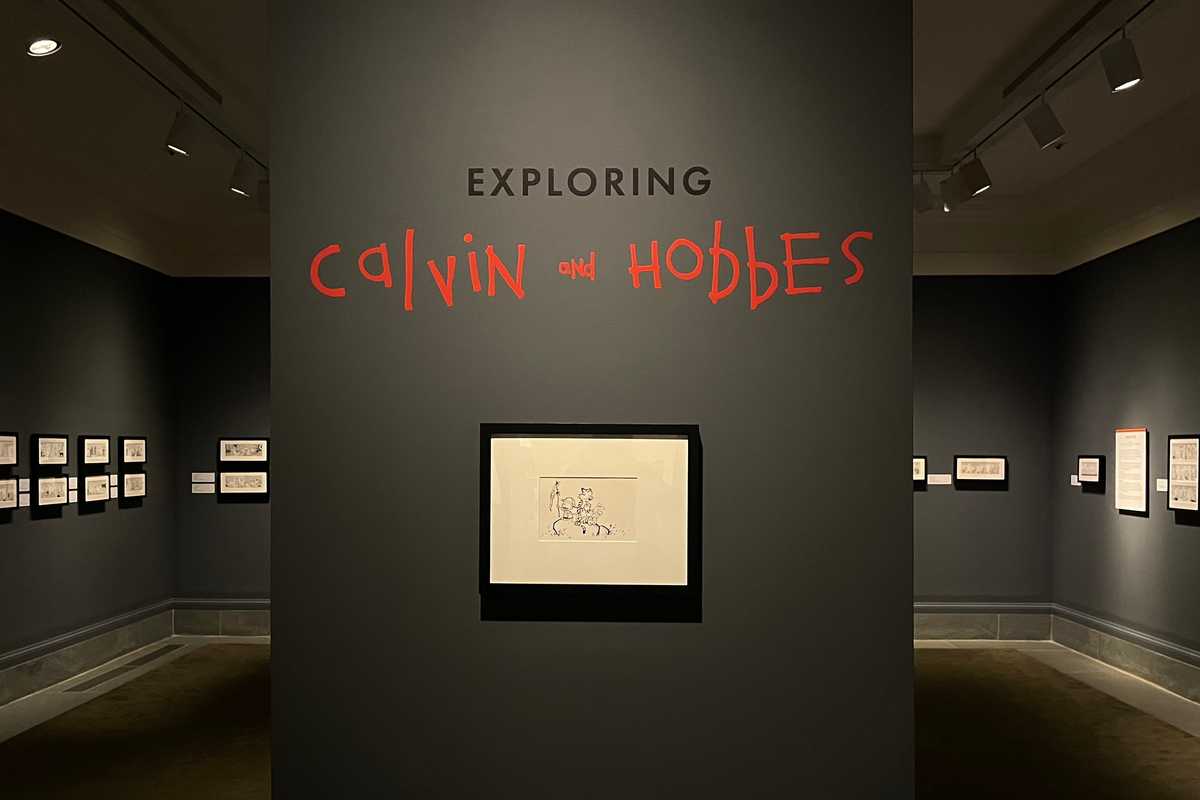
Original “Calvin and Hobbes” comic strips by Bill Watterson are on view alongside works by Norman Rockwell in “Exploring Calvin and Hobbes” at the Norman Rockwell Museum. Stockbridge. The exhibition runs through May 31, 2027.
Two distinctive approaches to American life and storytelling come together in a new exhibition at the Norman Rockwell Museum in Stockbridge, Massachusetts. Opening Saturday, Nov. 14, the exhibition brings the imaginative world of Bill Watterson’s “Calvin and Hobbes” into conversation with the familiar scenes of everyday life captured by Norman Rockwell. Though separated by generations and working in different mediums, both artists found humor, humanity and complexity in the seemingly ordinary.
Norman Rockwell skyrocketed to popularity when he started painting the covers for the Saturday Evening Post, a magazine with a history spanning more than two centuries.Its last print edition ran this past September, transitioning the publication to an online-only format. From 1897 until 1963, it published a new issue every week. Over that time, it published writings by literary legends like F. Scott Fitzgerald, Kurt Vonnegut, Agatha Christie, William Faulkner, Edgar Allan Poe, Louis L’Amour, John Steinbeck and Lenox, Massachusetts resident Edith Wharton, and featured comics by “Peanuts” creator Charles M. Schultz. In 1916, the magazine first featured one of Rockwell’s illustrations. He was just 22 years old.
Through his work illustrating covers for the Post, as well as a prolific, nearly omnipresent advertising illustrations, Rockwell found his way into virtually every home in America. Known for his idealization of American life, Rockwell used the quaint life of rural New England as the center of the world he depicted and made his later-years home of Stockbridge famous as a beacon of idealized, wholesome living.
It wasn’t until later in his career, during his third marriage, that Rockwell began tackling larger social issues, famously releasing “The Problem We All Live With,” which depicted a young black girl being escorted to school by federal marshals. The painting, based on the story of Ruby Bridges, originally appeared in Look magazine in 1964 and is part of the collection of the Norman Rockwell Museum in Stockbridge.
For the next six months, many of Rockwell's paintings will be joined by original “Calvin and Hobbes” comic strips by Bill Watterson. “Calvin and Hobbes” dealt with another kind of idealized American lifestyle — that of a mischievous youth. Though Rockwell would hint at the naughty notions of children, Watterson explored them to the fullest.
The comic strip focuses on an imaginative 6-year-old boy named Calvin and his best friend, Hobbes. To everyone else in the strip’s world, Hobbes was an inanimate stuffed tiger, but to Calvin, an only child, he was a very sentient accomplice, friend, confidant and voice of reason. Together, the friends battled monsters and aliens through Calvin’s imagination, dealt with the dregs of boredom in the middle of rural winters and even grappled with philosophy, existentialism, climate change, consumerism, political theater, and even, improbably, artificial intelligence.
Watterson and Rockwell have more in common than just their success. Though both artists were known for their unmistakable styles, neither was recognized as a fine artist, often relegated to the periphery as simply illustrators. Watterson confronted this notion in his work. Rockwell accepted and even stated confidently that he was an illustrator, rather than a “fine-art man.” Both used their art to tell vivid stories that rewarded the curious observer for looking a little closer. Both created art intended for broad publication rather than primarily for sale as individual works.
Where they differ most dramatically is in their relationships with celebrity and the intersection of art and commerce. Rockwell became a rock star artist, even before rock stars existed. He relished in the nation’s fixation on his disarming demeanor, which seemed ripped right out of one of his illustrations. Watterson, on the other hand, eschewed the spotlight at all costs.
Rockwell was known to be a client pleaser, accommodating publications and advertisers with little, if any, pushback. With him, corporations knew what they were getting, and he was happy to provide it. But when The Saturday Evening Post told him to only paint white people, push back he did. Rockwell was able to get his “Golden Rule” painting published, but eventually left the Post to go to Look magazine where he had more creative freedom.
Watterson, on the other hand, was disgusted by the rampant commercialization of beloved cartoon and comic characters for the profits of corporate America. His was a pure art, not intended to be meddled with by stakeholders or turned into commodities to help sell unrelated products.
“Calvin and Hobbes,” Watterson once said, “was designed to be a comic strip and that’s all I want it to be.”
At the height of “Calvin and Hobbes’s” success, Watterson was under immense pressure to further monetize his art. Instead of acquiescing, he ended the run of the comic with a poignant final edition, leaving us to believe the pair continued their exploring indefinitely.
In addition to Watterson’s strips, the exhibition will feature works by some of his inspirations, including George Herriman, creator of “Krazy Kat,” and the father of the “Peanuts,” Charles M. Schulz, once known for his contributions to the Saturday Evening Post. On loan from the Billy Ireland Cartoon Library & Museum at Ohio State, the works mark the first touring exhibition of Watterson’s original drawings. A rare exhibition poster and catalog, featuring an interview with the reclusive artist, are available for purchase, with proceeds benefiting the museums.
“Exploring Calvin and Hobbes” runs through May 31, 2027. For more information, visit nrm.org.

Want more of our stories on Google? Click here to make us a Preferred Source.
Want more of our stories on Google? Click here to make us a Preferred Source.