

Latest News
Wassaic Project co-founder Eve Biddle presents her “Field Notes”
D.H. Callahan
Artist Eve Biddle and Tremaine Gallery Director Terri Moore.
On Wednesday, Sept. 2, the Tremaine Gallery at the Hotchkiss School in Lakeville opened its new show, “Field Notes,” with works by multidisciplinary artist Eve Biddle.
Biddle is best known in the area as one of the founders of the iconic Wassaic Project in the hamlet of Wassaic, New York. The project, which is part art incubator, part gallery, part studio and a whole lot of community, is housed in an old converted grain elevator right next to the Metro North train tracks. It’s credited by many as the spark that revitalized the hamlet, which now boasts a craft bakery, a curated wine and liquor store, a pizza hot spot, the Lantern.
But Biddle is not just a community builder. She’s an artist herself with a robust tool belt of skills. Of those tools, sculpture, object-making, photography, and screen printing are highlighted in “Field Notes.” It’s partially due to her robust skillset, and multiple medium pieces that she hesitates to call herself a sculptor or photographer. Biddle is an artist, and to her, that means finding ways to bring her ideas to life, independent of specific disciplines.
The ambiguity of her categorization can be seen in her work as well. She seems to focus on the space between what is natural and how the human hand, or even technology can alter it in ways that turn it into art. One piece features a picture of flowers growing in the dirt. But Biddle takes this natural, innocuous plant and processes the photo through software that allows her to use small dots to rebuild the image, then silkscreens the result onto board. Yes, it’s still a photo of flowers, but it’s been manipulated by man and machine to create something unlike its original form.
Clearly, the artist’s hands play a major role. This is sometimes implied in the imperfections of a ceramic sculpture, or in the knowledge that she held a camera to snap a shot, but it’s also literal. Multiple pieces feature her hands, and the hands of fellow artists interacting with or even manipulating nature. While just one of many apparent themes in “Field Notes,” it’s even more central in Biddle’s show at the Portland Museum of Art in Maine, which runs through January of next year.
Her hands can also be seen in the finger imprints she left on a cast of a spine. The sculpture was made of molten glass poured over a sand and silica mold at the RISD Hot Shop in Rhode Island. The thematic implications of a glass spine that resembles an amorphous jellyfish might make a Hotchkiss art student want to raise their hand, confident they have the right answer. Biddle rejects the notion of right or wrong meanings in art and doesn’t see it as the artist’s job to define it. It’s one of the reasons the show features snakes, which have been used throughout history to mean wildly different things. Are they evil incarnate, or do they represent fertility? Both can work depending on your perspective.
These are some of the intangible lessons that Biddle and Tremaine Gallery director Terri Moore want to impart to the students. Beyond Biddle’s show is a short tenure as Hotchkiss artist in residence, but she’ll be the first to point out that she is not a teacher. That’s exactly what Moore is looking for. She wants the young artists to get experience from a working professional who has not trained to teach. From Biddle, students will get a different perspective than the ones they’re used to from faculty. And thanks to her role in facilitating the growth of young artists at the Wassaic Project, she might be the perfect person for such a task.
“Field Notes” will be on view at the Tremaine Gallery through Oct. 18 with an opening reception on Saturday, Sept. 19. and an artist’s talk on Thursday, Sept. 17. To learn more about Eve Biddle, visit
evebiddle.works.
Victor Cella is painting his own path
Robin Roraback
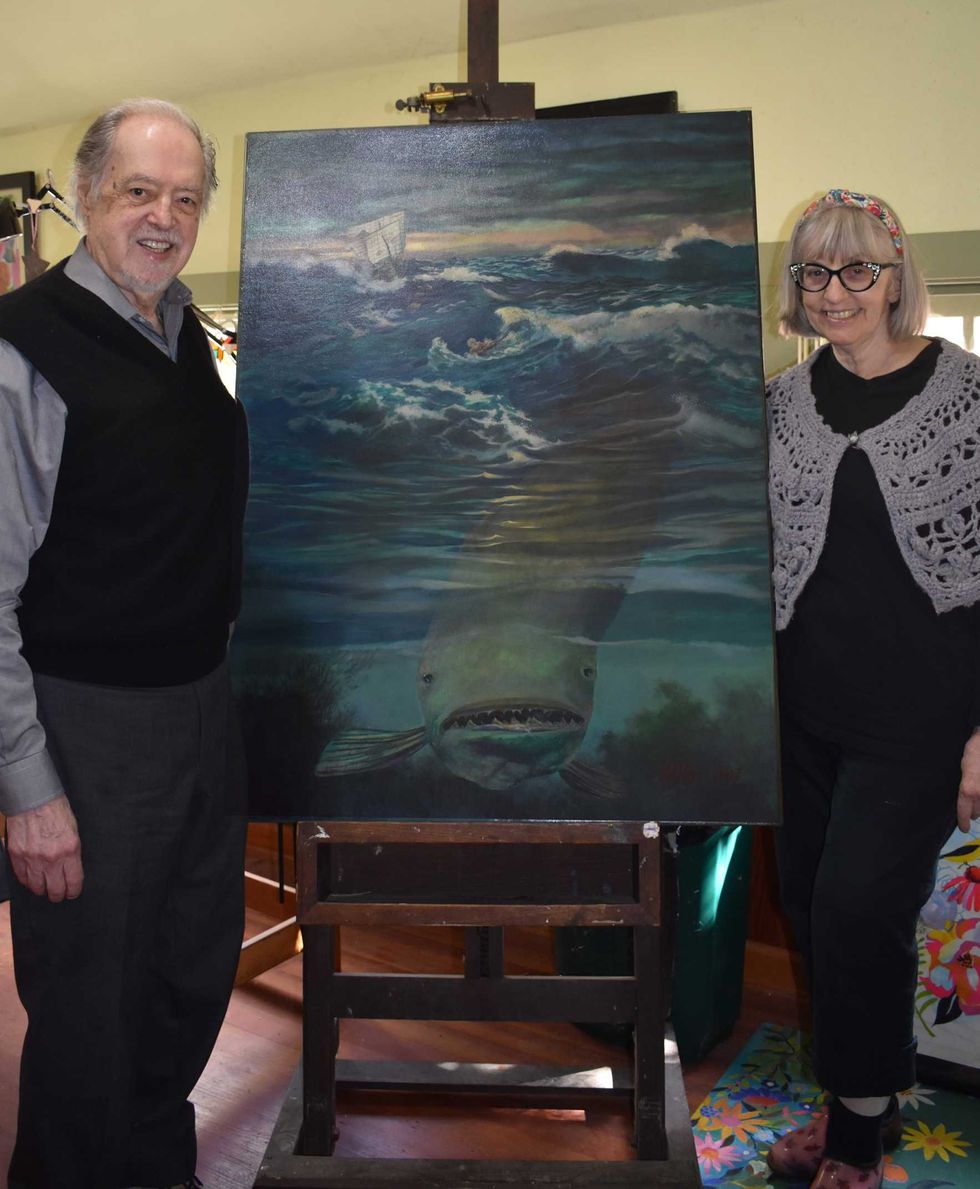
Artist Victor Cella with his recent painting “White Dog” in his studio and shop, Little Store Antiques in Great Barrington.
If I taught art, I’d teach it in a different way. I could teach it as an awareness — how to free yourself up.
— Victor Cella
Paintings by Victor Cella of a blue dog, a flower still life and a colorful abstract greet visitors as they mount the steps to The Little Store, an antique shop he runs with his husband, John Ortisi, at 88 Main St. in Great Barrington, Mass.
The shop is filled not only with antiques but also with Cella’s paintings. People stop by to see what Cella is currently painting and to talk with him. He is known for his amiability as well as his paintings.
Cella greets visitors while talking with a fellow painter who comments about his work and Cella himself: “Eclectic, amazing! Victor is decidedly loved in the community and exhibits to everyone his completely open heart.” She added, “He inspires the rest of us who paint.”
Cella began devoting himself to painting about four and a half years ago. He remembers taking art classes in high school. He had finished all his credits early and was allowed, in his senior year, to take art for four hours a day. He credits his art teacher, Mr. Owen, with giving him a good foundation in art.
“Now that I paint, I rely on my teacher’s words: ‘To unify a painting, pick a color and wash it over the painting,’ or, ‘You need to mix the colors!’”
He won a scholarship to New York University to study art, but his parents said no.Instead, he attended North Adams State College, where he also took an art class at Williams College, repeating a pattern from high school in which he finished his required credits early and used the extra time to study art.
He earned a teaching degree in special education and ended up working in schools in Massachusetts and Connecticut for 37 years. He retired in 2019.
Then, four and a half years ago, he got the urge to paint, and the paintings flowed out of him.
He has sold 757 paintings, with 95 of those sold since May 7. “I am having bizarrely good luck with my paintings.” He estimates he has painted 2,000 paintings in four and a half years.
He modestly attributes his success to “I sell low and I have a built-in client base of 51 years,” he said, referring to recurring customers in his antique shop. “A billion people give me feedback.” He has two patrons who each have several of his paintings. “Unbelievably,” says Cella, “one person owns 32 and the other owns 27.”
His studio is in the back of the shop. He paints now on 16-by-20-inch canvases, some of which he recycles, finding them at Goodwill.

To keep his painting fresh and himself interested because, as Cella explained, “I can’t stay with one idea for long,” he has gone through several phases: crazy dogs, grids, flowers with black backgrounds, a geometric phase and “weird people.” The “crazy dogs,” as he calls them, are popular now. One person bought eight, left to go to her car and came back for a ninth, spotted in the shop’s window — the one that brought her into the shop in the first place.
He may even illustrate a children’s book with the “crazy dogs.” A local author liked them so much she asked Cella if he’d illustrate a story about three dogs if she wrote one.
Cella was also approached recently by a person who said, “Do you know you were my favorite teacher?” She came into The Little Store, attracted by the paintings in the shop’s window. It turned out the former student owns Crystal Essence on Railroad Street in Great Barrington and has asked to sell Cella’s paintings there.
Cella, who will soon be selling the building where The Little Store is located and move it nearer to his Southfield home, was glad to be offered a new venue for his paintings.
An artist he knows, Scott Prior, a painter from Nantucket, bought one of Cella’s paintings and gave him this advice: “Never go to art school. You are an artist. Let it pour out of you.”
Cella said, “You have to follow your own path.” He mused, “If I taught art, I’d teach it in a different way. I could teach it as an awareness — how to free yourself up.”
To see more of Cella’s work, visit The Little Store (88 Main St.) or Crystal Essence (39 Railroad St.) in Great Barrington.
Fear and Loathing in the Woodland
Dee Salomon
Fear and Loathing in the Woodland Japanese barberry, an invasive shrub with thorny branches, provides shelter for mice and can contribute to conditions that allow tick populations to thrive.
I am tempting tick-bite fate by writing this, even from the safety of my office.
Eight people emailed me with a link to the New York Times article on ticks that ran in the Aug. 20 magazine section.My Instagram algorithm made sure that I saw the same story several times over.The article, “The Summer the Ticks Took Over,” by Benjamin Wallace reads like a horror story, engendering a kind of paranoia that sidewalk-hugging New Yorkers can easily fall prey to.The reader comments enhance the author’s terror and fall into key categories: readers who are living proof of the sometimes harrowing, life-altering consequences of a tick bite; readers’ instructive life hacks against ticks (“permethrin is your friend”); readers’ collective chant to kill the deer; and, finally, readers who question why anyone would ever go in the woods again.
This last category of comment is, to me, the most troublesome. Staying out of the woods means that the conditions that begat the tick proliferation (hint: it’s not the deer) will continue.You see, we are the solution, or at least part of the solution. But only if we go into the woods.
I was born in New York City, and my family moved to the nearby suburbs when I was 8. My experience with nature as a child was limited to raking up leaves in our front yard until my parents sent me, at 12 years old, to a Girl Scout camp in Mahopac, New York.There, I was enchanted by the woods; the hemlocks created a pink glow on the floor with their dead needles and, combined with their cathedral height, brought awe to a girl who, until then, would rather play with a Barbie doll than get her hands in the dirt.
It wasn’t until 2012, when my now-husband and I bought our house and property in West Cornwall, that those memories came back to me.Where were those awe-provoking woods? Had a spell been put on the enchanted forest of my youth? The woods looked foreboding: swags of bittersweet vine choking the life out of mature trees and distorting the branches of young trees, thorns from invasive shrubs acting like barbed wire to keep humans away. And the ticks!
We began removing bittersweet from the large trees, many of them already dead from being choked by the vines. I spent the next decade, and continue still, removing the invasive undergrowth of barberry, Japanese honeysuckle, multiflora rose and the many other plants fighting to become monoculture. This was no wave of a magic wand, but it had a transformative effect. Native plants grew in to take the place of the invasives. And we noticed a marked reduction in ticks.
On Aug. 17, the Cary Institute released the findings of 35 years of research on ticks that carry Lyme.The major finding is that, rather than deer, mice and other small rodents that are the primary vector for passing the bacteria that causes Lyme to ticks. Mice are proliferating, along with the ticks that feed on them, as the loss of diversity in ecosystems promotes their survival.
James Sheppard, an infectious disease physician at Yale University, goes further: “These rodents also tend to be synanthropic — they thrive in human-altered environments. The loss of biodiversity and the urbanization and suburbanization of humans is promoting transmission of infections.”
So how do you reduce mouse populations? Removing barberry goes a long way, as this one invasive plant with its barbed branches has enabled mice, and the ticks that love them, to proliferate. Without the barberry barriers, hawks, owls, foxes and coyotes can hunt mice effectively and reduce their populations. This is biodiversity at work.
The proliferation of ticks and the severity of disease they transmit is a skin-crawling reality. We need to stay vigilant as other tick-borne infections, such as anaplasmosis and Alpha-Gal (which is not an infection but rather a tick-transmitted allergic reaction), creep into nearby areas. I am in favor of culling deer, which are vectors for the ticks that cause Alpha-Gal. In fearing the outdoors, uninformed people cannot apply the most effective solution now at our disposal for eradicating ticks. It’s a good time to cut down barberry and poison the cut stem by dabbing on glyphosate or triclopyr. And remember, permethrin, sprayed on gloves, shoes and clothing, is your friend.
Dee Salomon ungardens in Litchfield County.
Want more of our stories on Google? Click here to make us a Preferred Source.
Glass artists at Cornwall Open Studios
Ruth Epstein
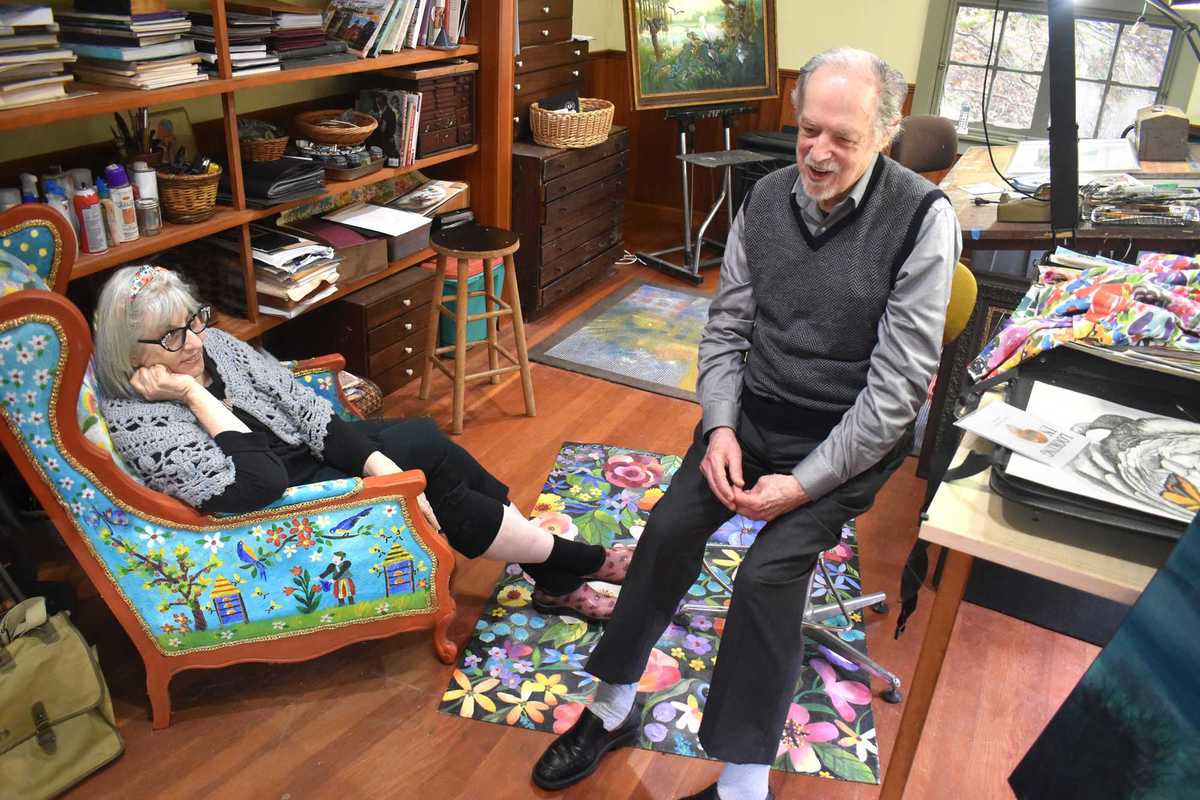
Jessica Landau creates jewelry from glass. She welcomed visitors to her studio during the Cornwall Open Studio tour on Sept. 5.
David Willis and Jessica Landau were brought together by glass.
They each focus on using the medium for different types of art; he paints and sculpts, while she primarily creates jewelry and glassware.
The couple were part of the Cornwall Open Studio tour held Saturday, Sept. 5. They and their two young children cheerfully welcomed guests.
Their workspace is attached to their home on Cemetery Hill Road, where Willis’ large glass paintings are displayed on the walls and Landau’s jewelry can be seen neatly placed in compartmented cases.
A walk to the rear of the property offered a view of two of Willis’ sculptures, which appear to float in the air. Stainless steel is twisted in large loops, giving it a cloudlike feel, while long, thin glass tubes hang from its bottom edge.

A graduate of the University of California, Berkeley, Willis began working in glass in 1994.
“Glass is firm, unexplored because of things like painting, metals and ceramics. But it’s made art for centuries,” he said. He likes its shine and the fact that he can bend it with his hands.
Willis has taught at several schools, including the University of Washington, Corning Museum of Glass and Pilchuck Glass School in Washington, which is where he met his wife.
During the visit, a woman purchased glass tubing for flower arrangements, another of Willis’ creations.
Landau’s calling is designing tiny sculptures as wearables by infusing minerals into glass.
A graduate of Moore College of Art and Design in Philadelphia, she spent some years in Hawaii, where she apprenticed in her field for four years. She also served as a glassblower from 2014 to 2019 for the renowned Chihuly Studio and has taught the art at several schools and galleries.
“I’m drawn to the whimsical,” she said, pointing to pendants and earrings that feature figures of bacon and eggs, beer steins or mustaches. There are also many with floral patterns and other designs from the environment.
She noted that a lot of her designs come from either her love of nature or are inspired by childhood.
She pointed to the three kilns where she works with glass that she described as similar to Pyrex, the familiar cooking material.
“Glass is a material that cares how you treat it,” said Landau. “When you work with it, you come to know its rules. It’s precious, but in a different way from gems.”
Others who opened their studios that day were Lauren Brinkers, David Colbert, Magaly Ohika, Nick Jacobs, April Stewart Klausner, Legacy Glass Studio, Stephan Sagmiller, Souterrain Gallery and Sally Van Doren.
Oldtone brings roots music, dancing and community to Cool Whisper Farm
Natalia Zukerman
The Allum Ridge Boys & Ashlee at Oldtone Music Festival in 2025
The Oldtone Music Festival returns Sept. 10 through 13, bringing musicians and audiences together for a four-day celebration of roots music at Cool Whisper Farm in Hillsdale.
Founded in 2015 as a one-day show in Wassaic, Oldtone moved the following year to the Schober family’s Cool Whisper Farm, where it grew into a three-stage camping festival. The festival ran annually until the COVID-19 pandemic forced its cancellation in 2020. After limited attempts to bring it back in 2021 and 2022, organizers announced in early 2023 that the festival would end.
But Oldtone wasn’t quite ready to disappear. With strong support from local and artist communities, a new nonprofit, Oldtone Arts Inc., was formed in 2023, and the festival returned to Cool Whisper Farm in 2024. Today, the festival is co-produced by Jim Wright and Trevor Roush and continues to operate with an emphasis on keeping its intimate, artist-driven character.
That spirit is reflected in Oldtone’s motto, “Participation is Preservation.” Rather than simply presenting traditional music onstage, the festival encourages audiences to take part through workshops, dancing, jams, contests and other opportunities for musicians and listeners to play and learn together.

This year’s lineup ranges across bluegrass, Cajun, country, folk, Latin and other roots traditions. Performers include Bella White, The Po’ Ramblin’ Boys, Los Texmaniacs, Jerron Paxton, Linzay Young & Joel Savoy, Cajun Country Revival, Alex Torres & His Latin Orchestra, Jesse Lége & Bayou Brew, Sammy Lind & Nadine Landry and The Ozark Highballers.
In addition to multiple stages, the weekend includes dancing, workshops and opportunities for musicians to join in. Campers have long made late-night music-making a central part of the experience, with informal jams continuing into the night.
Visitors can attend for a single day or camp on the property for the entire festival. Children 12 and younger are admitted free.
Oldtone Music Festival takes place Sept. 10 through 13 at Cool Whisper Farm, 1011 County Route 21 in Ghent, New York. For tickets, camping information and the complete schedule, visit oldtone.org.
“Come From Away,” a story of kindness at Sharon Playhouse
Natalia Zukerman
Twenty-five years after the events of Sept. 11, 2001, the Sharon Playhouse is staging a musical about what happened in the aftermath — and about an extraordinary act of kindness in a small Newfoundland town.
“Come From Away,” the Tony Award-winning musical by Irene Sankoff and David Hein, runs Sept. 11 through 27 and concludes the Playhouse’s 2026 MainStage season. Directed by Hunter Foster, with choreography by Krystyna Resavy and music direction by Eric Thomas Johnson, the production tells the true story of the thousands of airline passengers who suddenly found themselves stranded in Gander, Newfoundland, after U.S. airspace was closed following the terrorist attacks.
Thirty-eight planes carrying approximately 7,000 passengers were diverted to Gander and surrounding communities. Almost overnight, the local population nearly doubled. Residents opened their homes, schools and churches to strangers from around the world, providing food, clothing and shelter — and, eventually, friendship.
The musical transforms those events into a story that balances humor and heartbreak. A company of 12 actors portrays dozens of characters as the passengers and residents navigate fear, confusion, culture shock and unexpected connections. The score draws on Newfoundland’s traditional music and includes songs such as “Welcome to the Rock,” “Me and the Sky” and “Somewhere in the Middle of Nowhere.”
“Come From Away feels especially meaningful for us to present this year,” said Sharon Playhouse Artistic Director Carl Andress. “Twenty-five years after September 11, this extraordinary musical asks us to remember that terrible day by telling a story about the very best of humanity — the kindness of strangers, the strength of community, and our capacity to take care of one another when it matters most.”
The cast includes Chelsie Nectow, Max Bennett-Parker, Meagan Lewis-Michelson, Erin Lindsay Krom, Tracy Liz Miller, Jeffrey Konowitch, Willie Marte, Cameron Sirian, Ricky Oliver, Sophie Nassiri, Michael F. McGuirk and Cherish Love.
“Come From Away” opened on Broadway in 2017 and received seven Tony Award nominations, winning for Best Direction of a Musical. The Sharon production features scenic design by Christopher and Justin Swader, costume design by Kathleen DeAngelis, lighting design by Aidan English and sound design by Graham Stone, with Bobbie Zlotnik handling wigs and makeup.
The Sharon Playhouse will conclude its 2026 season in December with its sixth annual Holiday YouthStage production, a new adaptation of Lewis Carroll’s “Alice in Wonderland,” running Dec. 11 through 20.
“Come From Away” runs Sept. 11 through 27 at the Sharon Playhouse. Tickets are available at SharonPlayhouse.org. The theater cautions patrons to purchase tickets directly through its website rather than third-party sellers.
Want more of our stories on Google? Click here to make us a Preferred Source.